 HYGO News
 Sullivan Calls Afghanistan Withdrawal Merely 'Challenges and Difficulties'; Names AI as Top Geopolitical Threat
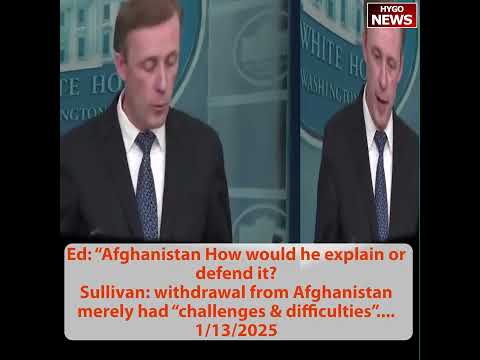
Sullivan Calls Afghanistan Withdrawal Merely “Challenges and Difficulties”; Names AI as Top Geopolitical Threat
In one of his final briefings as National Security Advisor, Jake Sullivan addressed three topics that captured the contradictions and priorities of the outgoing Biden administration. He characterized the chaotic Afghanistan withdrawal as merely having “challenges and difficulties,” identified artificial intelligence as the greatest geopolitical threat facing the United States, and engaged with a question about whether AI racial bias constituted a national security concern. The briefing took place on January 13, 2025, one week before President-elect Trump’s inauguration.
Afghanistan: “Challenges and Difficulties”
CBS’s Ed O’Keefe noted that Sullivan had not mentioned Afghanistan in his opening remarks and asked how Biden would address the withdrawal in an upcoming speech.
Sullivan’s response minimized the catastrophic nature of the August 2021 withdrawal, during which 13 U.S. service members were killed in a suicide bombing at Kabul airport and scenes of Afghans clinging to departing military aircraft shocked the world.
“He will address Afghanistan in the speech, and it was in a sense referenced because I said we kept America out of war,” Sullivan said. “When you end a war after 20 years with all of the decisions that have piled up over that time, there are going to be challenges and difficulties, and there were challenges and difficulties in the period of the drawdown.”
Sullivan then argued that the predictions of critics had not materialized: “People predicted once we left Afghanistan, it would harm our alliances. Our alliances are at historic highs. They predicted that we would have a safe haven in Afghanistan for plotting terrorist attacks against the American homeland.”
He acknowledged that terrorism remained “a very real concern” but reframed the threat landscape: “President Biden pointed out before he pulled out that it’s a more diffuse and metastasized threat, including the kind of homegrown violent extremism that we saw on display in New Orleans in January.”
Sullivan pointed to the New Orleans attack as the only terrorist incident on American soil during Biden’s tenure, noting it was “not connected to Afghanistan as far as we know” but rather “connected to inspiration from ISIS.”
He concluded by defending Biden’s decision in the strongest terms: “President Biden believes that the decision he took has left America in a profoundly stronger position, and he will explain in his speech today why he thinks that’s the case.”
The characterization of the withdrawal as having merely “challenges and difficulties” drew criticism from those who viewed it as a dramatic understatement of one of the defining debacles of the Biden presidency. The withdrawal resulted in the deaths of 13 service members, the abandonment of billions of dollars in military equipment, and the rapid collapse of the Afghan government to the Taliban.
AI as the Greatest Geopolitical Threat
When asked by the Wall Street Journal’s Ken Thomas about the greatest geopolitical threat facing the United States, Sullivan pointed not to China, Russia, or terrorism, but to artificial intelligence.
Sullivan described the threat as “the scale, pace, and breathtaking speed with which AI is going to transform” the world. He argued that the United States, not China, needed to lead in determining “the rules of the road” for AI governance and development.
The framing reflected the Biden administration’s focus on AI regulation during its final year, including executive orders on AI safety and ongoing diplomatic efforts to establish international norms for AI development. It also highlighted a fundamental strategic question: whether the greater risk lay in AI development itself or in ceding leadership on AI to geopolitical competitors like China.
April Ryan Asks About AI Racial Bias
TheGrio’s April Ryan then steered the AI discussion in a different direction, asking Sullivan whether the national security implications of AI extended to racial bias in AI systems.
“Is there a concern about how AI is not accurately depicting or scanning people of color?” Ryan asked. “Because we are understanding civil rights groups are very upset about that, how it’s misidentifying. Is that a concern with the national security as well?”
Sullivan affirmed the concern: “Yes, it is, of course. If you think about the series of concerns that are raised by the advent of artificial intelligence, they range across economic, military, and social risks. One of those is bias. And there have been a lot of studies to show that bias is a genuine challenge when it comes to artificial intelligence.”
He then connected the issue to national security: “The ways in which that could undermine social cohesion in the United States and globally has national security —”
Ryan interjected: “And terrorism.”
Sullivan continued: “And terrorism has national security implications and it’s something that we have to contend with. It is part of the President’s executive order on artificial intelligence alongside a number of these other risks.”
The exchange illustrated the breadth of the Biden administration’s framing of AI risks, which encompassed not only military and economic competition with China but also domestic social concerns about algorithmic bias and its effects on minority communities.
Key Takeaways
- National Security Advisor Jake Sullivan characterized the Afghanistan withdrawal as having “challenges and difficulties” rather than as a catastrophic failure, arguing that Biden’s decision left America “in a profoundly stronger position.”
- Sullivan identified artificial intelligence as the greatest geopolitical threat facing the United States, citing “the scale, pace, and breathtaking speed with which AI is going to transform” the world.
- TheGrio’s April Ryan asked whether AI racial bias was a national security concern; Sullivan said it was, connecting algorithmic bias to risks to “social cohesion” and terrorism.
- Sullivan argued that alliances were “at historic highs” despite predictions that the Afghanistan withdrawal would damage them, and pointed to the New Orleans attack as the only domestic terrorist incident during Biden’s term.