 HYGO News
 Student loan: use emergency powers after emergency over? A: emergency ending doesn’t change legal
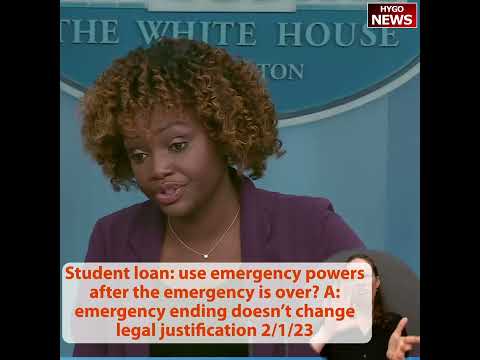
KJP on Student Loans After COVID Emergency Ends: “Doesn’t Change the Legal Justification”
In February 2023, a reporter asked White House Press Secretary Karine Jean-Pierre whether the administration could continue using emergency powers on student loans after the COVID emergency ended. “On student loans, does the White House believe that the president or administration can continue to use emergency powers after the emergency is over?” the reporter asked. KJP defended: “Providing debt relief or pausing loan payments as it relates to the student loans does not require an ongoing national emergency. And I just laid out for Karen how we see this process in talking about the HEROES Act, which was an authority that was given to the Secretary of Education through Congress, and that’s how we’re moving forward there. And look, the emergency ending doesn’t change the legal justification.”
The Legal Authority Question
Authority:
Emergency ending — Upcoming.
Powers usage — After emergency.
Legal basis — Question.
Authority source — Disputed.
Administrative position — Tested.
The question about continuing emergency power use after emergency ended was legal authority challenge. Administrative position needed defense given forthcoming end of COVID emergency declarations.
The HEROES Act Basis
HEROES Act:
2003 legislation — Originally.
Secretary of Education — Authority.
National emergencies — Context.
Broad power — Claimed.
Student loans — Target.
The HEROES Act (Higher Education Relief Opportunities for Students) from 2003 gave Secretary of Education authority to modify student loan programs during national emergencies. Administration claimed broad power under it.
”Does Not Require an Ongoing National Emergency”
Continuation claim:
Authority doesn’t require — Active emergency.
Past emergency — Sufficient.
Continuing effects — Justify.
Administrative position — Developed.
Legal argument — Technical.
The claim that student loan authority didn’t require ongoing emergency was administrative position. Past emergency and its continuing effects cited as sufficient basis. Technical legal argument about scope.
”The Authority That Was Given to the Secretary of Education Through Congress”
Congressional authority:
Statute-based — Authority.
Congressional grant — To Secretary.
Broad interpretation — By admin.
Not executive overreach — Claim.
Legal basis — Specific.
The Congressional authority framing emphasized statute-based power rather than executive overreach. Congressional grant to Secretary of Education specifically. Broad interpretation by administration.
”How We’re Moving Forward There”
Forward framing:
Continuing action — Confirmed.
Policy continuation — Planned.
Administrative decision — Made.
Legal defense — Developed.
Implementation — Ongoing.
The “moving forward” framing confirmed continuing action. Policy continuation planned. Administrative decision made to continue. Legal defense developed in advance. Implementation ongoing.
”Emergency Ending Doesn’t Change the Legal Justification”
Key claim:
Emergency irrelevance — To authority.
Legal basis — Independent.
Administrative position — Stated.
Test — For future challenge.
Consistency — Maintained.
The key claim that emergency ending didn’t affect legal justification was administrative position that would be tested legally. Consistency maintained from prior positions. Future challenge anticipated.
The Student Loan Policy Context
Context:
Forgiveness plan — Announced.
$10K/$20K — Per borrower.
Supreme Court case — Pending.
Legal challenges — Multiple.
Political debate — Intense.
Student loan policy context was complex. Forgiveness plan announced at $10,000-$20,000 per borrower. Supreme Court case pending. Multiple legal challenges. Political debate intense.
The Supreme Court Challenge
Challenge:
Nebraska v. Biden — Case.
Standing questions — Key.
Legal authority — Disputed.
Conservative court — Skeptical.
Decision coming — 2023.
The Supreme Court case on student loan forgiveness (Nebraska v. Biden) involved standing questions and legal authority disputes. Conservative Court was skeptical of administrative action. Decision coming in 2023.
The HEROES Act Interpretation
Interpretation:
“Waive” authority — Central.
Broad reading — Administrative.
Conservative critique — Of scope.
Judicial review — Pending.
Dispute real — Significant.
The HEROES Act interpretation dispute centered on “waive” authority scope. Administration read it broadly. Conservative critics disputed scope. Judicial review pending. Dispute was significant and genuine.
The Emergency Ending Timing
Timing:
May 2023 — Planned ending.
COVID emergency — Formally ends.
Student loan — Authority question.
Timeline pressure — Created.
Legal clarity needed — Soon.
The COVID emergency was scheduled to end in May 2023 formally. This created timeline pressure for student loan authority question. Legal clarity needed soon from courts.
The Biden Campaign Promise
Promise:
Student debt relief — Promised.
$10K per borrower — Commitment.
Campaign commitment — Made.
Base expectation — Delivered.
Progressive priority — Major.
Biden’s campaign promise on student debt relief had been significant. $10K per borrower commitment. Major progressive priority. Base expectation for delivery. Policy emerged from campaign commitment.
The Progressive Pressure
Pressure:
Stronger relief — Some wanted.
$50K — Some proposals.
Biden negotiated — With advocates.
$10K baseline — Settled.
Pell Grant — Additional $10K.
Progressive pressure for stronger relief existed. Some had wanted $50K forgiveness. Biden negotiated with advocates. Settled on $10K baseline with additional $10K for Pell Grant recipients. Political compromise within coalition.
The Legal Challenges Origin
Origin:
Missouri-led — Challenge.
Nebraska case — Similar.
Standing questions — Central.
State interest — Claimed.
Court skepticism — Conservative.
The legal challenges originated from Missouri-led case and similar. Standing questions central. State interest in servicing contracts claimed. Conservative court skepticism about student loan authority.
The Conservative Legal Theory
Theory:
Major questions doctrine — Invoked.
Congressional specificity — Required.
Broad authority — Suspect.
Recent precedents — Applied.
Hostile to — Student loans.
The conservative legal theory against student loan forgiveness invoked “major questions doctrine” requiring Congressional specificity for major policy decisions. Broad administrative authority suspect under theory. Hostile to student loan action.
The Administration Legal Defense
Defense:
HEROES Act — Central.
Emergency authority — Broad.
COVID impact — Continuing.
Borrower hardship — Real.
Legal team — Preparing.
Administration legal defense centered HEROES Act. Emergency authority interpreted broadly. COVID impact on borrowers continuing. Real hardship argued. Legal team preparing for Supreme Court arguments.
The COVID Emergency End
End:
May 11, 2023 — Scheduled.
Public health — End.
Biden announcement — Previously.
Administrative — Major.
Many programs — Affected.
The COVID emergency ending on May 11, 2023 was scheduled after Biden announcement. Public health emergency ending. Major administrative event. Many programs affected including student loans.
The Multiple Program Impact
Impact:
Title 42 — Border.
Vaccine requirements — Federal workers.
Testing protocols — Various.
Student loans — Questioned.
Multiple — Agency programs.
COVID emergency ending affected multiple programs. Title 42 border policy. Vaccine requirements. Testing protocols. Student loans. Various agency programs across federal government.
The Political Calculation
Calculation:
Emergency ending — Political.
Administrative convenience — Served.
Policy continuity — Desired.
Legal challenges — Accepted.
Electoral considerations — Factor.
The political calculation around emergency ending was complex. Administrative convenience served by ending. Policy continuity desired for various programs. Legal challenges accepted as risk. Electoral considerations factor in timing.
The Republican Response
Response:
Legal challenges — Supported.
Emergency questioning — Continuing.
Student loan opposition — Strong.
Authority challenge — Welcomed.
Political attack — Material.
Republican response supported legal challenges. Questioned continued emergency use. Strong opposition to student loan forgiveness. Welcomed authority challenge. Political attack material from issue.
The Democratic Coalition
Coalition:
Supports student loan relief — Strongly.
Progressive base — Priority.
Moderate concerns — Some.
Political messaging — Unified.
Implementation pressure — Real.
Democratic coalition strongly supported student loan relief. Progressive base had major priority. Some moderate concerns about scope and fairness. Political messaging unified publicly. Implementation pressure real.
The Borrower Impact
Impact:
Millions — Potentially affected.
Thousands per person — Average.
Payment pause — Continuing.
Financial relief — Substantial.
Real impact — On families.
The borrower impact would be substantial if forgiveness implemented. Millions potentially affected. Thousands per person average. Payment pause continuing. Substantial financial relief. Real impact on American families.
The Political Popularity
Popularity:
Mixed — Polling.
Young voters — Strong support.
Older voters — More mixed.
Fairness concerns — Some.
Generational — Divide.
Political popularity of student loan forgiveness was mixed in polling. Strong support among young voters. More mixed among older voters. Fairness concerns about those without loans. Generational divide on issue.
The Fairness Debate
Debate:
Those without loans — Paying for those with.
College graduates — Benefit largely.
Wealthier average — Borrowers.
Regressive — Some argue.
Progressive intent — Claimed.
Fairness debate around student loan forgiveness was genuine. Those without loans paying for those with. College graduates benefit largely. Average borrower wealthier than non-borrower. Some argued regressive effect despite progressive intent.
The Alternative Proposals
Proposals:
Income-driven — Repayment.
Public service — Forgiveness.
Interest elimination — Only.
Default assistance — Focus.
Various — Alternatives.
Alternative proposals to broad forgiveness existed. Income-driven repayment enhancement. Public service loan forgiveness expansion. Interest elimination only. Default assistance focus. Various alternatives to broad cancellation.
The Public Service Loan Forgiveness
PSLF:
Existing program — Expanded.
Administration changes — Major.
Previously dysfunctional — Program.
Now working — Better.
Bipartisan support — Partial.
Public Service Loan Forgiveness was existing program that administration had significantly expanded. Previously dysfunctional. Now working better. Had partial bipartisan support unlike broader forgiveness.
The Income-Driven Repayment
IDR:
Changes announced — Major.
Payment caps — Lower.
Forgiveness faster — Timeline.
Interest limits — Added.
Separate from — Forgiveness plan.
Income-Driven Repayment changes announced separately had major reforms. Lower payment caps. Faster forgiveness timeline. Interest limits added. Separate from controversial broad forgiveness plan.
The Court Schedule
Schedule:
Arguments — February 2023.
Decision expected — Summer.
Implementation — Depends on ruling.
Timeline pressure — Real.
Administrative readiness — Variable.
Supreme Court schedule had arguments in February 2023. Decision expected summer. Implementation depended on ruling. Real timeline pressure. Administrative readiness variable depending on outcome.
The Eventual Decision
Decision:
June 2023 — Expected.
Against Biden — Outcome.
Alternative approach — Required.
New plan — Eventually.
Legal battles — Continuing.
The eventual Supreme Court decision in June 2023 went against Biden administration. Alternative approach required. New plan eventually developed. Legal battles continuing under different authorities.
The Student Loan Politics
Politics:
Central — To Biden agenda.
Controversial — Bipartisan.
Electoral — Significant.
Base motivating — Progressive.
Opposition — Intense.
Student loan politics were central to Biden agenda. Controversial across bipartisan lines. Electorally significant for various voter groups. Progressive base motivating. Intense opposition from conservatives.
The 2024 Implications
Implications:
Follow-through — Tested.
Campaign promises — Stake.
Delivery — Challenged.
Messaging — Developed.
Electoral impact — Real.
2024 implications of student loan issue were significant. Biden’s follow-through on campaign promises tested. Delivery challenged by courts. Messaging developed around issue. Real electoral impact for various voter segments.
The Constitutional Questions
Questions:
Separation of powers — Central.
Executive overreach — Alleged.
Congressional authority — Claimed.
Court authority — To decide.
Constitutional balance — At stake.
Constitutional questions about student loan forgiveness authority were real. Separation of powers central. Executive overreach alleged by critics. Congressional authority claimed by administration. Court authority to decide. Constitutional balance at stake.
The Administrative Law Challenge
Challenge:
Major questions — Doctrine.
Chevron deference — Weakening.
Executive authority — Limits.
Court approach — Conservative.
Policy implications — Broad.
The administrative law challenges to student loan forgiveness involved major questions doctrine, weakening Chevron deference, executive authority limits. Conservative court approach. Broad policy implications beyond just student loans.
The HEROES Act Review
Review:
Text examination — Close.
“Waive” meaning — Disputed.
Congressional intent — Interpreted.
Emergency context — Considered.
Administrative practice — Evaluated.
Courts would review HEROES Act text closely. “Waive” meaning disputed. Congressional intent interpreted. Emergency context considered. Administrative practice evaluated for consistency with statutory text.
The Administration Legal Strategy
Strategy:
Defend broadly — Authority.
Emphasize precedent — HEROES Act.
Congressional — Grant.
Emergency continuing — Claim.
Alternative arguments — Prepared.
Administration legal strategy was to defend authority broadly. Emphasize HEROES Act precedent. Congressional grant of authority. Emergency continuing claim. Alternative arguments prepared for court.
The Press Secretary Defense
Defense:
Legal justification — Invoked.
Continuing authority — Claimed.
Emergency ending — Deemed irrelevant.
Implementation — Continuing.
Standard position — Maintained.
KJP’s press defense invoked legal justification. Continuing authority claimed. Emergency ending deemed irrelevant to authority. Implementation continuing. Standard administrative position maintained in briefing.
The Broader Emergency Powers Debate
Debate:
Various programs — Question.
Executive authority — Scope.
Legislative role — Reform.
Judicial review — Continuing.
Constitutional — Balance.
The broader emergency powers debate extended beyond student loans. Various programs questioned. Executive authority scope under review. Legislative reform possible. Judicial review continuing. Constitutional balance question.
The Reagan-Era Comparison
Comparison:
Emergency powers reform — 1976 act.
National Emergencies Act — Limits.
Various declarations — Over decades.
Congressional review — Weak.
Reform needed — Eventually.
National Emergencies Act of 1976 had established some limits on emergency powers. Various declarations over decades. Congressional review weak. Reform eventually needed. Issues beyond any single administration.
The Trump-Era Emergency
Trump:
Border declaration — 2019.
Legal challenges — Some.
Precedent — Set.
Democratic opposition — Then.
Current reverse — Ironic.
Trump-era border emergency declaration in 2019 had faced some legal challenges. Set precedent for expansive emergency use. Democratic opposition then. Current Democratic support ironic reversal of positions.
The Expansive Executive Power
Power:
Both parties — Use.
Expansion continuous — Over time.
Reform resistance — From holders.
Congressional abdication — Pattern.
Accountability — Reduced.
Expansive executive power use was bipartisan pattern. Continuous expansion over time. Reform resistance from current power holders. Congressional abdication pattern. Accountability reduced through pattern.
The Student Loan Policy Future
Future:
Court decision — Determines immediate.
New plans — Eventually.
Progressive priority — Continues.
Political — Remains central.
Long-term — Uncertain.
Student loan policy future depended on court decision for immediate action. New plans eventually if initial plan struck down. Progressive priority continuing. Politically central issue. Long-term uncertain.
The Political Messaging Strategy
Strategy:
Defend authority — Publicly.
Emphasize delivery — On promise.
Blame obstruction — If challenged.
Constituency — Served.
2024 — Focus.
Political messaging strategy defended authority publicly. Emphasized delivery on campaign promise. Would blame obstruction if courts interfered. Constituency served through messaging. 2024 focus on education voters.
The Press Briefing Pattern Maintained
Pattern:
Legal confidence — Projected.
Authority defended — Consistently.
Emergency end — Deflected.
Administrative position — Firm.
Message discipline — Maintained.
Press briefing pattern on student loans maintained legal confidence projection. Authority defended consistently. Emergency ending question deflected. Administrative position firm. Message discipline maintained across briefings.
The Karen Reference
Karen:
Previous question — Likely.
Earlier briefing — Content.
Standard reference — To prior.
Consistent messaging — Across reporters.
Briefing continuity — Noted.
The “Karen” reference was to earlier question in briefing. Standard briefing continuity where KJP referenced prior exchanges. Consistent messaging across reporters noted.
The Legal Timing Pressure
Pressure:
Emergency ending — May.
Court decision — Expected.
Implementation — Various.
Legal clarity — Needed.
Timeline — Compressed.
Legal timing pressure was real with emergency ending May 2023 and court decision expected around that time. Implementation of various programs depended on legal clarity. Timeline compressed.
The Policy Continuity Demand
Demand:
Borrowers expect — Relief.
Administrative commitment — Made.
Continuity — Required.
Uncertainty — Problematic.
Delivery — Pressured.
Borrowers expected relief following Biden announcements. Administrative commitment made. Policy continuity required. Uncertainty problematic for borrower planning. Delivery pressured by expectations.
The Long-Term Student Debt Crisis
Crisis:
$1.7 trillion — Outstanding.
Growing — Continuously.
Systemic — Problem.
Reform needed — Comprehensive.
Various angles — Debated.
The long-term student debt crisis was systemic. $1.7 trillion outstanding. Growing continuously. Reform needed comprehensive. Various angles debated — cost, access, repayment, forgiveness, quality.
The Higher Education System
System:
Costs rising — Continuously.
State disinvestment — Factor.
Federal aid — Growing.
Institutional — Incentives.
Complex — Dynamics.
Higher education system costs rising continuously. State disinvestment factor. Federal aid growing in response. Institutional incentives questionable. Complex dynamics across multiple levels of education system.
The For-Profit Issue
For-profit:
Problematic history — Documented.
Default rates — High.
Closures — Various.
Administrative actions — Taken.
Continued concerns — Ongoing.
For-profit college issues had documented problematic history. High default rates. Various closures. Administrative actions against specific institutions. Continued concerns ongoing.
The Broader Education Debate
Debate:
Access vs. quality — Tension.
Cost — Central.
Value proposition — Questioned.
Alternative credentials — Growing.
System reform — Needed.
Broader education debate involved access versus quality tension. Cost central. Value proposition of traditional college questioned. Alternative credentials growing. System reform needed eventually.
The Political Capital Investment
Investment:
Significant — Biden.
Base expectations — Met attempted.
Legal risk — Accepted.
Political reward — Sought.
Long-term — Uncertain.
Biden’s political capital investment in student loan forgiveness was significant. Base expectations met attempted through action. Legal risk accepted. Political reward sought. Long-term outcome uncertain depending on court.
The Campaign Theme Continuity
Continuity:
Education — Central theme.
Middle-class — Focus.
Affordability — Message.
Various policies — Combined.
Coalition appeal — Strategic.
Education as central theme had campaign continuity. Middle-class focus emphasized. Affordability message. Various policies combined. Coalition appeal strategic through education focus.
The Substantive Policy Merits
Merits:
Debated — Broadly.
Economic impact — Mixed studies.
Social justice — Arguments.
Fairness questions — Real.
Complexity — Genuine.
Substantive policy merits of student loan forgiveness were genuinely debated. Mixed studies on economic impact. Social justice arguments. Real fairness questions. Genuine complexity rather than simple answer.
The Implementation Challenges
Implementation:
Processing — Massive.
Verification — Complex.
Technology — Demands.
Staff resources — Required.
Timeline — Pressure.
Implementation challenges were substantial. Processing millions of applications. Verification complex. Technology demands high. Staff resources required. Timeline pressure from political and legal constraints.
The Communication Strategy
Strategy:
Legal confidence — Projected.
Policy justification — Emphasized.
Delivery — Promised.
Opposition framing — Standard.
Media engagement — Regular.
Administrative communication strategy projected legal confidence. Policy justification emphasized. Delivery promised. Standard opposition framing. Media engagement regular through briefings and statements.
The Conservative Legal Movement
Movement:
Coordinated challenge — Administrative actions.
Judicial philosophy — Aligned.
Major questions doctrine — Developed.
Chevron weakening — Continued.
Administrative state — Targeted.
The conservative legal movement had coordinated challenges to administrative actions. Judicial philosophy aligned across courts. Major questions doctrine developed. Chevron deference weakening continued. Administrative state targeted broadly.
The Chevron Deference Question
Question:
Legacy doctrine — Chevron.
Deference to agencies — Traditional.
Conservatives — Challenging.
Future uncertain — Broadly.
Implications — Massive.
The Chevron deference doctrine had been traditional deference to agencies. Conservatives challenging for years. Future uncertain broadly. Implications massive if overturned for administrative state generally.
The Administrative State Debate
Debate:
Scope — Modern government.
Power — Executive agencies.
Accountability — Questions.
Reform — Various proposals.
Constitutional — Dimensions.
Administrative state debate had real substance. Scope of modern government through agencies. Executive agency power. Accountability questions genuine. Reform various proposals. Constitutional dimensions serious.
The Biden Administration Response
Response:
Defend administrative state — Generally.
Emphasize Congressional — Authority delegation.
Apply broadly — Authority.
Accept challenges — As cost.
Implement — Regardless.
Biden administration response defended administrative state generally. Emphasized Congressional authority delegation as basis. Applied authority broadly across issues. Accepted legal challenges as cost. Implemented policies regardless.
The Long-Term Balance
Balance:
Executive authority — Tested.
Congressional role — Strained.
Judicial review — Active.
Constitutional — Evolution.
Reform — Eventually.
The long-term balance between executive authority, Congressional role, and judicial review was being tested through student loan and other issues. Constitutional evolution ongoing. Reform eventually needed to address accumulated issues.
The Press Engagement Pattern
Pattern:
Standard questions — Asked.
Template responses — Given.
Substantive issues — Touched.
Limited engagement — Deep.
Consistent messaging — Maintained.
Press engagement pattern on student loans was standard. Template responses given. Substantive issues touched. Limited deep engagement. Consistent messaging maintained across briefings.
The Administrative Continuity
Continuity:
Policy — Continuing.
Authority — Defended.
Delivery — Implementing.
Legal risk — Accepted.
Political commitment — Firm.
Administrative continuity on student loans involved policy continuing despite challenges. Authority defended consistently. Delivery implementing where possible. Legal risk accepted. Political commitment firm.
The Future Outlook
Outlook:
Court decision — Determines.
Alternative approaches — Prepared.
Political fight — Continuing.
Long-term — Uncertain.
Reform needed — Eventually.
Future outlook on student loans depended on court decision. Alternative approaches prepared administratively. Political fight continuing regardless. Long-term outcome uncertain. Comprehensive reform eventually needed.
Key Takeaways
- A reporter asked KJP about continuing emergency powers on student loans after COVID emergency ends.
- KJP defended authority: “Providing debt relief or pausing loan payments as it relates to the student loans does not require an ongoing national emergency.”
- Legal basis cited: “The HEROES Act, which was an authority that was given to the Secretary of Education through Congress.”
- Key claim: “The emergency ending doesn’t change the legal justification.”
- The administrative position would be tested in pending Supreme Court case on student loan forgiveness authority.
- The COVID emergency was scheduled to end May 11, 2023, creating timeline pressure for legal clarity.
Transcript Highlights
The following is transcribed from the video audio (unverified — AI-generated from audio).
- On student loans, does the White House believe that the president or administration can continue to use emergency powers after the emergency is over?
- Providing debt relief or pausing loan payments as it relates to the student loans does not require an ongoing national emergency.
- I just laid out for Karen how we see this process in talking about the HEROES Act.
- Which was an authority that was given to the Secretary of Education through Congress, and that’s how we’re moving forward there.
- And look, the emergency ending doesn’t change the legal justification.
- There was a national emergency as we all…
Full transcript: 110 words transcribed via Whisper AI.