 HYGO News
 Stefanik: bill to prevent abuse of SPR & require Biden a plan to increase domestic production
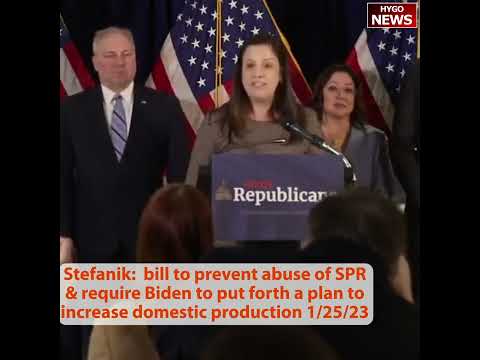
Stefanik: House GOP Bill Will “Prevent Abuse of SPR” and Require Biden to Provide “Plan to Increase Domestic Production”
In January 2023, House Republican Conference Chair Elise Stefanik outlined House GOP plans to pass legislation addressing Strategic Petroleum Reserve abuse and requiring domestic production plans. “Joe Biden and his administration have no plan to reverse course. Under an open rule this week, House Republicans will continue to implement our commitment to America. This week we will pass a bill to prevent abuse of the SPR and require Joe Biden to put forth a plan to increase domestic production,” Stefanik said. She framed the legislation as accountability measure: “It is long past time to unleash American energy and restore our standing on the world stage. House Republicans will hold the Biden administration accountable for tying the hands of America’s oil and gas producers in the midst of an energy crisis. We will deliver on our promise to defend our energy security to support an economy that’s strong.”
The “Commitment to America”
The “commitment to America” reference:
GOP campaign document — 2022.
Multiple policy areas — Covered.
Energy focus — Specific.
Economy emphasis — Central.
Implementation framework — Now.
Stefanik was invoking the House Republicans’ pre-election policy document. Having won House majority, they were implementing promises. Energy was major section of commitment.
”Open Rule”
Procedural reference. “Under an open rule this week, House Republicans will continue to implement our commitment to America,” Stefanik said.
The procedural reference:
Open rule — Allows amendments.
Democratic process — Framed.
Deliberative — Claimed.
Contrast with closed rules — Often used.
Procedural reform — Signal.
House Republicans had committed to more open rule procedures. Stefanik’s reference highlighted this commitment. Open rules allowed more amendments than closed rules traditionally used.
The Dual-Purpose Bill
The bill’s dual purpose:
Prevent SPR abuse — One goal.
Domestic production plan — Second goal.
Comprehensive approach — Framework.
Policy response — Substantive.
Political messaging — Clear.
The legislation addressed both restrictions on SPR misuse and requirements for production planning. This paired restriction with positive policy element, avoiding pure negative framing.
”Prevent Abuse of the SPR”
The SPR abuse framing:
Current usage — “Abuse.”
Restriction goal — Stated.
Emergency purpose — Preserved.
Biden’s draws — Characterized.
Policy reform — Goal.
By framing Biden’s SPR draws as “abuse,” Stefanik was making normative argument. Not just excessive use but inappropriate use. The legislation would establish clearer rules.
”Require Joe Biden to Put Forth a Plan”
The requirement framing:
Biden accountability — To Congress.
Production plan — Substantive demand.
Accountability mechanism — Legislative.
Administration target — Clear.
Oversight function — Served.
Requiring Biden to produce plan was oversight mechanism. This would force administration to articulate production strategy. The requirement would create accountability document.
”Long Past Time to Unleash American Energy”
The “unleash” framing was characteristic:
“Unleash” — Standard GOP energy language.
“American energy” — National pride.
“Long past time” — Urgency.
Implicit restraint — Claim.
Policy goal — Clear.
The “unleash American energy” framing suggested Biden policies were restraining production. Whether this was accurate was debated. U.S. oil production was actually near record highs but growth had slowed.
The Production Reality
U.S. production reality:
Near record levels — 12+ million b/d.
Growth slowed — From pre-COVID.
Shale response — Modified.
Capital discipline — Industry.
Policy influence — Debated.
The actual production picture was complex. Record levels but slowing growth. Some industry restraint. Policy influence debatable. GOP framing was political but had some basis.
”Restore Our Standing on the World Stage”
International framing:
World stage — International context.
U.S. standing — National credibility.
Energy diplomacy — Role.
Global competition — China.
Leadership claim — GOP position.
The international framing added diplomatic dimension to domestic energy debate. U.S. energy production had international implications for both economics and geopolitics.
”Tying the Hands of America’s Oil and Gas Producers”
The industry restraint claim. “House Republicans will hold the Biden administration accountable for tying the hands of America’s oil and gas producers in the midst of an energy crisis,” Stefanik said.
The claim:
Administration restraint — On producers.
“Tying hands” — Metaphor.
Energy crisis context — Emphasized.
Producer victimhood — Framed.
GOP accountability role — Claimed.
The “tying hands” framing was industry narrative. Producers cited regulatory barriers, drilling permits, and leasing restrictions as constraints. Administration response was that permits were available and industry chose not to drill.
The Actual Policy Actions
Biden administration actions on oil/gas:
Federal leases — Some restrictions.
Permit processing — Continued.
Keystone XL cancelled — Early.
Drilling bans — Some areas.
Regulatory actions — Various.
Actions had been taken that could be characterized as restrictive. Whether they meaningfully affected production was debated. The political framing was clear; the actual impact was contested.
”Energy Crisis”
The “energy crisis” framing:
Gas prices — Elevated.
Global supply — Disrupted.
Russia war — Major factor.
Ukraine aid — Affecting.
Consumer burden — Real.
Whether there was true “energy crisis” was partly framing question. Gas prices had been high but were declining. Supply disruptions existed but markets were adjusting. The crisis characterization was political but had some basis.
The Industry Response
Oil and gas industry response to Biden:
Mixed — Generally.
Some cooperation — On production.
Some criticism — On policies.
Investment decisions — Driven by economics.
Capital discipline — Chosen.
Industry hadn’t dramatically increased production despite high prices. Whether this was due to administration restrictions or industry capital discipline was debated. Companies cited multiple factors.
”Defend Our Energy Security”
The energy security framing:
Security elevation — Of issue.
National interest — Claimed.
GOP commitment — Promised.
Strategic importance — Emphasized.
Political frame — Effective.
Energy security was important national interest. Framing energy policy as security issue elevated political stakes. This was effective messaging that combined practical and security concerns.
The “Strong Economy” Theme
Economic theme connection:
Energy costs — Consumer impact.
Business costs — Affecting.
Inflation — Partly energy.
Economic strength — Energy-dependent.
GOP theme — Central.
Energy issues connected to broader economic themes GOP was emphasizing. High energy costs affected inflation. Strong economy required affordable energy. The connections were politically effective.
The Open Rule Significance
Open rule significance:
Amendments allowed — Generally.
Democratic process — Enhanced.
Debate possibility — Increased.
Committee chair power — Reduced.
GOP reform — From deals.
The open rule procedure was reform implemented by GOP majority. It allowed more amendments than previous closed rules. This was part of McCarthy’s deal with Freedom Caucus.
The Conference Chair Role
Stefanik’s Conference Chair role:
Third-ranking — House GOP.
Messaging function — Primary.
Floor presence — Regular.
Political advocate — Role.
Leadership voice — Established.
As Conference Chair, Stefanik delivered regular messaging. Her floor speeches were part of coordinated GOP communication. Her attacks represented official House GOP position.
The Political Strategy
Political strategy elements:
Strong attacks — On Biden.
Specific legislation — As vehicle.
Policy substance — With messaging.
Committee work — Continuing.
2024 setup — Building.
The approach combined specific legislation with strong messaging. This created both policy product and political content. Both served GOP objectives heading toward 2024.
The Biden Administration Response
Expected administration response:
Veto threat — Likely.
Policy defense — Continuing.
Counter-messaging — Deployed.
Alternative framing — Promoted.
Campaign positioning — For 2024.
Administration would continue defending its approach while threatening to veto. The messaging battle would continue through legislative process.
The Legislative Outlook
Legislative outlook:
House passage — Likely.
Senate consideration — Uncertain.
Biden veto — Probable.
Override unlikely — Given margins.
Political messaging — Main purpose.
Even if passed, legislation probably wouldn’t become law. But the process served political purposes. Bill introduction, committee action, floor debate, and voting all created messaging opportunities.
The Hunter Biden Connection
Hunter Biden angle:
BHR Partners — Connection.
Chinese investment — Through firm.
SPR sales to China — Context.
Investigation target — House committees.
Political linkage — Pursued.
GOP was connecting SPR issues to Hunter Biden investigations. The linkage was political but had some factual basis. Committee investigations would pursue connections.
The Energy Independence Theme
Energy independence theme:
National goal — Broad appeal.
Trump emphasis — Continued by GOP.
Biden complication — Framed.
Production focus — Required.
Political resonance — Strong.
Energy independence had bipartisan appeal historically. GOP was positioning themselves as true defenders of it. Biden policies were framed as opposing this goal.
The Refill Requirements
Refill considerations:
Restoration needed — Of reserves.
Timeline question — How fast.
Cost issue — Budget impact.
Market effects — Of purchases.
Strategic importance — National security.
Any legislation would address refill requirements. How quickly and at what cost reserves should be replenished was policy question with political dimensions.
The China Angle Continued
China angle:
Reserve building — By China.
Strategic competition — With U.S.
Oil diplomacy — Global.
Energy weaponization — Concern.
Bipartisan concern — China.
China’s energy position was bipartisan concern. Using this concern to attack Biden administration energy policy was effective political strategy.
The Messaging Effectiveness
Stefanik messaging effectiveness:
Clear narrative — Established.
Specific actions — Announced.
Political attacks — Embedded.
Policy positions — Stated.
Coordinated theme — Consistent.
The messaging combined multiple elements effectively. It was more than pure attack — it included policy substance. This made the attacks more credible and effective.
The 2024 Campaign Setup
2024 campaign setup:
Legislative record — Being built.
Messaging — Being tested.
Voter resonance — Being gauged.
Coalition building — Continuing.
Campaign infrastructure — Developing.
Each legislative action served multiple purposes. Policy substance, political messaging, and campaign positioning were all served. This was sophisticated legislative-political strategy.
Key Takeaways
- House GOP Conference Chair Elise Stefanik announced legislation to “prevent abuse of the SPR” and require Biden production plans.
- She claimed: “Joe Biden and his administration have no plan to reverse course.”
- Stefanik invoked the House GOP “Commitment to America” campaign document.
- She framed the bill as accountability: “House Republicans will hold the Biden administration accountable for tying the hands of America’s oil and gas producers in the midst of an energy crisis.”
- Key theme: “It is long past time to unleash American energy and restore our standing on the world stage.”
- The legislation combined SPR restrictions with domestic production requirements — addressing both restrictive and productive policy elements.
Transcript Highlights
The following is transcribed from the video audio (unverified — AI-generated from audio).
- Joe Biden and his administration have no plan to reverse course.
- Under an open rule this week, House Republicans will continue to implement our commitment to America.
- This week we will pass a bill to prevent abuse of the SPR and require Joe Biden to put forth a plan to increase domestic production.
- It is long past time to unleash American energy and restore our standing on the world stage.
- House Republicans will hold the Biden administration accountable for tying the hands of America’s oil and gas producers in the midst of an energy crisis.
- We will deliver on our promise to defend our energy security to support an economy that’s strong.
Full transcript: 113 words transcribed via Whisper AI.