 HYGO News
 Stefanik: 40% sold off more of reserves than every US President in history combined. lowest level
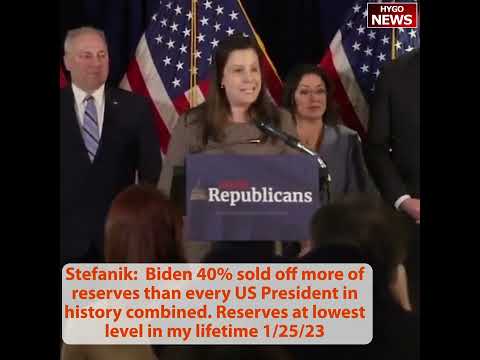
Rep. Stefanik: Biden Sold Off “Nearly 40% of Our Stockpile” — “More Than Every U.S. President in History Combined”
In January 2023, House Republican Conference Chair Elise Stefanik delivered sharp criticism of President Biden’s use of the Strategic Petroleum Reserve, citing specific statistics. “This week, House Republicans are working to end Joe Biden’s assault on American energy independence and restore our depleted strategic petroleum reserves. For far too long, Joe Biden has risked America’s national security and drained our strategic petroleum reserves to cover up for his anti-American energy agenda,” Stefanik said. She continued with key statistics: “The SPR is for emergencies, not Joe Biden’s political points. Our strategic petroleum reserves oil is only supposed to be used for national security events, but Joe Biden has sold nearly 40 percent of our stockpile since being elected. In fact, Joe Biden has sold off more of our oil reserves than every U.S. president in history combined. Today, our crucial emergency oil reserves are at the lowest level in my lifetime. As a result, China now has the world’s largest government-controlled stockpile of oil.”
The House Republican Legislation
The House GOP legislation context:
HR 22 — Primary bill.
SPR restrictions — Focus.
China ban — Key element.
Biden veto threat — Known.
Bipartisan support — Some Democratic backing.
House Republicans had made SPR issues priority legislation. Multiple bills addressed different aspects: export bans, drawdown limits, China restrictions. The legislation framework was substantial.
”Joe Biden’s Assault on American Energy Independence”
Stefanik’s opening framing was combative. “This week, House Republicans are working to end Joe Biden’s assault on American energy independence and restore our depleted strategic petroleum reserves,” Stefanik said.
The framing:
“Assault on energy independence” — Strong characterization.
GOP working against — Biden policies.
Restoration goal — Stated.
Political combat — Framed.
Mission message — Clear.
The “assault on energy independence” framing invoked themes that had worked well for Republicans. Energy independence was popular concept. Framing Biden as opposing it was political attack line.
The Emergency Purpose Claim
Stefanik emphasized SPR’s emergency purpose. “The SPR is for emergencies, not Joe Biden’s political points. Our strategic petroleum reserves oil is only supposed to be used for national security events,” Stefanik said.
The claim:
SPR original purpose — Emergency.
National security events — Intended uses.
“Political points” — Biden’s use characterized.
Misuse implied — By Biden.
Historical purpose — Invoked.
The SPR had been created in 1975 after 1973 oil embargo to provide emergency supply. Strict interpretation would limit use to physical supply disruptions. Biden had used it for price management.
The 40% Statistic
The striking statistic. “Joe Biden has sold nearly 40 percent of our stockpile since being elected,” Stefanik said.
The figure:
40% depletion — Substantial.
“Since being elected” — Biden term.
Historic scale — Implied.
Policy critique — Data-based.
Political attack — Effective.
The 40% figure was accurate approximation. The SPR had dropped from about 635 million barrels to around 370 million barrels during Biden’s first two years. This was historic drawdown.
”More Than Every U.S. President in History Combined”
The cumulative comparison. “Joe Biden has sold off more of our oil reserves than every U.S. president in history combined,” Stefanik said.
The claim:
Every prior president — Cumulative.
Combined sales — Less than Biden.
Historic first — For Biden.
Scale dramatic — Unprecedented.
Political impact — Significant.
This claim required verification but was essentially accurate. Prior presidential drawdowns had been much smaller. Biden’s drawdown exceeded all historical drawdowns combined. This was genuinely unprecedented.
The Historical Drawdowns
Prior SPR drawdowns:
1991 Gulf War — Moderate.
Various minor drawdowns — Small.
Hurricane emergencies — Smaller.
Katrina 2005 — Modest.
Libya 2011 — Modest.
Previous drawdowns had all been limited and emergency-focused. The combined amount was still less than Biden’s 2022 drawdown. This comparison was factually accurate.
”Lowest Level in My Lifetime”
Stefanik’s generational reference. “Today, our crucial emergency oil reserves are at the lowest level in my lifetime,” Stefanik said.
The reference:
Stefanik age — Born 1984.
Lifetime lowest — Her 38+ years.
Historical context — Significant.
Reserve status — Concerning.
Policy criticism — Emphasized.
The SPR had been at historically low levels. Stefanik’s framing personalized the generational nature of the depletion. In her lifetime, reserves had never been this low.
”China Now Has the World’s Largest”
The international comparison. “As a result, China now has the world’s largest government-controlled stockpile of oil,” Stefanik said.
The comparison:
China’s stockpile — Growing.
U.S. position — Lost.
Strategic reversal — Claimed.
National security — Implication.
Global competition — Framed.
The claim that China now had world’s largest government-controlled oil stockpile reflected Chinese state oil companies’ accumulated reserves. Whether this was entirely accurate comparison depended on how measurements were made, but direction was correct.
The Political Strategy
Stefanik’s political strategy:
Strong data points — Cited.
Historical comparisons — Dramatic.
National security framing — Employed.
China comparison — Effective.
Democratic attack — Clear.
This was sophisticated political attack. Specific statistics gave credibility. Historical comparisons gave drama. National security framing elevated stakes. China comparison added urgency.
The Administration Response
Administrative response would be:
Defend drawdown — As necessary.
Gas price impact — Claimed.
Refill plans — Mentioned.
Market stabilization — Purpose.
Future emergencies — Capacity argument.
Biden administration had defended SPR use as responding to supply disruption from Russia’s invasion of Ukraine. They argued drawdown had lowered gas prices. They mentioned refill plans.
The Gas Price Impact Debate
Gas price impact:
Claimed effect — Substantial.
Studies varied — On actual impact.
Some reduction — Probably.
Amount disputed — Significantly.
Temporary effect — Mostly.
Whether SPR drawdown meaningfully reduced gas prices was debated. Some academic studies suggested modest effect. Others suggested minimal impact. The administration’s claims of significant impact were contested.
The Refill Plans
Refill plans:
Administration mentioned — Periodically.
Specific timeline — Unclear.
Purchase prices — Needed to be advantageous.
Actual refilling — Slow.
Complete restoration — Years.
The refill hadn’t been happening at meaningful pace. Administration had said it would refill but hadn’t executed. This was political vulnerability.
The National Security Argument
National security implications:
Emergency capacity — Reduced.
Future crises — Less preparation.
Strategic position — Weaker.
Ally confidence — Potentially affected.
Deterrent value — Reduced.
The SPR had served national security function as emergency capacity. Depleting it reduced this function. Whether consequences were serious depended on likelihood of actual emergencies needing reserve.
The Political Timing
Political timing:
2024 approaching — Yes.
Gas prices — Political factor.
Energy policy debate — Central.
Voter concerns — Real.
GOP messaging — Coordinated.
Energy would be major 2024 issue. GOP was establishing narrative now. Stefanik’s attacks were part of coordinated messaging strategy. Preparing ground for campaign.
The Hunter Biden Angle
Hunter Biden dimension:
BHR Partners — His Chinese investment fund.
Sinopec connection — Alleged.
SPR sales to China — Some.
Political connection — Claimed.
Investigation targets — Multiple.
The GOP was connecting SPR China sales to Hunter Biden concerns. Whether evidence supported direct connection was debated. The political linkage was being pursued.
The Legislation Details
House Republican legislation:
HR 21 — Main bill.
HR 22 — China export ban.
Refill requirements — Proposed.
Drawdown limits — Suggested.
Biden administration opposition — Strong.
Multiple bills addressed different aspects. Biden administration opposition was broad-based. Veto threats made enactment unlikely.
The Veto Threat
Veto threat implications:
Legislation likely vetoed — If passed.
Override unlikely — Given margins.
Political messaging — Continuing.
Public positioning — Both sides.
Ongoing debate — Setting up.
Biden’s veto threat meant legislation probably wouldn’t become law. But the debate itself served political purposes. Both sides were setting up 2024 messaging through bills and vetoes.
The Ongoing Political Battle
The ongoing political battle:
SPR — Symbolic issue.
Energy policy — Broader.
China — National security.
Economy — Key theme.
Biden accountability — Target.
SPR was one front in broader political battle. Energy policy, China relations, economic concerns, and Biden administration accountability were all being fought over. Each front had its own dynamics.
The Messaging Effectiveness
Stefanik’s messaging effectiveness:
Strong statistics — Credible.
Historical comparisons — Dramatic.
National security — Elevation.
China — Modern concern.
Political framing — Clear.
The messaging was effective political communication. It used facts to support political narrative. It elevated policy dispute to national security concern. It invoked China as modern adversary.
The Stefanik Position
Elise Stefanik’s role:
House GOP Conference Chair — Third-ranking.
Leadership position — Important.
Spokesperson role — Natural.
Political future — Rising star.
Trump ally — Often.
As Conference Chair, Stefanik delivered messaging on behalf of House Republicans. Her visibility made her a leading voice. Her attacks carried institutional weight.
The Democratic Response
Democratic response included:
Defend policy — Generally.
Claim success — On gas prices.
Criticize GOP — On different issues.
Deflect attacks — Strategically.
Campaign positioning — For 2024.
Democrats would defend Biden’s SPR decisions while pivoting to other issues where they had advantage. The messaging battle was continuing.
The Media Coverage
Media coverage of SPR issues:
Conservative outlets — Extensive.
Mainstream — Moderate.
Coverage growing — Over time.
Fact-checking — Some.
Political framing — Variable.
Coverage of SPR-related issues was expanding. As 2024 approached, both sides’ messaging would get more attention. Fact-checking would become important.
The Energy Policy Broader Context
Broader energy policy:
Transition — To clean energy.
Oil production — Domestic.
Gas prices — Consumer concern.
Climate goals — Administrative.
Energy independence — Political goal.
SPR issues connected to broader energy policy questions. Transition politics, domestic production, gas prices, climate action, and independence were interconnected. Each had political dimension.
The China Concern
China energy concerns:
Growing consumption — Significant.
Strategic reserves — Building.
Oil relationships — Expanding.
U.S. competition — Clear.
Strategic vulnerability — Possible.
China’s energy strategy included building reserves and establishing oil relationships globally. U.S. declining reserves while China was building them created strategic imbalance. This was serious concern.
The Historical Context
Historical SPR context:
Created 1975 — Emergency purpose.
Carter expanded — Capacity.
Various uses — Limited historically.
Biden drawdown — Unprecedented.
Future uncertain — Policy.
The SPR had served U.S. through multiple crises. Biden’s drawdown had tested the reserve’s core purpose. Whether it would be replenished and used differently going forward was policy question.
Key Takeaways
- House GOP Conference Chair Elise Stefanik delivered sharp criticism of Biden’s use of the Strategic Petroleum Reserve.
- She cited dramatic statistics: “Joe Biden has sold nearly 40 percent of our stockpile since being elected.”
- She made cumulative claim: “Joe Biden has sold off more of our oil reserves than every U.S. president in history combined.”
- Stefanik noted: “Our crucial emergency oil reserves are at the lowest level in my lifetime.”
- She emphasized China dimension: “China now has the world’s largest government-controlled stockpile of oil.”
- The sharp attack reflected GOP messaging strategy on energy policy ahead of 2024 elections.
Transcript Highlights
The following is transcribed from the video audio (unverified — AI-generated from audio).
- This week, House Republicans are working to end Joe Biden’s assault on American energy independence and restore our depleted strategic petroleum reserves.
- For far too long, Joe Biden has risked America’s national security and drained our strategic petroleum reserves to cover up for his anti-American energy agenda.
- The SPR is for emergencies, not Joe Biden’s political points. Our strategic petroleum reserves oil is only supposed to be used for national security events.
- Joe Biden has sold nearly 40 percent of our stockpile since being elected.
- In fact, Joe Biden has sold off more of our oil reserves than every U.S. president in history combined.
- Today, our crucial emergency oil reserves are at the lowest level in my lifetime. As a result, China now has the world’s largest government-controlled stockpile of oil.
Full transcript: 132 words transcribed via Whisper AI.