 HYGO News
 Pittsburgh Steelers Legend Rocky Bleier Presents Trump with Honorary #47 Jersey -- 'A Number That Hangs in the NFL Hall of Fame'; Nippon Steel Investing $2.2B in Mon Valley + $7B Across Indiana, Minnesota, Alabama, Arkansas; 'Will Create or Save 100,000 Jobs'; US Steel Worker: 'I Would Rather Be Nowhere Than Here Today'
Pittsburgh Steelers Legend Rocky Bleier Presents Trump with Honorary #47 Jersey — “A Number That Hangs in the NFL Hall of Fame”; Nippon Steel Investing $2.2B in Mon Valley + $7B Across Indiana, Minnesota, Alabama, Arkansas; “Will Create or Save 100,000 Jobs”; US Steel Worker: “I Would Rather Be Nowhere Than Here Today”
At a late May 2025 rally in Pittsburgh, President Trump formally completed the US Steel-Nippon Steel deal and received a Pittsburgh Steelers honorary #47 jersey. Pittsburgh Steelers legend Rocky Bleier, along with current players QB Mason Rudolph and DB Miles Killebrew, made the presentation. The US Steel representative: “On behalf of US Steel and to the people of Pittsburgh, more importantly though to all the Steelers fans that are here this evening, I have the honor of making you an honorary Pittsburgh Steeler and would like to present to you your Jersey as with the number 47 as the 47th president of the United States, a number that hangs in the National Football League Hall of Fame. I’d like to present to this to a Hall of Fame president.” Rudolph: “I’m honored to be here with a great Steeler legend like Rocky Bleier, somebody who fought for our country in Vietnam and came back and played some great football with the black and gold.” A US Steel worker said: “I’m not prepared, but I can tell you I would rather be nowhere than where I am today with all of my US Steel family, friends, and everybody that I love. Thank you, Donald J. Trump!” Trump announced Nippon’s $2.2 billion investment in Mon Valley Works plus $7 billion for steel mills in Indiana, Minnesota, Alabama, and Arkansas — “will create and save over 100,000 American jobs, including 14,000 jobs in Pennsylvania.”
The Jersey Presentation
A US Steel representative opened the presentation.
“Mr. President, on behalf of US Steel and to the people of Pittsburgh, more importantly though to all the Steelers fans that are here this evening, I have the honor of making you an honorary Pittsburgh Steeler,” the representative said.
He presented the specific gift: “And would like to present to you your Jersey as with the number 47 as the 47th president of the United States, a number that hangs in the National Football League Hall of Fame.”
He made the compliment: “I’d like to present to this to a Hall of Fame president. Please accept it.”
The Steelers Legacy Presenters
Three Steelers legends/players were involved:
Rocky Bleier: The legend. Bleier had been drafted by the Steelers in 1968, deployed to Vietnam, wounded severely in combat, and fought his way back to play in all four Steelers Super Bowl championships of the 1970s. His story had been the subject of:
- The 1980 TV movie “Fighting Back: The Rocky Bleier Story”
- Numerous books and documentaries
- Motivational speaking tours
- Veterans advocacy
Bleier represented:
- Military service (Vietnam veteran, wounded)
- Personal perseverance (fighting back from injury)
- Super Bowl excellence (4-time champion)
- American exceptionalism (triumph over adversity)
- Steelers heritage (played 1968-1980)
Mason Rudolph: Current Steelers QB, representing the team’s present. A veteran quarterback who had been with the organization for years.
Miles Killebrew: Current Steelers DB, representing the current team’s defensive excellence.
The combination of legendary figure, current players, and the jersey gift created a powerful moment. Trump was being honored by representatives of the team that had defined Pittsburgh identity for over five decades.
The “47” Number
The “47” jersey had specific significance:
Trump’s presidency: He was the 47th President of the United States (as well as the 45th). His second term made him both the 45th and 47th president, a rare historical occurrence.
NFL Hall of Fame: The representative noted that “47” hangs in the NFL Hall of Fame. Several specific players had worn number 47, but the most significant was Mel Blount — the legendary Steelers cornerback who had revolutionized cornerback play and was enshrined in the Hall of Fame.
Personal connection: Trump had been photographed wearing Steelers gear throughout his career. His business and entertainment history had connected him to Pittsburgh in various ways.
Political significance: The Steelers had fan bases throughout western Pennsylvania, Ohio, and West Virginia — key electoral regions that had shifted toward Trump during 2016-2024. Acknowledgment by the Steelers organization had political resonance beyond just sports.
Bleier’s Comment
Rudolph (or possibly Killebrew) made a brief statement acknowledging Bleier.
“Listen, I’m honored to be here with a great Steeler legend like Rocky Bleier, somebody who fought for our country in Vietnam and came back and played some great football with the black and gold,” he said.
He closed: “Awesome to be here a part of this big investment in Pittsburgh, go Steelers.”
The “black and gold” reference was to the Steelers team colors. “Go Steelers” was the traditional fan exhortation. By invoking these elements, the current Steeler was connecting to decades of Pittsburgh football tradition.
The Vietnam Connection
Bleier’s Vietnam service was particularly meaningful.
Bleier had been drafted by both the Steelers (football) and the U.S. Army (Vietnam) in 1968. He had attempted to serve both initially, missing his Steelers rookie year to serve in Vietnam.
In Vietnam, Bleier had:
- Been ambushed in a rice paddy in August 1969
- Taken a rifle bullet in the left thigh
- Had his right foot and leg severely damaged by grenade shrapnel
- Undergone multiple surgeries
- Been initially told he would never walk normally again
- Faced the end of his football career
Bleier’s recovery had been extraordinary:
- Long physical therapy
- Personal determination and conditioning
- Return to Steelers training camp
- Eventually earning starting running back role
- Winning 4 Super Bowls (1975, 1976, 1979, 1980)
- Building an Italian-American American story of triumph
His presence at the Trump rally made multiple connections:
- Veteran service (and Trump as Commander-in-Chief)
- Personal perseverance (and Trump’s own comeback narrative)
- Pittsburgh identity (and Trump’s rally purpose)
- American exceptionalism (and Trump’s messaging)
The Pittsburgh Blessing
Rudolph added a personal note: “Just wanted to say God bless you, President Trump, and God bless you, Pittsburgh.”
Trump acknowledged: “Thank you. Thank you very much, everybody. It’s a great group of people.”
The “God bless you” framing was significant in several ways:
- Religious expression in public political setting
- Personal blessing of Trump specifically
- Blessing of Pittsburgh as a community
- Sincere rather than performative
- Reflected actual religious sentiment
Mason Rudolph was known as an openly Christian athlete. His willingness to publicly bless Trump reflected both personal religious conviction and alignment with Trump’s cultural positioning.
The Emotional US Steel Worker
A US Steel worker made an unplanned emotional statement.
“I’m not prepared, but I can tell you I would rather be nowhere than where I am today with all of my US Steel family, friends, and everybody that I love,” the worker said.
She expressed gratitude: “Thank you very much. Thank you, Mr. Berg. Thank you, Mr. Moria. Most of all, thank you, Donald J. Trump.”
The worker’s emotional state reflected the reality of the US Steel situation:
The threat: US Steel had been struggling financially. The company had been considering closing Mon Valley Works mills that had operated for over a century. Jobs would have been lost; communities would have been devastated.
The Biden block: The Biden administration had blocked the Nippon Steel acquisition in January 2025, citing national security concerns. This had left US Steel in precarious position — neither fully protected nor able to access Nippon Steel’s investment capital.
The uncertainty: Workers had been uncertain whether their jobs would continue, whether their mills would operate, whether their communities would remain economically viable.
The resolution: Trump’s deal had preserved:
- US Steel’s American control
- Nippon Steel’s investment capital
- Existing Mon Valley Works operations
- Worker jobs and benefits
- Community economic foundation
The “I would rather be nowhere than where I am today” framing captured the relief that workers had felt. Rather than losing their jobs and seeing their communities decline, they had secured both American control and Nippon’s investment.
Trump’s Political Framing
Trump took the podium to address the workers.
“Well, the men and women here today, they work every day to keep America powerful and strong,” Trump said.
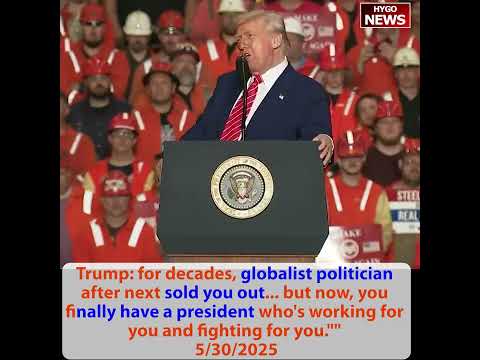
He made the political indictment: “And for decades, you watched as one globalist politician after the next sold you out and sent your dreams to China and to many other foreign countries.”
He made the contrast: “But now you finally have a president who’s working for you and fighting for you.”
He expressed ongoing commitment: “And we’re going to be watching over you. This is going to be so successful.”
The “Globalist” Framing
Trump’s “globalist politicians” framing had specific meaning for steel workers:
The NAFTA era (1994): Trade liberalization with Mexico and Canada had begun the manufacturing offshoring process. Much steel-related manufacturing had moved south.
China’s WTO entry (2001): Had dramatically accelerated manufacturing offshoring. Chinese steel subsidies had undermined American producers.
Bush, Obama, Biden administrations: Had generally supported trade liberalization with minimal protection for American steel producers.
Specific impact on Pittsburgh: The region had seen:
- Massive decline in steel employment
- Community deterioration
- Population decline
- Economic stagnation
- Cultural deterioration
The bipartisan consensus: Both Republican and Democratic politicians had largely supported the trade policies that had devastated Pittsburgh. Steel workers had watched as their jobs disappeared with minimal defense from either party.
Trump’s framing was that he was breaking this bipartisan consensus. While previous presidents from both parties had allowed American steel to be destroyed by foreign competition and policy choices, Trump was:
- Imposing tariffs to protect American production
- Blocking and conditioning foreign acquisitions
- Directing capital toward American facilities
- Creating policy framework for American manufacturing revival
The Specific Investment
Trump laid out the specific Nippon investment.
“As part of this monumental commitment, Nippon will also invest $2.2 billion to increase Steel production here in the Mon Valley works specifically allocated to Mon Valley,” Trump said.
He included additional investment: “Along with $200 million for the advanced technology research and development center that’s being built already in Pennsylvania.”
He expanded the scope: “So I want to congratulate you. And in addition, another $7 billion to modernize steel mills, expand ore mines and build state of the art facilities in Indiana, Minnesota, Alabama, and Arkansas.”
He specified the timeline: “So I want to thank you and congratulations to those who have been working for us. Congratulations. And the bulk of these expenditures will be made in the next 14 months.”
He created the memorable imagery: “It’s going to happen fast. You’re going to be very busy watching trucks go back and forth, load it up with cash or it’s equivalent.”
The Total Investment Package
Breaking down the investment:
Mon Valley Works: $2.2 billion
- Direct investment in Pittsburgh-area steel production
- Modernization of existing facilities
- Capacity expansion
- Worker training programs
R&D Center: $200 million
- Advanced steel technology development
- University and industry partnerships
- American intellectual property
- Innovation in steel applications
Other American facilities: $7 billion
- Indiana steel mills
- Minnesota ore operations
- Alabama facilities
- Arkansas operations
Total: Approximately $9.4 billion in American steel industry investment
Employment impact: “Will create and save over 100,000 American jobs, including 14,000 jobs in Pennsylvania.”
Timeline: “Bulk of these expenditures will be made in the next 14 months.”
The Comparison
The investment package represented a dramatic reversal of recent trends:
Recent history: American steel capacity had declined for decades. Each year had brought more closures than openings.
The Nippon deal: $9.4 billion in investment committed over 14 months. This was:
- More than American steel industry had seen in years
- Accelerated timeline compared to typical infrastructure investment
- Geographically diverse across multiple states
- Focused on modernization and expansion, not just maintenance
The jobs impact: 100,000 jobs “created or saved” was significant:
- Many positions would have been lost under continued US Steel decline
- The deal preserved existing employment
- Expansion would create additional positions
- Pennsylvania specifically received 14,000 job commitment
The “Trucks Going Back and Forth”
Trump’s “trucks go back and forth, load it up with cash” imagery was characteristic.
The mental image was deliberately vivid:
- Physical trucks
- Going back and forth between facilities
- Carrying “cash or its equivalent”
- Representing concrete investment
- Creating visible economic activity
This was Trump’s preferred rhetorical style. Rather than discussing investment in abstract financial terms, he made it tangible. Workers would see:
- Construction trucks delivering materials
- Equipment arriving at facilities
- Workers hired and trained
- Production ramping up
- Community economic activity
The “trucks loaded up with cash” image captured the fundamental economic reality: billions of dollars flowing into specific American communities over a short timeframe.
Key Takeaways
- Rocky Bleier (Vietnam veteran, 4-time Super Bowl champion) presents Trump honorary Pittsburgh Steelers #47 jersey.
- “47” significance: 47th president, and jersey number in NFL Hall of Fame.
- US Steel worker: “I would rather be nowhere than where I am today with all my US Steel family. Thank you, Donald J. Trump.”
- Nippon investment: $2.2B Mon Valley, $200M R&D center, $7B mills in Indiana, Minnesota, Alabama, Arkansas = $9.4B total.
- Jobs impact: 100,000 American jobs created or saved, including 14,000 in Pennsylvania, over 14 months.