 HYGO News
 Starting today 4 free at-home tests on a limited basis, so order yours soon
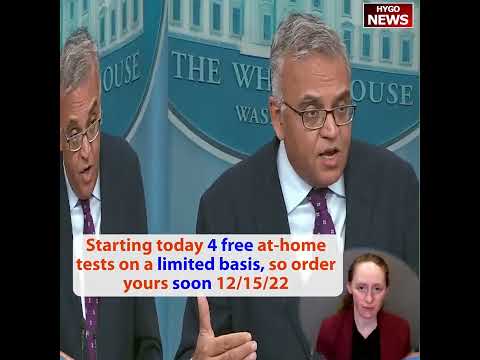
Admin Official Relaunches Free COVID Test Program “On a Limited Basis” — Took Money From Other COVID Programs and ARP Funds
In December 2022, the Biden administration relaunched its free at-home COVID test program for the winter, with Americans able to order four free tests per household through COVIDTests.gov. An administration official explained the funding for this relaunch had come partly from diverting resources from other COVID programs and using American Rescue Plan funds. “We paused the program at the end of the summer while we took a lot of the resources we had for tests to purchase vaccines and treatments. We still had some resources left. We didn’t use to deplete the whole supply and so we had money in the American Rescue Plan to still be able to buy some more tests.” The official acknowledged the program was “on a limited basis” because resources had been stretched: “We’re not going to be able to keep this open forever.”
The Free Test Program Relaunch
The Biden administration had operated the free COVID test program intermittently during the pandemic. The December 2022 relaunch was:
Winter-focused — Targeting the seasonal respiratory illness period.
Four-test allocation — Per household, standard format.
COVIDTests.gov — The familiar ordering website.
Limited duration — “On a limited basis” was explicitly stated.
Funded from various sources — Including ARP and test program pauses.
The relaunch was timely given the “tripledemic” of COVID, RSV, and flu that was stressing healthcare systems. Making home tests available could:
Reduce emergency visits — By helping people self-identify COVID.
Support appropriate care — Different illnesses require different treatments.
Ease health system strain — By avoiding unnecessary visits.
Provide public reassurance — That government was responding.
The Funding Question
The reporter asked a substantive funding question. “Were there cuts to other COVID programs in order to pay for those tests?” the reporter asked.
This was a legitimate policy question. Budget tradeoffs were real:
Test program — Had been paused in late summer 2022.
Vaccines and treatments — Had been prioritized.
Other COVID programs — Were being considered for cuts.
Overall COVID spending — Was being reduced.
Congressional funding — Had been limited.
The reporter was asking whether the free test program was new spending or reallocation from other programs.
The Acknowledged Tradeoff
The administration official acknowledged the tradeoff. “Yes, so let me talk about how we’re able to do this. So we paused the program at the end of the summer while we took a lot of the resources we had for tests to purchase vaccines and treatments,” the official said.
The acknowledgment was notable for its directness:
“Yes” — Direct confirmation of tradeoff.
“Paused the program” — Admitted the prior stoppage.
“Took a lot of the resources” — Admitted diversion to other purposes.
“For vaccines and treatments” — Specified the alternative uses.
This kind of direct acknowledgment was unusual in administration communications. Most similar questions would receive evasive responses. The direct answer on this funding question suggested:
No politically damaging admission — In acknowledging the funding sources.
Straightforward logistics — Rather than political messaging.
Professional response — From administration staff on operations.
Technical rather than political — Answer appropriate.
”Some Resources Left”
The official explained remaining resources. “We still had some resources left. We didn’t use to deplete the whole supply and so we had money in the American Rescue Plan to still be able to buy some more tests,” the official said.
The explanation had two parts:
Remaining test resources — Not all prior resources had been diverted.
ARP funding — American Rescue Plan funds still available.
Combination enabled relaunch — Both sources contributed.
Limited scale — Given the combined resources.
This was a transparent accounting of how the relaunch was being funded. Unlike many administration communications, this response provided specific informational content.
”On a Limited Basis”
The official acknowledged program limitations. “It is on a limited basis. We’re not going to be able to keep this open forever,” the official said.
The “limited basis” framing was politically important. It conveyed:
Not a permanent restoration — Of free test availability.
Specific timeframe — For current round of distribution.
Resource constraints — Limiting scale.
Future uncertainty — About continuation.
Urgency — For Americans to order now.
The “not forever” framing served multiple purposes. It managed expectations (don’t count on this continuing). It created urgency (order while available). It acknowledged fiscal reality (resources were limited).
The American Rescue Plan Reference
The ARP had been the major Biden administration COVID response legislation, passed in March 2021. It had included various COVID-related funding:
Direct payments — To individuals and families.
State and local aid — To governments.
Public health resources — For testing, vaccines, treatment.
Economic recovery — Various business support.
Education funding — For schools and students.
Much of the ARP’s public health funding had been spent by late 2022, but some remained available for specific uses. Using remaining ARP funds for tests was legitimate within the authorizing legislation’s scope.
The Funding Constraint Context
By late 2022, COVID funding had become increasingly constrained:
Congressional resistance — To new COVID spending.
Previous appropriations exhausted — In many areas.
Administration requests rejected — Multiple times.
Emergency funding ended — For many programs.
Regular appropriations only — Not supplemental emergency money.
The administration had been asking Congress for additional COVID funding but hadn’t received approval for major new spending. The creative reallocation the official described — using remaining ARP funds, diverting previous test resources — was making do with what was already authorized.
The Program’s Political Value
The free test program had disproportionate political value relative to its fiscal cost. Despite being:
Relatively small spending — Compared to other COVID programs.
Simple administration — Just mailing tests.
Limited health impact — One of many COVID interventions.
It had high visibility:
Direct public benefit — Americans receiving free tests.
Regular reminders — Every order generated awareness.
Media coverage — When program launched/relaunched.
Political messaging — Administration responding to public health.
Constituent contact — Positive interaction with government.
The visibility made the program politically valuable despite its modest fiscal footprint. The administration had incentive to continue it even when resources were tight.
The Africa Vaccines Pivot
The transcript ends with a pivot to Africa vaccines. “And combat COVID-19. The United States delivered 231, 231 million doses of vaccines to 49 countries across Africa,” the official said.
The 231 million doses figure was a significant administration achievement:
Large scale — 231 million doses.
Wide distribution — 49 African countries.
Health diplomacy — Supporting global partnerships.
Pandemic response — Beyond U.S. borders.
Administration credit — For international engagement.
The repetition of “231, 231 million doses” was typical of administration messaging — repeating impressive numbers for emphasis. The Africa focus also reflected administration diplomatic priorities.
But the pivot also showed disjointed messaging. The free test question had been substantively answered. The Africa vaccines claim was tangential to the test funding discussion. The pivot felt like talking points inserted regardless of question context.
The Winter Surge Context
December 2022 was a concerning moment for respiratory illnesses:
COVID subvariants — XBB and others emerging.
RSV surge — Particularly affecting children.
Flu season — Early and severe.
Combined “tripledemic” — Straining healthcare.
Holiday gatherings — Creating transmission risk.
Healthcare worker shortages — Many still dealing with COVID effects.
The free test program was part of the broader response to this challenging period. Home testing could help people make informed decisions about:
Isolation — If COVID-positive.
Healthcare utilization — When to seek care.
Gathering attendance — Testing before events.
Return to work — Confirming negative status.
Protecting vulnerable — Before visiting at-risk individuals.
The Ordering Process
The practical ordering process was straightforward:
COVIDTests.gov — Main website.
Four tests per household — Standard allocation.
USPS delivery — Free shipping.
No income requirements — Available to all.
No health information — Not required.
The simplicity was a virtue. Americans across various backgrounds could easily order. The program had high compliance because it was easy to use.
The Program’s Eventual End
The “limited basis” framing proved accurate. The free test program continued intermittently during 2023 but eventually ended. By 2024, free tests were no longer generally available through the program.
The program’s lifecycle reflected:
Pandemic-era emergency measures ending — Return to normal insurance-based coverage.
Federal COVID resources depleted — Without new Congressional action.
Shift in pandemic phase — From emergency to endemic.
Political priorities changing — Reduced focus on COVID interventions.
Healthcare reality — Tests available through regular channels for many.
The December 2022 relaunch was among the later iterations of the program. The administration was stretching remaining resources to maintain visible COVID response during a challenging winter. When those resources ran out, the program effectively ended.
The Transparency Note
This briefing exchange was unusually transparent about program funding and limitations. Most administration communications on COVID matters had been more defensive or promotional. The direct acknowledgment of:
Program pauses — When resources were needed elsewhere.
Resource diversion — To vaccines and treatments.
Limited current scale — Due to resource constraints.
Uncertain future — Beyond current round.
Was candid in a way that contrasted with political messaging elsewhere. The operational nature of the response — explaining how tests were being funded — allowed for this transparency. Political messaging on COVID had been more guarded.
Key Takeaways
- The Biden administration relaunched free COVID test program in December 2022, with four tests per household available through COVIDTests.gov.
- An administration official acknowledged the program was funded partly by diverting resources from other COVID programs to purchase vaccines and treatments.
- The relaunch was funded by combining remaining test program resources with American Rescue Plan funds.
- The official explicitly acknowledged the program was “on a limited basis” and “not going to be able to keep this open forever.”
- The response also included a pivot to mention that the U.S. had delivered 231 million vaccine doses to 49 African countries.
Transcript Highlights
The following is transcribed from the video audio (unverified — AI-generated from audio).
- Were there cuts to other COVID programs in order to pay for those tests?
- Yes, so let me talk about how we’re able to do this.
- We paused the program at the end of the summer while we took a lot of the resources we had for tests to purchase vaccines and treatments.
- We still had some resources left… and so we had money in the American Rescue Plan to still be able to buy some more tests.
- It is on a limited basis. We’re not going to be able to keep this open forever.
- The United States delivered 231, 231 million doses of vaccines to 49 countries across Africa.
Full transcript: 153 words transcribed via Whisper AI.