 HYGO News
 Starmer: UK Ready for 'Boots on the Ground' in Ukraine; Flashback: Trump Slammed Germany on Russian Energy
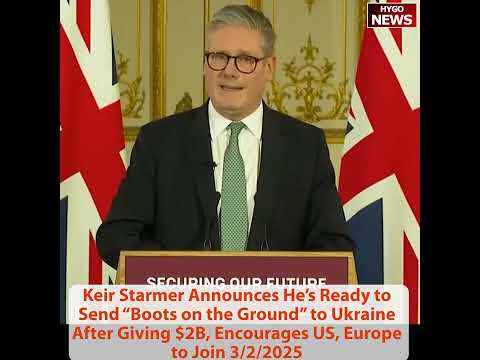
Starmer: UK Ready for “Boots on the Ground” in Ukraine; Flashback: Trump Slammed Germany on Russian Energy
On March 2, 2025, UK Prime Minister Keir Starmer announced at a leaders’ summit in London that “the UK is prepared to back this with boots on the ground and planes in the air” to defend a peace deal in Ukraine, while calling on Europe to “do the heavy lifting” with “strong U.S. backing.” He outlined a four-point plan including continued military aid, sovereignty guarantees, a “coalition of the willing,” and intensified planning “with real urgency.” The compilation paired Starmer’s announcement with resurfaced footage from seven years earlier in which Trump slammed Germany and NATO nations for paying billions to Russia for energy while expecting the U.S. to defend them — warnings that proved devastatingly prescient when Russia invaded Ukraine.
Starmer’s Four-Point Plan
Starmer delivered a structured announcement at the London summit that represented the most concrete European security commitment since the war began.
“First, we will keep the military aid flowing and keep increasing the economic pressure on Russia to strengthen Ukraine now,” Starmer said.
“Second, we agreed that any lasting peace must ensure Ukraine’s sovereignty and security. And Ukraine must be at the table,” he continued.
“Third, in the event of a peace deal, we will keep boosting Ukraine’s own defensive capabilities to deter any future invasion,” Starmer said.
“Fourth, we will go further — develop a coalition of the willing to defend a deal in Ukraine and to guarantee the peace,” he announced.
The “coalition of the willing” language echoed the terminology used for the Iraq War coalition in 2003, but applied to a defensive peacekeeping mission rather than an offensive military operation. Starmer was proposing that willing European nations would deploy forces to Ukraine to enforce a peace agreement — a commitment that went far beyond financial aid or weapons shipments.
”Boots on the Ground and Planes in the Air”
Starmer delivered the headline commitment with language that left no room for ambiguity.
“Not every nation will feel able to contribute,” Starmer acknowledged. “But that can’t mean that we sit back. Instead, those willing will intensify planning now with real urgency.”
Then the declaration: “The UK is prepared to back this with boots on the ground and planes in the air.”
He addressed the burden-sharing question that Trump had raised repeatedly. “Together with others, Europe must do the heavy lifting,” Starmer said. “But to support peace on our continent, and to succeed, this effort must have strong U.S. backing.”
The announcement represented a dramatic escalation of British commitment. Sending UK troops to Ukraine — even as peacekeepers enforcing a peace deal rather than combat forces fighting Russia — would be the most significant British military deployment in Europe since the Balkans operations of the 1990s. It would also partially answer Trump’s demand that European nations take greater responsibility for their own security.
Starmer connected the announcement to his recent Washington visit. “We’re working with the U.S. on this point after my meeting with President Trump last week,” he said. “And let me be clear: we agree with the President on the urgent need for a durable peace. Now we need to deliver together.”
The UK’s $2 billion military aid announcement — announced alongside the boots-on-the-ground commitment — was modest compared to the $350 billion the U.S. had spent. But the willingness to deploy actual military personnel represented a qualitatively different kind of contribution that money alone could not provide.
”Time to Act, Not Talk”
Starmer closed his London remarks with the urgency that the moment demanded.
“We are at a crossroads in history today,” he said. “This is not a moment for more talk. It’s time to act, time to step up and lead, and to unite around a new plan for a just and enduring peace.”
He announced that “leaders will meet again very soon to keep the pace behind these actions and to keep working towards this shared plan.”
The “crossroads in history” framing reflected the reality that the Trump-Zelensky confrontation had fundamentally altered the diplomatic landscape. With the American president demanding immediate action and threatening to walk away, European leaders could no longer defer to Washington while contributing minimally. Starmer was stepping into the void, offering British military commitment as the foundation for a European security guarantee that could make a peace deal viable.
Flashback: Trump Slammed Germany Seven Years Earlier
The compilation then cut to footage from 2018, when Trump had delivered a blistering critique of Germany and NATO allies at a Brussels summit — warnings that had been mocked at the time but proved prophetic.
“It’s very sad when Germany makes a massive oil and gas deal with Russia, where you’re supposed to be guarding against Russia, and Germany goes out and pays billions and billions of dollars a year to Russia,” Trump had said.
He identified the fundamental contradiction: “We’re protecting Germany, we’re protecting France, we’re protecting all of these countries. And then numerous of the countries go out and make a pipeline deal with Russia, where they’re paying billions of dollars into the coffers of Russia.”
Trump’s frustration was palpable: “So we’re supposed to protect you against Russia, but they’re paying billions of dollars to Russia. And I think that’s very inappropriate.”
He cited a specific detail that illustrated the incestuous relationship between European politics and Russian energy. “The former chancellor of Germany is the head of the pipeline company that’s supplying the gas,” Trump said, referencing Gerhard Schroeder’s role at Nord Stream. “Ultimately, Germany will have almost 70% of their country controlled by Russia with natural gas.”
Trump had asked the rhetorical question that Europe would spend the next four years failing to answer: “You tell me, is that appropriate? I think it’s not. And I think it’s a very bad thing for NATO.”
He addressed the spending shortfall: “On top of that, Germany is just paying a little bit over 1%, whereas the United States in actual numbers is paying 4.2% of a much larger GDP. I think that’s inappropriate also.”
Trump’s conclusion in 2018 could have been delivered verbatim in 2025: “I think these countries have to step it up, not over a 10-year period. They have to step it up immediately.”
The Vindication
The pairing of the two clips — Starmer’s 2025 announcement and Trump’s 2018 warning — told a complete story. Seven years earlier, Trump had warned that Europe’s dependence on Russian energy and its failure to invest in defense would have catastrophic consequences. European leaders had dismissed the warnings. The media had mocked them. And then Russia invaded Ukraine, precisely because the conditions Trump had identified — European energy dependence, defense underspending, and the perception of Western weakness — had created an environment in which Putin believed aggression would succeed.
Now, in 2025, a British Labour prime minister was announcing exactly the kind of European military commitment that Trump had been demanding for nearly a decade. The UK was offering “boots on the ground” — a phrase that would have been unthinkable in 2018 — because the alternative Trump had warned about had come to pass. Europe was finally stepping up, not because it wanted to, but because it had to. And the man who had been right all along was the one demanding they do it.
Key Takeaways
- UK PM Starmer announced “the UK is prepared to back this with boots on the ground and planes in the air” to defend a Ukraine peace deal, calling it “a crossroads in history.”
- He outlined a four-point plan: continued military aid, sovereignty guarantees, boosted Ukrainian defenses, and a “coalition of the willing” to guarantee the peace.
- Starmer said Europe “must do the heavy lifting” but that the effort “must have strong U.S. backing,” reflecting Trump’s demand for European responsibility.
- Resurfaced 2018 footage showed Trump warning that Germany paying Russia “billions and billions” for energy while expecting U.S. defense was “very inappropriate” and “very bad for NATO.”
- Trump had predicted Germany would become “70% controlled by Russia with natural gas” — a warning that proved prescient when Russia invaded Ukraine four years later.