 HYGO News
 Speaker Johnson and Dr. Oz: 'NOT Cutting Medicaid -- 1.4M Illegals, 4.8M Able-Bodied Not Working = FRAUD We're Eliminating'; 'Why Should Mississippi, Texas, Florida Pay for Illegal Immigrants in California?'; Rand Paul: 'Emperor Has No Clothes'; OBBB $1.5T Largest Cut in 30 Years
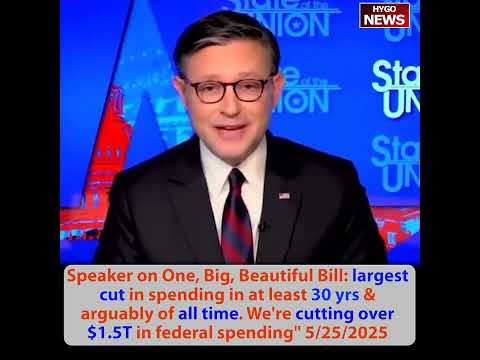
Speaker Johnson and Dr. Oz: “NOT Cutting Medicaid — 1.4M Illegals, 4.8M Able-Bodied Not Working = FRAUD We’re Eliminating”; “Why Should Mississippi, Texas, Florida Pay for Illegal Immigrants in California?”; Rand Paul: “Emperor Has No Clothes”; OBBB $1.5T Largest Cut in 30 Years
House Speaker Mike Johnson and CMS Administrator Dr. Mehmet Oz defended the OBBB’s Medicaid provisions against opposition criticism in May 2025. Johnson: “We are not cutting Medicaid. There’s a lot of misinformation out there. You got more than 1.4 million illegal aliens on Medicaid. Medicaid is not intended for non-U.S. citizens. It’s intended for the most vulnerable — pregnant women, young single mothers, the disabled, the elderly. They are protected. You’re talking about 4.8 million able-bodied workers, young men, for example, who are on Medicaid and not working. They are choosing not to work when they can. That is called fraud. They are cheating the system.” Dr. Oz on federalism: “Why should people living in Mississippi or Texas or Florida be paying for illegal immigrants getting health care in California?” Senator Rand Paul publicly opposed: “Somebody has to stand up and yell, ‘the emperor has no clothes,’ and everybody’s falling in lockstep on this… If we don’t stand up, I really fear the direction the country is going.” Johnson on OBBB overall: “This is the largest cut in spending in at least 30 years and arguably of all time. We’re cutting over $1.5 trillion in federal spending."
"We Are Not Cutting Medicaid”
Speaker Johnson opened with the fundamental framing.
“We are not cutting Medicaid in this package,” Johnson said. “There’s a lot of misinformation out there about this, Jake.”
The clarification was necessary because Democratic messaging had characterized OBBB’s Medicaid provisions as “cuts.” This was a rhetorical claim rather than a factual one:
Technical definition of “cuts”: Actual reduction in program spending below current levels.
OBBB Medicaid provisions: Maintained and even expanded spending on legitimate beneficiaries while restricting spending on those who shouldn’t have been receiving benefits.
Democratic framing: Any reduction in projected growth rates or elimination of ineligible beneficiaries was called a “cut.”
Under neutral accounting, eliminating $100 billion in payments to ineligible Medicaid recipients was not “cutting” Medicaid — it was enforcing Medicaid eligibility rules. Democrats’ characterization conflated these distinctly different concepts.
”1.4 Million Illegal Aliens”
Johnson cited a specific number.
“The numbers of Americans who are affected are those that are entwined in our work to eliminate fraud, waste, and abuse,” Johnson said. “What do I mean by that? You got more than 1.4 million illegal aliens on Medicaid.”
He stated the legal principle: “Medicaid is not intended for non-U.S. citizens.”
He described the intended beneficiaries: “It’s intended for the most vulnerable populations of Americans, which is pregnant women and young single mothers, the disabled, the elderly.”
He made the protection point: “They are protected in what we’re doing because we’re preserving the resources for those who need it most.”
The 1.4 million illegal aliens on Medicaid figure reflected several dynamics:
State policy divergence: Some states (particularly California, New York, Illinois) had explicitly extended Medicaid-style coverage to illegal immigrants using state funds plus federal reimbursements through various mechanisms.
Emergency Medicaid: Federal Medicaid did cover emergency care for anyone regardless of immigration status.
Enrollment errors: Identity verification failures had allowed illegal immigrants to enroll in Medicaid in various states.
Social Security verification gaps: Medicaid’s verification processes had been weak enough to allow ineligible individuals to access benefits.
Policy choices by sanctuary states: Some states had actively supported Medicaid access for illegal immigrants despite federal restrictions.
Under OBBB, federal reimbursement for state programs that included illegal immigrants would be restricted. States could still choose to cover illegal immigrants using state funds, but federal taxpayers would no longer subsidize these state choices.
”4.8 Million Able-Bodied”
Johnson addressed the other major category.
“You’re talking about 4.8 million able-bodied workers, young men, for example, who are on Medicaid and not working,” Johnson said.
He made the characterization: “They are choosing not to work when they can.”
He delivered the conclusion: “That is called fraud. They are cheating the system.”
He described the effect: “When you root out those kinds of abuses, you save the resources that are so desperately needed by the people who deserve it and need it most. That’s what we’re doing.”
The 4.8 million able-bodied non-working Medicaid recipients was a significant number. Medicaid enrollment had grown dramatically in recent years, with working-age adults becoming a growing share of beneficiaries. Many of these adults were:
- Not disabled or caring for disabled family members
- Not pregnant or caring for young children
- Not seeking work or engaged in work-related activities
- Not students or in training programs
Traditional Medicaid eligibility had focused on specific categories of need (pregnancy, disability, elderly, children). The Medicaid expansions under Obamacare and subsequent legislation had extended coverage to able-bodied adults regardless of work status. The result was that working-age adults who could have been working were receiving free healthcare.
OBBB’s work requirements would address this population specifically:
- Require 20 hours/week of work, volunteering, job search, or training
- Exempt those with legitimate reasons they couldn’t work
- Provide transition time for compliance
- Allow various activities to count toward the requirement
- Enforce through state administrative processes
Dr. Oz’s Federalism Argument
Dr. Mehmet Oz made the broader federalism case.
“Why should people living in Mississippi or Texas or Florida be paying for illegal immigrants getting health care in California?” Oz asked.
The question captured a fundamental federalism issue. Federal programs that provided benefits based on state policies created:
Transfer mechanics: Federal taxpayers in restrictive states funded benefits provided by permissive states.
Policy subsidies: State policies that would otherwise have fiscal costs were subsidized by federal taxpayers.
Moral hazard: States had reduced incentive to limit benefit programs because costs flowed to federal level.
Democratic accountability problems: Taxpayers in Mississippi couldn’t vote on California’s Medicaid policy, but they paid for it.
The Oz framing was politically powerful because it captured the intuition that most Americans shared: people in states that chose restrictive immigration policies shouldn’t pay for states that chose permissive ones. Federalism allowed different states to make different policy choices, but those choices should have financial consequences for the states making them.
Reforming Provider Payments
Dr. Oz also addressed provider payment issues.
“We have to make this the program sustainable,” Oz said. “We have to protect it.”
He cited Trump’s commitment: “President Trump has said over and over again, publicly and privately, he wants to love and cherish these programs because he wants to love and cherish the people in them.”
He described the provider perspective: “But to do that, you have to make sure, for example, they’re not for providers. If you don’t pay providers, they do it for free, let’s say.”
He illustrated the mechanics: “They can do that for 1 in 7 patients. But if you say, hey, listen, half your patients, we’re not going to pay you for. We’re going to make programs that don’t reimburse you. That doesn’t work.”
He noted the consequence: “Now providers begin to flee, and now we don’t have enough, for example, mental health providers in rural parts of this country.”
The provider payment dynamics Oz described were real. Medicaid reimbursement rates had been historically much lower than Medicare or private insurance rates. Providers could tolerate Medicaid patients as a minority of their practice, but a majority Medicaid patient panel was financially unsustainable.
This created a vicious cycle:
- Medicaid patients needed providers
- Providers couldn’t afford to accept many Medicaid patients
- Low provider acceptance created access problems for Medicaid patients
- Medicaid patients had difficulty finding care
- Rural and underserved areas became medical deserts
Addressing this required sustainable provider payment that would support adequate access. The OBBB included various provider payment reforms alongside the eligibility reforms.
”$200 Million for Housekeeping”
Dr. Oz cited a specific spending example.
“But the buck stops here,” Oz said. “We’ve got to clean up the system. We’re not paying $200 million for housekeeping anymore a year.”
The “$200 million for housekeeping” reference was apparently a specific program expense that Oz was targeting. CMS and HHS spent substantial sums on various administrative services, including:
- Office management
- Data processing services
- Facility management
- Various contracted services
- Administrative overhead
Finding $200 million in annual housekeeping expenses that could be eliminated or reduced was exactly the kind of line-item waste that DOGE and similar efforts had targeted. Every $200 million freed up was resources that could be redirected to actual healthcare or returned to taxpayers.
Rand Paul’s Opposition
Senator Rand Paul publicly broke with Trump on the bill.
“Somebody has to stand up and yell, the emperor has no clothes,” Paul said. “And everybody’s falling in lockstep on this, passed the big beautiful bill, don’t question anything.”
He made the broader argument: “Well, conservatives do need to stand up and have their voice heard.”
He cited historical patterns: “This is a problem we’ve been facing for decades now, and if we don’t stand up on it, I really fear the direction the country is going.”
Rand Paul was one of the Senate’s most consistent fiscal conservatives. His opposition to Trump-supported legislation was not unusual; he had similarly opposed various spending bills and Trump policies he considered fiscally irresponsible.
The “emperor has no clothes” framing invoked the Hans Christian Andersen fable. In that story, a vain emperor had been deceived by tailors who pretended to make him an invisible suit. Everyone pretended to see the invisible clothing because admitting they couldn’t see it was treated as personal failure. A child finally pointed out that the emperor was naked.
Paul was casting himself as that child — willing to say what others were pretending not to notice. His specific objection was presumably that:
- OBBB added substantial spending despite being framed as deficit reduction
- Tax cuts without spending cuts would increase deficits
- Dynamic scoring assumptions were optimistic
- Republican lockstep support reflected tribalism rather than principle
- American fiscal trajectory was unsustainable
From a fiscal conservative perspective, Paul’s critique was legitimate. OBBB was substantial tax cuts combined with modest spending reductions, resulting in larger deficits under conventional scoring. Whether growth effects would offset the revenue loss was uncertain.
”Largest Cut in 30 Years”
Johnson pushed back on the deficit concerns.
“This is the largest cut in spending in at least 30 years and arguably of all time,” Johnson said. “We’re cutting over $1.5 trillion in federal spending while we check all the boxes and bring about a pro-growth economy.”
He addressed the CBO scoring: “The CBO has been panned because, as you said, they don’t do dynamic scoring. What that means is they don’t account for the growth that will be fostered by all the policies that are in this big piece of legislation.”
He cited first-term experience: “This is not theoretical, Jake. Just remember the last Trump administration. After the first two years, we brought about the greatest economy in the history of the world, not just the U.S. The growth was off the charts. It was an average of about 3% of growth in GDP.”
He explained the mechanism: “Why? Because we cut taxes and we cut regulations. We’re doing the same thing this time around.”
He made the scale claim: “But on steroids, this is a much larger package, a much more robust package with all these features that will really get the economy going because wages will rise, job creators, entrepreneurs, risk takers will have more ability to expand their businesses, U.S. manufacturing onshore.”
Dynamic vs. Static Scoring
The scoring methodology debate was central to the fiscal analysis:
Static scoring (CBO’s default):
- Assumes tax and spending changes don’t affect economic behavior
- Calculates direct fiscal impact of policy changes
- Produces larger deficit estimates for tax cuts
- Doesn’t account for growth effects
- Tends to favor incumbent fiscal arrangements
Dynamic scoring (Trump administration preference):
- Accounts for economic behavior changes from policy
- Calculates direct and indirect effects
- Produces smaller (or negative) deficit estimates for pro-growth policies
- Accounts for growth effects
- Favors supply-side policies
The actual fiscal impact of policies depended on which approach was more accurate for specific circumstances. For incremental changes to marginal taxes, static scoring was often approximately accurate. For major policy shifts (like significant tax cuts), dynamic effects could be substantial.
Trump’s first-term experience supported some dynamic scoring claims. The 2017 TCJA had produced stronger economic growth than static scoring had predicted. Revenue effects had been better than static scoring’s pessimism, though not as good as dynamic scoring’s optimism.
”Greatest Economy in History”
Johnson’s first-term claim was politically potent.
Pre-COVID, the Trump economy had shown:
- Unemployment at 50-year lows (3.5%)
- Record low unemployment for Black Americans, Hispanic Americans, women
- Strong wage growth, particularly for lower-income workers
- Growing labor force participation
- Strong consumer confidence
- Rising median household income
- Historic stock market gains
- Manufacturing employment growth
The COVID-19 pandemic had disrupted this economic pattern. But the pre-pandemic economic performance had been strong by most metrics.
Whether OBBB would replicate and exceed this performance was the key question. The administration’s argument was that the combination of:
- Tax cuts (extending TCJA, adding new cuts)
- Regulatory reductions
- Energy abundance
- Immigration enforcement
- Trade policy
- Workforce development
would produce strong sustained economic growth that would generate revenue sufficient to manage debt.
Critics like Rand Paul worried that:
- Growth assumptions were optimistic
- Structural debt problems required direct reduction, not growth alone
- Tax cuts would increase deficits even with modest growth
- Political pressure would prevent genuine spending discipline
- Future economic downturns could create fiscal crisis
These were genuine policy disagreements within the conservative coalition. Johnson’s framing represented the pro-growth majority position; Paul’s framing represented the fiscal hawk minority position.
Key Takeaways
- Speaker Johnson: “NOT cutting Medicaid. 1.4M illegal aliens on Medicaid; 4.8M able-bodied choosing not to work = fraud we’re eliminating.”
- Dr. Oz’s federalism: “Why should Mississippi, Texas, Florida pay for illegal immigrants getting health care in California?”
- Rand Paul opposition: “Emperor has no clothes. Everybody is falling in lockstep… if we don’t stand up, I fear the direction the country is going.”
- Johnson on OBBB: “Largest cut in spending in at least 30 years and arguably of all time. $1.5 trillion in federal spending.”
- CBO scoring debate: Dynamic scoring would account for growth effects missed by CBO’s static approach.