 HYGO News
 Speaker Johnson to Courts: 'Step Back' from Blocking Trump; Agrees 'Wholeheartedly' with VP Vance
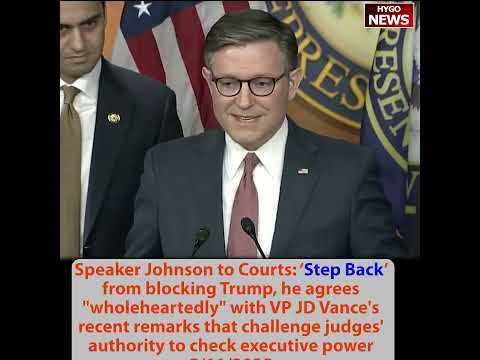
Speaker Johnson to Courts: “Step Back” from Blocking Trump; Agrees “Wholeheartedly” with VP Vance
On February 11, 2025, House Speaker Mike Johnson, a former constitutional lawyer, delivered a forceful defense of the Trump administration’s DOGE-led audits of federal agencies and called on federal courts to “take a step back” from blocking the president’s efforts to root out waste, fraud, and abuse. Johnson said he agreed “wholeheartedly” with Vice President JD Vance’s recent remarks challenging the authority of federal judges to halt executive actions, and revealed that he had met with Elon Musk the previous day and found the DOGE findings “very exciting."
"I Agree Wholeheartedly with Vice President JD Vance”
The remarks came during a press conference at the Capitol, where reporters pressed Johnson on the growing confrontation between the executive branch and federal courts. Multiple judges had issued injunctions blocking various Trump administration actions, including U.S. District Judge Paul A. Engelmayer’s order preventing DOGE from accessing the Treasury Department’s central payment system.
When asked whether the administration should comply with court orders, Johnson affirmed the constitutional order while expressing support for the executive branch’s position. “Of course, the branches have to respect our constitutional order, but there’s a lot of game yet to be played,” Johnson said. “Those will be appealed, we’ve got to go through the whole process, and we’ll get to the final analysis.”
He then aligned himself directly with Vance, who had recently stated that “judges aren’t allowed to control the executive’s legitimate power.” Johnson said: “In the interim, I will say I agree wholeheartedly with Vice President JD Vance, my friend, because he’s right.”
The Speaker’s endorsement of Vance’s position was significant because Johnson was not a political provocateur but a former constitutional litigator. His backing lent legal credibility to the argument that federal judges were overstepping their authority by issuing sweeping injunctions against executive branch operations. The fact that the third-ranking official in the U.S. government was publicly telling courts to stand down sent a clear signal about the Republican establishment’s posture on judicial intervention.
The DOGE Audit and Congressional Frustration
Johnson devoted much of his remarks to defending DOGE’s work and explaining why he viewed Elon Musk’s government efficiency efforts as doing what Congress had been unable to accomplish on its own.
“I met with Elon yesterday about this to get an update, and to me, it’s very exciting what they’re able to do,” Johnson said. “Because what Elon and the DOGE effort is doing right now is what Congress has been unable to do in recent years, because the agencies have hidden some of this from us.”
The Speaker described a pattern of federal agencies stonewalling congressional oversight requests. “When duly elected representatives of the people request information to find all of these abuses, and it’s not turned over to us, what it takes is an actual audit of the systems and the files themselves that are often hidden from Congress,” Johnson explained. “That’s what you’re seeing right now, and that’s why this is so exciting.”
Johnson argued that the discoveries being made by DOGE were confirming what members of Congress had long suspected. “They’re uncovering things that we have known intuitively have been there, but we couldn’t prove it,” he said. “Now the proof is being provided, and no one can argue the counter to that.”
The admission that federal agencies had successfully hidden information from Congress — the branch of government constitutionally empowered to conduct oversight — underscored the scale of the accountability problem that DOGE was attempting to address. If elected representatives could not obtain basic information about how taxpayer money was being spent, the argument for an independent audit function became considerably stronger.
Congressional Spending Discretion and the Executive Branch
Johnson also addressed the legal foundation for the Trump administration’s actions, drawing on his background as a constitutional attorney. He argued that Congress itself had granted the executive branch broad authority over how appropriated funds were used.
“When Congress, for example, appropriates dollars for the executive branch to use, we build in, not only in the spirit of the law, but in the letter of law, a broad amount of discretion for how that is used,” Johnson said. “There is a presupposition in America that the Commander-in-Chief is going to be a good steward of taxpayer dollars.”
He then provided examples of the kind of spending that the executive branch was now identifying as problematic. “The Commander-in-Chief, the President of the United States, is going to command those within his branch of government to do the right thing by the people, to be accountable, to not fund drag shows in Middle Eastern countries or South America, to not waste our taxpayer dollars,” Johnson said.
The Speaker’s argument reframed the DOGE effort not as executive overreach but as a president exercising the discretion that Congress had deliberately built into appropriations law. Under this interpretation, identifying and halting wasteful expenditures was precisely the kind of stewardship that the legal framework contemplated.
Courts Should “Take a Step Back”
Johnson concluded with a direct appeal to the judiciary, urging restraint in a manner that was notable for its forcefulness from a lawmaker who had built his career on constitutional principles.
“I think the courts should take a step back and allow these processes to play out,” Johnson said. “What we’re doing is good and right for the American people. What DOGE is doing is making sure that your taxpayer dollars, all of us, are spent in the way that they’re intended to be spent, and that they’re in America’s interest and they’re financially responsible with the precious taxpayers’ money.”
Johnson connected the efficiency effort to the nation’s fiscal crisis. “We have a $36 trillion federal debt, and we have got to get hold of these things,” he said. “You’re going to see it reflected in the reconciliation packages that come forward. You’re going to see it reflected in appropriations as we go forward, and you’re going to see it in these efforts to cut the waste, fraud, and abuse.”
The Speaker projected confidence about the magnitude of the eventual findings. “We think the final number on that is going to be substantial and a game changer in Washington for the country,” he said. “So we’ll have a lot more questions and answers as the week goes through.”
The Broader Constitutional Confrontation
Johnson’s remarks placed the Speaker of the House firmly on the side of the executive branch in what was developing into a significant constitutional confrontation between the elected branches of government and the federal judiciary. The pattern of district court judges issuing nationwide injunctions against executive actions had accelerated since Trump took office, and the administration’s willingness to challenge those orders — backed now by the Speaker of the House — signaled that the confrontation was likely to intensify rather than diminish.
The alignment of the House, the Senate (through Vice President Vance’s remarks), and the White House on the question of judicial overreach created a unified front from the elected branches against what they characterized as unelected judges substituting their policy preferences for those of the voters. Whether the courts would heed Johnson’s call to “step back” remained to be seen, but the political pressure was now coming from every direction.
Key Takeaways
- Speaker Mike Johnson said he agreed “wholeheartedly” with VP JD Vance that judges should not block the executive branch’s legitimate exercise of power, telling courts to “take a step back.”
- Johnson revealed he had met with Elon Musk the previous day and called DOGE’s findings “very exciting,” saying DOGE was accomplishing what Congress had been unable to do because agencies had “hidden” information from lawmakers.
- The Speaker argued that Congress builds “a broad amount of discretion” into appropriations law for the executive branch, providing the legal basis for the administration’s spending reviews.
- Johnson connected the DOGE effort to the $36 trillion national debt, predicting the final savings number would be “substantial and a game changer in Washington.”
- U.S. District Judge Paul A. Engelmayer had placed an injunction blocking DOGE from accessing the Treasury Department’s central payment system, one of several judicial orders the administration was challenging.