 HYGO News
 SA Delegation Refuses to Look at TV During 'Kill the Boer' Video -- 'Tells You Everything'; McMahon to Rep. Bonnie Watson Coleman: 'I Will Not Respond to Any Question Based on Theory This Administration Doesn't Care About the Law'; DeSantis Signs Anti-SWATTING Bill
SA Delegation Refuses to Look at TV During “Kill the Boer” Video — “Tells You Everything”; McMahon to Rep. Bonnie Watson Coleman: “I Will Not Respond to Any Question Based on Theory This Administration Doesn’t Care About the Law”; DeSantis Signs Anti-SWATTING Bill
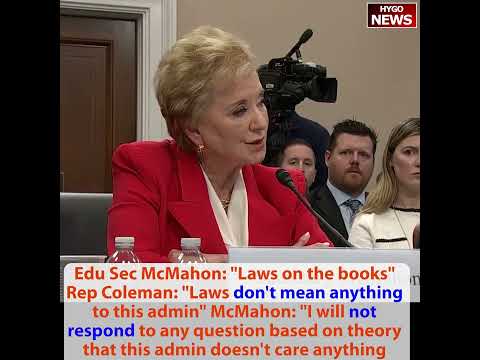
Three stories from May 2025 captured distinct political dynamics. During President Trump’s video confrontation with Ramaphosa, the South African delegation was documented refusing to look at the TV showing EFF’s Malema chanting “Kill the Boer, kill the farmer” — their aversion captured the substantive weight of the evidence. Education Secretary Linda McMahon rebuffed Rep. Bonnie Watson Coleman (D-NJ) in a House hearing: “I will not respond to any question based on the theory that this administration doesn’t care anything about the law and operates outside it. That is a mischaracterization.” Watson Coleman escalated: “Your rhetoric means nothing to me. What means something to me is the actions of this administration from the president conducting himself in a corrupt manner to his family enriching himself corruptly.” Meanwhile, Florida Governor Ron DeSantis signed legislation cracking down on SWATTING of conservative commentators, specifically referencing the case of Benny Johnson in Tampa: “These are not victimless crimes… If you SWAT, you are going to get hit with serious criminal offenses.”
The Delegation’s Aversion
The captured moment of the South African delegation refusing to look at the TV during the “Kill the Boer” video was itself substantive evidence.
During the Oval Office meeting, Trump had ordered the lights dimmed and played video showing EFF leader Julius Malema chanting the violent anti-white rhetoric. The camera showed multiple members of the South African delegation actively looking away from the screen, their body language communicating discomfort and avoidance.
The Hygo framing captured this: “Watch the South Africans refuse to look at the TV as video evidence of White persecution plays in the Oval Office. Tells you everything you need to know. Trump is right.”
The psychological significance of the aversion was important. If the videos had been:
- Misleading edits taken out of context
- Exaggerations of isolated incidents
- Fake or AI-generated content
- Old footage from pre-democracy South Africa
Then the South African delegation would have been comfortable looking at the footage and confidently explaining why it did not represent current reality. They would have been eager to correct the record by watching the videos and providing contextual rebuttal.
Instead, their visible discomfort — looking down, looking away, visibly tense — suggested that the videos were accurate representations of current South African political reality. The delegation members knew the footage was authentic, knew it represented a genuine political phenomenon, and knew they had no good explanation to offer.
This was a form of nonverbal testimony. Body language had communicated what verbal responses had denied: that the reality Trump was describing matched the reality the South African delegation knew existed.
The “Kill the Boer” Audio
The video segment that played during the meeting included the chant: “But who are starting with this white mess? Who are cutting the throat of white mess? It’s not enough. Shoot to kill, Gamazah. Kill the Boer, the farmer. Kill the Boer, the farmer. Brr-pa-pa-brr-pa. Shoot to kill, Gamazah.”
The “starting with this white mess” framing was significant. It described the racial targeting as a starting point — with the implication that further actions would follow. The “cutting the throat” imagery was gruesome, suggesting specific violent conduct rather than metaphorical political competition. The “shoot to kill” command was literal military language.
The combination of the rhetorical content with the large crowd response created a disturbing atmosphere. Thousands of people were chanting along with the “Kill the Boer” verses, treating the violent incitement as a political celebration rather than as morally objectionable content. When masses of people could chant “kill the farmer” without social sanction, the implicit social license for violence against farmers was substantial.
McMahon vs. Watson Coleman
The Education Department hearing produced a sharp exchange.
Education Secretary Linda McMahon was addressing a congresswoman: “Congresswoman, there are laws on the books in Title VI that totally…”
Rep. Bonnie Watson Coleman interrupted: “Laws don’t mean anything to this administration.”
McMahon refused to accept the framing: “I’m asking you how you… do you realize to eliminate your determination as to resources going to schools that are that are teaching public schools that we had to get the involvement of the federal government in this issue? And that’s a yes or no.”
Watson Coleman: “I do you believe it is a yes or no.”
McMahon delivered her response: “But I will not respond to any question based on the theory that this administration doesn’t care anything about the law and operates outside it. So that is a mischaracterization.”
The refusal to engage with false premises was a significant rhetorical move. Rather than getting drawn into defending the administration against the claim that it “doesn’t care about the law,” McMahon was rejecting the premise of the question itself. This prevented the congresswoman from structuring questions that embedded political attacks in their framing.
The specific policy context was about Title VI enforcement — the federal civil rights law prohibiting racial discrimination in federally funded programs. The Trump administration had been aggressively using Title VI to pressure schools that appeared to be engaged in racial discrimination against white, Asian, or Jewish students under various DEI or affirmative action programs. Democrats had framed this enforcement as “not caring about the law.” McMahon was rejecting that framing.
Watson Coleman’s Escalation
Watson Coleman responded to McMahon’s refusal with broader accusations.
“I’ll be playing my time for five seconds because you can say anything you want,” Watson Coleman said. “Your rhetoric means nothing to me.”
She made the sweeping indictment: “What means something to me is the actions of this administration from the from the president of the United States conducting himself in a corrupt manner to his family, enriching him and himself corruptly to determine that this administration can tell you what’s right, what’s wrong, what’s lawful, what’s not, that it can arrest judges, it can arrest lawyers, it can use its power to bully people.”
She closed with the personal attack: “And I’m telling you the Department of Education is one of the most important departments in this country and you should feel shameful to be engaged with an administration that doesn’t give a damn.”
The escalation was remarkable. McMahon had refused to engage with one false premise; Watson Coleman responded with a cascade of more serious accusations, several of which were factually disputed or inaccurate:
“Conducting himself in a corrupt manner”: The specific nature of the “corruption” was not specified. Trump had been the subject of various legal proceedings, but most had concluded without meaningful judgments of corruption.
“Family enriching himself corruptly”: Trump family members had various business activities, but the “corrupt” characterization required specific evidence not provided.
“Arrest judges”: The Trump administration had indeed had a Wisconsin judge arrested for allegedly obstructing immigration enforcement, though the constitutional propriety of the arrest was contested.
“Arrest lawyers”: Specific lawyers had faced legal consequences for various actions, but mass “arrest of lawyers” was not an administration practice.
“Use its power to bully people”: A characteristically vague accusation that could describe any use of executive power.
Watson Coleman’s approach illustrated a broader Democratic pattern: when substantive policy questions became difficult, expanding the scope to general accusations of corruption and lawlessness. This rhetorical approach offered political satisfaction but made productive policy discussion impossible.
”Shameful to Be Engaged”
The personal attack was notable. Watson Coleman was telling Linda McMahon — who had left private business success to serve as Education Secretary — that she should be “shameful” for accepting the cabinet appointment.
This kind of personal attack on cabinet officials represented a style shift in congressional hearings. Traditionally, members of Congress engaged with cabinet officials on policy substance, reserving personal attacks for extraordinary cases. By 2025, personal attacks on cabinet officials had become routine in Democratic congressional behavior. McMahon, Kennedy, Rubio, and others had all been targets.
The strategic calculation was that personal attacks generated viral moments and fundraising for the attacking member, even when they made actual policy work impossible. Watson Coleman’s attack on McMahon would play well on progressive media and might generate fundraising emails. Whether it advanced any policy purpose was a different question.
DeSantis’s Anti-SWATTING Legislation
Florida Governor Ron DeSantis signed legislation cracking down on SWATTING of conservative commentators.
“Now we led the effort in Florida in 2021 to combat swatting,” DeSantis said. “I signed a bill that established felonies for swatting offenses that lead to damage, injury or death. And we also required restitution to be paid by swatting perpetrators.”
He acknowledged incomplete results: “And while that has been helpful, it has not been fully sufficient. We continue to see these swatting activities happen across the country and even in the state of Florida.”
He described the specific targeting of conservatives: “Recently they have targeted people that are influential in conservative media. We had a fella in Tampa named Benny Johnson that was the target of a swatting incident.”
He described the incident: “Someone called the police and made a fake report and law enforcement did a basically a raid on his home as a result of that.”
He explained the harm: “These are not victimless crimes. One, people can get hurt by doing it, but even if nobody’s hurt, it’s taking resources and time and manpower away from actually doing the job that we want our law enforcement and first responders to do.”
The Anti-SWATTING Bill
DeSantis described the new bill’s provisions.
“The bill I’m signing today will increase penalties for people that are making these bogus police reports,” DeSantis said.
He stated the enforcement commitment: “If you swat, you are going to get hit with serious criminal offenses.”
He described the specific enhancements: “This has across enhanced penalties across the board. It also has enhanced penalties for repeat offenders. It lowers the threshold where what would be considered a habitual felony offender making it a felony after two or more convictions.”
SWATTING had emerged as a serious form of political violence. The practice involved making false emergency reports to trigger police responses — often armed SWAT teams — to the homes of targeted individuals. SWATTING had:
- Injured victims when police raids caused falls, heart attacks, or other trauma
- Killed at least one innocent person (the 2017 Andrew Finch case in Kansas)
- Terrorized entire families, including children
- Wasted enormous law enforcement resources
- Damaged targeted individuals’ relationships with neighbors and local authorities
The Benny Johnson case DeSantis referenced had involved conservative podcaster and commentator Benny Johnson, whose Tampa-area home had been raided by armed police responding to a fake emergency report. Johnson had been a prominent conservative voice; his SWATTING had been part of a broader pattern targeting right-wing commentators.
Other SWATTING victims in recent years had included:
- Rep. Marjorie Taylor Greene (multiple times)
- Judge Chutkan (presiding over Trump January 6 case)
- Various conservative media figures
- Several Supreme Court justices
- Trump-supporting election officials
The partisan pattern was notable. While SWATTING had originated as a gaming community harassment tactic, by 2023-2025 it had become a systematic tool of political intimidation, with targets disproportionately being conservative figures.
DeSantis’s legislation created multi-year felony penalties for SWATTING, mandatory restitution to victims, and enhanced penalties for repeat offenders. The legal framework represented one of the strongest state-level responses to the phenomenon.
Key Takeaways
- South African delegation documented refusing to look at TV during “Kill the Boer” video — body language confirmed the reality.
- McMahon to Rep. Watson Coleman: “I will not respond to any question based on the theory this administration doesn’t care about the law.”
- Watson Coleman escalated to sweeping corruption charges against Trump, family, and the administration.
- DeSantis signs Florida anti-SWATTING bill: Enhanced felony penalties for fake police reports targeting political opponents.
- Benny Johnson in Tampa specifically named as SWATTING victim; conservatives disproportionately targeted.