 HYGO News
 NVIDIA CEO Jensen Huang: '$500 Billion to Build AI Chips Entirely in USA'; 'Without Trump's Strong Encouragement, This Wouldn't Have Happened'
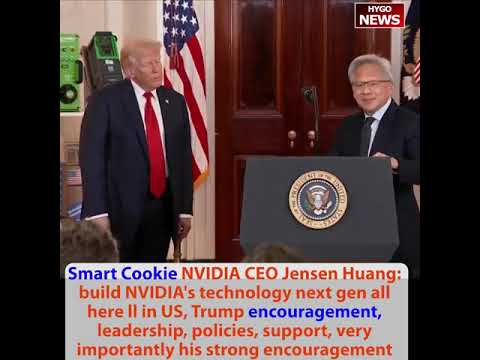
NVIDIA CEO Jensen Huang: “$500 Billion to Build AI Chips Entirely in USA”; “Without Trump’s Strong Encouragement, This Wouldn’t Have Happened”
NVIDIA CEO Jensen Huang announced a $500 billion commitment to manufacture the next generation of AI chips entirely in the United States at a White House event in April 2025. “We’re going to build NVIDIA’s technology, the next generation of that, all here in the United States,” Huang said. “Without the President’s leadership, his policies, his support, and very importantly his strong encouragement — and I mean his strong encouragement — manufacturing in the United States wouldn’t have accelerated to this pace.” Trump introduced Huang as “one of the most brilliant men you’ll ever meet” and “a smart cookie,” noting the $500 billion investment over four years “to manufacture the most powerful AI chips entirely in the USA for the first time ever."
"A Smart Cookie”
Trump introduced Huang with evident admiration.
“One of the most brilliant men that you’ll ever meet,” Trump said. “The man that’s done in a short period of time something that is incredible. He’s the founder, CEO, and president of NVIDIA, Jensen Huang.”
He described the commitment: “He’s producing up to $500 billion over the next four years to manufacture the most powerful AI chips entirely in the USA for the first time ever.”
He invited Huang to the podium: “Jensen, would you come up and say a few words? This is a smart cookie.”
The “smart cookie” designation from Trump was the kind of casual, personal endorsement that carried weight in the business community. NVIDIA was the most valuable company in the world by market capitalization, and Huang had built it from a graphics chip startup into the company that powered the AI revolution. Trump’s recognition placed NVIDIA’s domestic manufacturing commitment in a personal relationship context — the CEO was not just making a business decision; he was responding to presidential encouragement.
”Reinvented Computing”
Huang delivered a brief history of computing to contextualize NVIDIA’s significance.
“NVIDIA reinvented computing for the first time after 60 years,” Huang said. “The computer has largely been the same since the ’60s. All of the words we used to describe computers today were really invented in 1964.”
He described the physical scale of modern AI processors: “This is what a processor looks like. It’s 70 pounds, 60,000 parts, 10,000 watts.”
He described the supply chain: “In order to manufacture it, it requires probably a couple of hundred companies in the supply chain. It is so heavy that it requires robotics. It’s so precise. And just to test a supercomputer requires a supercomputer.”
The specification of the GPU — 70 pounds, 60,000 parts, 10,000 watts — made the manufacturing challenge tangible. These were not consumer electronics that could be assembled in a low-wage factory. They were precision-engineered systems that required advanced robotics, sophisticated testing, and hundreds of specialized suppliers. Manufacturing them in the United States was not a concession to political pressure; it was a recognition that the most advanced manufacturing belonged in the most technologically advanced country.
”Strong Encouragement”
Huang credited Trump with accelerating the reshoring of AI manufacturing.
“We’re going to build NVIDIA’s technology, the next generation of that, all here in the United States,” Huang confirmed.
He attributed the decision: “Without the President’s leadership, his policies, his support, and very importantly his strong encouragement — and I mean his strong encouragement — manufacturing in the United States wouldn’t have accelerated to this pace.”
He reframed manufacturing: “Manufacturing isn’t about low-cost labor anymore. Manufacturing is about technology. Most of the factories that build these systems today are the most advanced factories in the world.”
He described the future: “We’re going to use artificial intelligence and robotics and digital twin technology to make it possible for us to create the factories that we want to build. And we ought to build it right here.”
The “strong encouragement — and I mean his strong encouragement” repetition was Huang’s diplomatic way of saying that Trump had personally pressured him to commit to domestic manufacturing. The tariff regime, the regulatory environment, and the direct presidential engagement had combined to make the decision both economically rational and politically necessary.
Huang’s observation that “manufacturing isn’t about low-cost labor anymore” was the most important reframing in the speech. For decades, the argument against domestic manufacturing had been that American labor costs made it uncompetitive. Huang was saying that for advanced technology manufacturing, labor cost was irrelevant — the competitive advantages were technological sophistication, supply chain proximity, energy availability, and intellectual capital. On all of these dimensions, the United States was the obvious location.
”A Whole New Industry”
Huang described AI infrastructure as a manufacturing revolution.
“The real amazing thing is that this computer is the engine of a whole new industry,” he said. “And this new industry is called artificial intelligence. And this new industry is a manufacturing industry in itself.”
He drew the historical analogy: “Just as several hundred years ago, the dynamo was invented, water would come in and electricity would come out. Now electricity goes into this machine and incredible tokens come out — artificial intelligence.”
He connected to energy policy: “In order for this industry to thrive, we need a progressive, growth-oriented energy policy, which this President has really put his weight behind.”
He stated the stakes: “Without energy, we can’t possibly have new growth industries. And we now have the backing of the administration, the backing of President Trump to support the creation of a whole new industry.”
He described the downstream impact: “This industry is going to enable a whole bunch of other industries. AI infrastructure is going to revolutionize every industry we know — healthcare, drug discovery, life sciences, financial services, education.”
He concluded: “That’s going to be possible because we have the fundamental infrastructure here in the United States.”
The dynamo analogy was brilliant. Just as the invention of the electrical generator had created an entirely new economy — electrifying factories, homes, and cities — the AI processor was creating an entirely new economy of machine intelligence. And just as the countries that led in electrification became the dominant economies of the 20th century, the countries that led in AI infrastructure would dominate the 21st.
Trump’s energy policy was the critical enabler that Huang identified. AI data centers consumed enormous amounts of electricity. Without abundant, affordable energy, AI infrastructure was prohibitively expensive to operate. Trump’s expansion of domestic energy production — oil, gas, nuclear, and renewables — provided the power that made America the natural home for AI manufacturing and deployment.
The $500 Billion in Context
NVIDIA’s $500 billion commitment over four years was the largest single corporate investment announcement in American history. It represented more than the entire GDP of many nations and would create a manufacturing ecosystem that would sustain hundreds of thousands of jobs across the supply chain.
The investment was exclusively in domestic manufacturing — building the chips, testing the systems, and assembling the AI infrastructure that would power the global AI economy. For the first time, the most advanced semiconductors in the world would be manufactured on American soil, by American workers, using American energy.
Key Takeaways
- NVIDIA CEO Huang announced $500 billion over four years to build AI chips “entirely in the USA for the first time ever.”
- Huang credited Trump directly: “Without his strong encouragement — and I mean his strong encouragement — manufacturing wouldn’t have accelerated to this pace.”
- NVIDIA’s GPU: 70 pounds, 60,000 parts, 10,000 watts, requiring hundreds of supply chain companies and robotics to manufacture.
- Huang: “Manufacturing isn’t about low-cost labor anymore. It’s about technology. We ought to build it right here.”
- Energy policy credited as critical enabler: “Without energy, we can’t have new growth industries. This President has put his weight behind it.”