 HYGO News
 KJP: NDAA Repeals Military Vaccine Mandate — Would Biden Welcome Back Discharged Service Members?
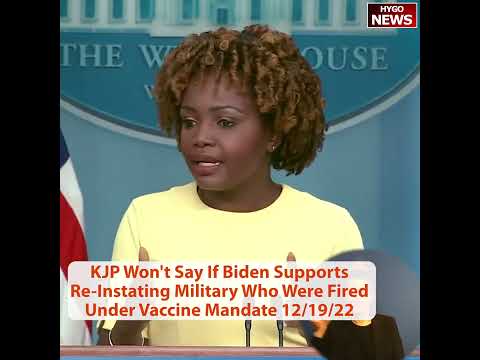
Reporter to KJP: Would Biden Welcome Back Military Members Discharged Over Vaccine Mandate? KJP: “That’s Something Department of Defense Has to Decide”
On 12/22/2022, a reporter asked White House Press Secretary Karine Jean-Pierre about the implications of the NDAA’s repeal of the military COVID-19 vaccine mandate — specifically whether Biden would welcome back service members who had been discharged or refused vaccination. “Clearly the President was opposed to rolling back the vaccine mandate, but we saw that Republicans in Congress decided that they rather fight against the health and well-being. So to be very clear, would the President welcome those who left the service or refused to get vaccinated if they now say, I want to serve the United States military?” the reporter asked. KJP deflected to the Pentagon: “That is something that the Department of Defense has to decide on. Specific service members, what I can tell you. Look, that again, they have a process on how that runs.” She also reiterated Biden’s opposition to the repeal while acknowledging he would sign the NDAA.
The NDAA Vaccine Mandate Repeal
The December 2022 NDAA included repeal of the military COVID-19 vaccine mandate:
August 2021 — Mandate imposed by Secretary Austin.
Enforcement period — Through 2022.
Discharges — About 8,000 service members.
Republican priority — Incoming House majority focus.
McCarthy engagement — Direct Biden conversation.
Final NDAA — Included repeal provision.
Biden signing — Despite opposition.
The repeal was one of the most tangible early victories for incoming House Republicans. Even before formally taking power, they had affected major defense legislation.
The Discharged Service Members
By December 2022, approximately 8,000 service members had been discharged for refusing vaccination:
Various branches — Army, Navy, Marines, Air Force.
Different categories — Active duty, reserves, National Guard.
Mixed circumstances — Some sought religious exemptions.
Various discharge types — Honorable, general, other.
Career impacts — On future employment.
Personal consequences — Financial and emotional.
These service members represented trained military personnel. Their loss:
Reduced force capacity — Experienced personnel gone.
Training investment — Lost by the military.
Readiness implications — Certain specialties affected.
Political costs — Seen by some as administration failure.
Humanitarian concerns — About individual service members.
The “Welcome Back” Question
The reporter asked about reinstatement. “Would the President welcome those who left the service or refused to get vaccinated if they now say, I want to serve the United States military?” the reporter asked.
The question was substantive:
Policy question — About reintegration.
Personal framing — For individual service members.
Administrative authority — Presidential versus DOD.
Political sensitivity — Mixed base reactions.
Practical implications — For military readiness.
If discharged service members could return, it would:
Restore some lost capacity — To military.
Signal acceptance — Of personal choices.
Address humanitarian concerns — For individuals.
Create administrative challenges — For processes.
Provide policy clarity — On reintegration.
The DOD Deflection
KJP’s response was deferential to Pentagon. “So look, that is something that the Department of Defense has to decide on. Specific service members, what I can tell you. Look, that again, they have a process on how that runs,” KJP said.
The DOD deflection was:
Procedurally appropriate — DOD handles service member decisions.
Administratively correct — Pentagon has authority.
Political cover — For administration.
Substantive avoidance — Of reinstatement position.
Flexibility preservation — For future decisions.
But the deflection also avoided:
Policy leadership — Presidential direction.
Humanitarian framing — For affected individuals.
Republican victory acknowledgment — Avoiding that framing.
Reintegration process — Detailed discussion.
Administrative commitment — To welcome policy.
”Republicans Decided to Fight Against Health”
The reporter’s question contained critical framing of Republicans. “Republicans in Congress decided that they rather fight against the health and well-being,” the reporter said.
This framing:
Characterized Republican action — As against health.
Implied poor values — Fighting health and well-being.
Not neutral reporting — Editorial characterization.
Reflected administration view — Of the repeal.
Opened question — For administration response.
Whether the reporter was endorsing this framing or simply summarizing the administration’s view wasn’t entirely clear. The framing was sharper than typical neutral journalism but was presented as background for the substantive question.
Biden’s NDAA Signing
KJP confirmed Biden would sign the NDAA. “The President, I said I’d mentioned, he’s going to sign the NDA,” KJP said.
The NDAA signing decision:
Must-pass defense legislation — Couldn’t be easily vetoed.
Contained vaccine repeal — As Republican provision.
Also contained many priorities — Both parties wanted.
Veto would damage military — Creating political cost.
Signing with objection — Preserved flexibility.
Presidential override — Not practical politically.
Biden’s decision to sign despite opposing the vaccine repeal reflected:
Political realism — About NDAA necessity.
Damage limitation — From broader bill.
Flexibility preservation — For future actions.
Signal to base — Of continued opposition.
Executive power limits — On specific provisions.
”He Was Very Clear”
KJP emphasized Biden’s prior clarity. “He was very clear. I was very clear from here about how, you know, how he opposed the fact that congressional Republicans removed a vaccination mandate from…,” KJP said, with the transcript cutting off.
The “very clear” framing:
Prior opposition noted — For record.
Administration position preserved — Despite signing.
Political positioning maintained — With base.
Republican blame continued — As before.
Flexibility remained — For future actions.
KJP was establishing that Biden’s signing didn’t represent endorsement of the repeal. This distinction mattered for political positioning:
With Democratic base — Showing continued opposition.
With military leaders — Respecting Austin’s position.
With media coverage — Establishing narrative.
With Republicans — Maintaining disagreement.
With future actions — Preserving options.
The Political Calculation
The administration’s political calculation on the NDAA vaccine repeal:
Opposition preserved — For base messaging.
Signing required — For defense funding.
Republican blame — For the change.
Military readiness — Affected outcomes.
Individual service members — Affected by implementation.
The administration couldn’t have the NDAA without accepting some Republican provisions. The vaccine repeal was accepted because:
Alternative was no NDAA — Unacceptable.
Repeal reflected political reality — Of election results.
Ongoing opposition — Could be maintained rhetorically.
Implementation details — Still to be determined.
Future actions possible — Despite current repeal.
The DOD Implementation
With the NDAA repeal, DOD faced implementation questions:
Ending ongoing enforcement — Stopping new discharges.
Handling in-progress cases — Various stages.
Former service members — Reintegration policies.
Record corrections — For discharged personnel.
Future vaccine policies — Other than COVID.
Readiness implications — Of policy change.
The Pentagon would need to develop specific implementation guidance. This would take time and could vary by specific circumstances. KJP’s deflection to DOD was technically correct but also avoided political responsibility for specific decisions.
The Eventual Policies
Following the NDAA signing, DOD announced policies:
January 10, 2023 — Formal mandate rescinded.
Service members could remain — Without vaccination.
Past discharges — Could request review.
Record adjustments — Possible for affected.
Reintegration — Possible but not automatic.
Religious exemption process — Continued.
The implementation generally allowed affected service members to:
Stay in service — If still enlisted.
Apply for reinstatement — Though with conditions.
Seek record corrections — In some cases.
Continue careers — With some limitations.
Access benefits — Based on discharge type.
These policies addressed some of the reporter’s question but with Pentagon details rather than presidential policy statements.
The Service Member Perspective
For affected service members, the NDAA repeal had mixed implications:
Policy vindication — For their stance.
Administrative complications — For individual cases.
Financial consequences — Still affecting many.
Career damage — Potentially lasting.
Personal trauma — From discharge process.
Limited remedies — Available.
The repeal didn’t automatically restore service members to their prior positions. It created the possibility of reinstatement but required individual action and administrative processing. Many service members would need to decide whether to pursue return.
The Broader Vaccination Debate
The NDAA vaccine repeal was one element of broader vaccination policy shifts:
Declining COVID acute phase — Reducing mandate justification.
Political polarization — Around vaccination.
Constitutional concerns — About mandates.
Individual choice — Increasingly prioritized.
Religious accommodation — Disputed.
Public health vs. liberty — Ongoing tension.
The specific NDAA action reflected broader trends in vaccination policy. Similar debates affected:
Federal contractor mandates — Various legal challenges.
Healthcare worker mandates — In specific settings.
School requirements — Ongoing.
International travel — Various policies.
Private employer mandates — Varied.
The 2024 Campaign Implications
The NDAA vaccine repeal had 2024 campaign implications:
Republican victory — Cited by incoming majority.
Democratic resistance — On record.
Individual stories — Of discharged service members.
Political framing — Available to both parties.
Base messaging — For different audiences.
Policy consequences — Continuing to unfold.
Each side would use the repeal for political purposes. Republicans would cite it as accomplishment. Democrats would cite administration opposition as principled. Specific discharged service members would be highlighted by both sides for different purposes.
Key Takeaways
- A reporter asked KJP whether Biden would welcome back military service members who had been discharged or refused vaccination, now that the NDAA repealed the military COVID-19 vaccine mandate.
- KJP deflected to the Pentagon: “That is something that the Department of Defense has to decide on.”
- She reiterated Biden’s opposition to the repeal: “He was very clear.”
- KJP confirmed Biden would sign the NDAA despite opposing the vaccine provision.
- The NDAA repeal represented an early Republican victory from the incoming House majority, reached through negotiation with Speaker-to-be Kevin McCarthy.
- Approximately 8,000 service members had been discharged under the mandate, creating significant readiness and humanitarian implications.
- DOD implementation followed in January 2023, ending active enforcement but not automatically reinstating all discharged personnel.
Transcript Highlights
The following is transcribed from the video audio (unverified — AI-generated from audio).
- This NDAA obviously includes the determination of the military vaccination program.
- Clearly the President was opposed to rolling back the vaccine mandate.
- Republicans in Congress decided that they rather fight against the health and well-being.
- Would the President welcome those who left the service or refused to get vaccinated if they now say, I want to serve the United States military?
- That is something that the Department of Defense has to decide on.
- He was very clear. I was very clear from here about how he opposed the fact that congressional Republicans removed a vaccination mandate.
Full transcript: 175 words transcribed via Whisper AI.