 HYGO News
 Sell emergency oil reserves painful? WH: We did propose OPEC cut wait after Midterm
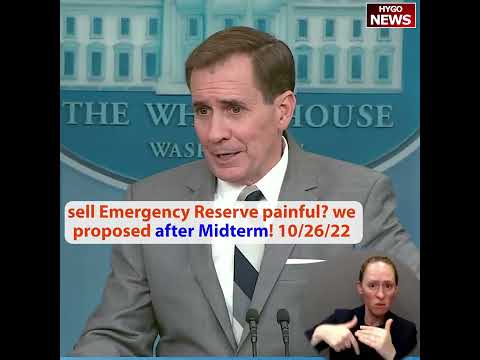
Saudis Warn Biden’s Emergency Oil Reserve Sales “May Become Painful”; Kirby Admits U.S. Asked OPEC to Delay Cut Until After Midterms
On 10/26/2022, Fox News reporter Jacqui Heinrich asked NSC Coordinator John Kirby about Saudi Arabia’s warning that Biden’s decision to sell emergency oil reserves “may become a painful one in the next few months.” When asked whether the Saudis planned further production cuts, Kirby made a stunning admission: “We did propose that they not make a decision right now and wait until the next scheduled meeting, which was very early next month.” The admission confirmed what critics had alleged — the Biden administration had asked OPEC+ to delay its production cut until after the November midterm elections, prioritizing political timing over energy policy. The Saudis had refused, cutting production in October and publicly warning that Biden’s SPR drawdown would backfire.
The Saudi Warning
Heinrich laid out the Saudi statement. “The Saudis took a veiled shot at the administration for selling the country’s emergency oil reserves and said that that decision may become a painful one in the next few months,” Heinrich said. “Is there any indication that they plan to further cut production?”
The Saudi warning was both a policy critique and a diplomatic taunt. Saudi officials had argued publicly that Biden’s massive SPR releases — 180 million barrels authorized, draining the reserve to its lowest level since the 1980s — were a short-term political gambit that would leave the United States vulnerable to future supply disruptions. By selling emergency reserves to suppress gas prices before an election, the Saudis argued, Biden was weakening America’s strategic position for temporary political gain.
The warning that the decision “may become a painful one” was not subtle. If oil prices spiked again — due to a geopolitical crisis, a natural disaster, or another OPEC+ production cut — the United States would have significantly fewer emergency reserves available to respond. The SPR, which held roughly 638 million barrels when Biden took office, had been drawn down to approximately 400 million barrels by October 2022. The cushion was shrinking at the precise moment the Saudis were signaling that more supply disruptions could be coming.
The Delay Admission
Kirby’s response to the question about future Saudi cuts produced the exchange’s most significant revelation. “I’d have to refer you to them, Jacqui. I don’t have insight into what their future decisions will or won’t be,” Kirby said.
Then came the admission: “We did propose that they not make a decision right now and wait until the next scheduled meeting, which was very early next month. So we’ll see what they end up doing at this next meeting.”
The statement confirmed that the Biden administration had explicitly asked OPEC+ to postpone its production cut — and that the timing of the requested delay was designed to push the cut past the November 8 midterm elections. The “next scheduled meeting” Kirby referenced was in early December, well after voters had cast their ballots.
The admission was remarkable because the White House had simultaneously insisted that its energy policy was “not politically motivated.” Biden himself had snapped “No, it’s not!” when asked days earlier whether SPR releases were a midterm ploy. Yet Kirby was now confirming that the administration had asked a foreign oil cartel to time its production decisions around the American electoral calendar.
The Political Timing Equation
The sequence of events told a clear story:
- Biden released emergency oil reserves to lower gas prices before the midterms
- OPEC+ announced a 2-million-barrel-per-day production cut that threatened to reverse the price decline
- The Biden administration asked OPEC+ to delay the cut until after the midterms
- OPEC+ refused and implemented the cut in October
- The administration then released additional SPR barrels to offset the OPEC+ cut’s impact before Election Day
Each step was calibrated around the November 8 election date. Release reserves to lower prices before the vote. Ask OPEC+ to delay cuts until after the vote. When OPEC+ refused, release more reserves to maintain lower prices through Election Day. The entire energy policy apparatus was functioning as a midterm campaign operation — exactly what Biden had denied.
The U.S.-Saudi Relationship Collapse
The exchange occurred against the backdrop of the worst U.S.-Saudi relationship in decades. Biden had campaigned on making Saudi Arabia a “pariah” state over the killing of journalist Jamal Khashoggi. He then reversed course and traveled to Jeddah in July 2022, producing the widely photographed fist bump with Crown Prince Mohammed bin Salman — a trip Biden took specifically to secure Saudi cooperation on oil production.
The OPEC+ cut in October represented MBS’s answer: a public rejection of Biden’s diplomatic overture and a production decision that undercut Biden’s pre-election strategy. The Wall Street Journal had reported that MBS privately mocked Biden’s gaffes and preferred Trump — adding personal insult to the policy rebuke.
Kirby’s admission that the U.S. had asked OPEC+ to delay its cut until after the midterms added another dimension to the diplomatic failure. The administration had not only failed to secure increased production during Biden’s July visit — it couldn’t even convince the Saudis to time their cuts in a way that didn’t damage Democratic electoral prospects. The Saudis had the leverage and used it.
”May Become Painful”
The Saudi warning about SPR releases becoming “painful” reflected a genuine strategic concern that extended beyond partisan politics. The Strategic Petroleum Reserve existed to provide a buffer against supply emergencies — wars, hurricanes, pipeline failures, and the kind of geopolitical disruptions that could suddenly remove millions of barrels from global markets.
By October 2022, that buffer had been significantly reduced. At roughly 400 million barrels, the SPR held approximately 20 days of total U.S. crude oil consumption — far below the 90-day import coverage the reserve was originally designed to provide. While the U.S. was less import-dependent than in the 1970s when the SPR was created, the diminished reserve meant less flexibility to respond to genuine emergencies.
The “painful” scenario the Saudis described was straightforward: if a crisis emerged — a conflict in the Persian Gulf, a major hurricane disrupting Gulf Coast refining, or a broader geopolitical confrontation — the United States would be responding with a significantly depleted emergency stockpile. Biden had traded long-term strategic security for short-term political benefit.
Kirby’s “We’ll See”
Kirby concluded with a notably passive posture. “So we’ll see what they end up doing at this next meeting,” Kirby said — a statement that conveyed the administration’s lack of leverage over OPEC+ decision-making.
The “we’ll see” was a far cry from the confident assertions of American energy leadership the administration had projected earlier in 2022. The United States — the world’s largest oil producer — was reduced to hoping that a foreign cartel would make production decisions favorable to American political interests. The dynamic illustrated how Biden’s anti-fossil-fuel policies had undermined the domestic production capacity that would have given the U.S. leverage in exactly these negotiations.
Key Takeaways
- Saudi Arabia warned Biden’s SPR drawdown “may become a painful one in the next few months” — a direct critique of using emergency reserves for political purposes.
- Kirby admitted the U.S. proposed that OPEC+ “wait until the next scheduled meeting” — effectively asking them to delay production cuts until after the midterms.
- The admission contradicted Biden’s insistence days earlier that SPR releases were “not politically motivated at all.”
- The SPR had been drawn down from 638 million to roughly 400 million barrels — reducing the emergency buffer that existed to protect against genuine supply crises.
- The exchange demonstrated the collapse of Biden’s Saudi diplomatic strategy, from the July fist bump to October’s public rebuke.
Transcript Highlights
The following is transcribed from the video audio (unverified — AI-generated from audio).
- The Saudis took a veiled shot at the administration for selling the country’s emergency oil reserves and said that decision may become a painful one in the next few months.
- Is there any indication that they plan to further cut production?
- I’d have to refer you to them. I don’t have insight into what their future decisions will or won’t be.
- We did propose that they not make a decision right now and wait until the next scheduled meeting, which was very early next month.
- So we’ll see what they end up doing at this next meeting.
- We proposed they wait until the next meeting.
Full transcript: 100 words transcribed via Whisper AI.