 HYGO News
 Sec Rubio after talks with Russian Foreign Minister: new & different approach; Ukraine weapons pause
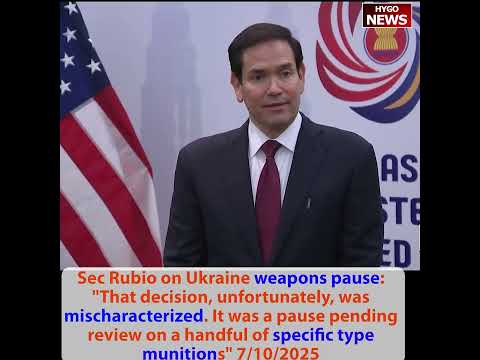
Sec Rubio after talks with Russian Foreign Minister: new & different approach; Ukraine weapons pause
Secretary of State Marco Rubio emerged from talks with the Russian foreign minister with what he described as “a new and different approach” from the Russian side — a concept he would take back to Trump for consideration. Rubio addressed the separate Ukraine weapons pause controversy, characterizing the recent Pentagon action as “mischaracterized” — it was “a pause pending review on a handful of specific type munitions” rather than a broad halt of weapons support. Rubio identified a broader strategic issue: European NATO members with Patriot missile batteries that are not currently needed elsewhere should provide them to Ukraine rather than hoarding capacity that would serve Ukrainian defensive needs.
”These Things Are Best Negotiated”
Rubio opened with measured diplomatic framing. “These things are best negotiated. I don’t want to imprive it and that’s how these things generally work.”
The “don’t want to imprive it” — likely a transcription of “don’t want to improvise it” — captures Rubio’s approach. Major diplomatic discussions require specific preparation, specific framings, and specific follow-up rather than improvised public statements. Rubio is not going to characterize the substance of the Russian position beyond what serves the specific negotiating purpose.
”Some Ideas Exchanged”
Rubio summarized the exchange. “There were some ideas exchanged today, some viewpoints that they expressed to us that I’ll take back to the president for his consideration and hopefully it will lead to something. I don’t want to over promise.”
“Some ideas exchanged” is diplomatically cautious. The meeting produced specific content that Rubio will communicate to Trump. Whether that content represents meaningful progress toward a Ukraine settlement is not yet clear. The diplomatic process requires Trump’s evaluation of whatever the Russian side specifically proposed.
“I don’t want to over promise” captures Rubio’s specific discipline. Diplomatic moments that seem promising sometimes produce follow-through. Sometimes they do not. Rubio is not going to commit publicly to outcomes that may not materialize.
”A Conflict That’s Been Going On Over Three Years”
Rubio provided the temporal framing. “I mean again, as I said, this is a conflict that’s been going on now for over three years.”
The Russia-Ukraine war began in February 2022 with the full Russian invasion, though the underlying conflict includes the 2014 annexation of Crimea. Over three years of active full-scale warfare has produced substantial casualties, economic damage, and strategic consequences. Any resolution requires addressing the accumulated complexity.
“We’ve seen an acceleration of attacks” captures the recent intensification. Russian strikes on Ukrainian cities have been increasing in scale and frequency. The specific reference to a “largest drone attack in a city close to the Polish border” captures the scale of recent escalation. “Pretty deep strike” means Russian operations are now reaching into Western Ukraine rather than being concentrated near the active front lines.
The Reconstruction Conference
Rubio noted a parallel event. “They’re going to be having a conference, maybe it starts today if I’m not mistaken, about reconstruction and the rebuilding of Ukraine.”
The reconstruction conference — presumably in Rome or a similar European capital — brings together donor countries, international organizations, and Ukrainian officials to plan post-war reconstruction. That planning occurs while the war continues, which captures the specific situation — reconstruction planning is necessary because damage accumulates daily.
”Every Time One Of These Strikes Is Launched, The Price Of Reconstruction Goes Up”
Rubio’s specific observation. “Every time one of these strikes is launched, the price of reconstruction goes up. There’s also the destruction of the country’s capabilities, the country’s economic capabilities that has to be added to this.”
The observation captures a specific dimension of the war that often gets less attention than casualty counts. Each Russian strike damages Ukrainian infrastructure, housing, and economic capacity. The cumulative damage affects how much reconstruction will cost when the war ends. Earlier ceasefire saves reconstruction costs.
“The country’s economic capabilities” are also being degraded. Ukrainian factories, agricultural infrastructure, energy systems, and commercial facilities all face specific damage from each attack. That damage reduces Ukraine’s post-war economic baseline and extends the time required for full recovery.
”The President Doesn’t Like Wars”
Rubio’s characterization of Trump’s posture. “But the president doesn’t like wars. He thinks wars are a waste of money and a waste of lives. And he wants them to end. And he’s going to do everything he can within his power to end this war and any other war he has a chance to end. As you’ve seen in the past.”
“A waste of money and a waste of lives” is Trump’s characteristic framing. Wars produce specific costs — military spending, infrastructure damage, casualties, refugee flows, economic disruption — that Trump views as avoidable if wiser diplomacy is employed.
The broader pattern — that Trump has ended or prevented specific wars (India-Pakistan, DRC-Rwanda, Serbia-Kosovo, the 12-Day War) — supports Rubio’s characterization. Trump’s approach to wars is consistent across regions and across specific conflicts.
”A New And Different Approach”
The reporter’s specific question. “These ideas that were put on the table today, would you characterize them as new ideas from the Russian side that the Trump administration had not heard before?”
Rubio: “Yes. Well, I think maybe, yes, I think it’s a new and a different approach. Again, I wouldn’t characterize it as something that guarantees a piece.”
“A new and different approach” is the specific characterization. The Russian side has moved from positions that the American side had heard before to positions that are distinct. Whether those new positions lead to actual settlement is the question — but the movement itself represents diplomatic progress.
“I wouldn’t characterize it as something that guarantees a peace” is the appropriate caveat. Movement does not equal agreement. Agreement requires specific terms both sides accept. The new Russian positions may or may not be acceptable to the American and Ukrainian sides.
Why The “New And Different” Framing Matters
The framing matters because it represents the first specific suggestion of Russian diplomatic flexibility in many months. For much of the past year, Russian positions had been characterized as fixed — maximal territorial demands, non-negotiable Ukrainian neutrality requirements, rejection of specific security guarantees. The “new and different approach” suggests that some of those fixed positions may be softening.
Whether the softening produces a deal that Ukraine can accept is the key question. Ukraine has its own non-negotiable positions — territorial integrity, security guarantees, membership pathways. A Russian position that addresses some American concerns while remaining unacceptable to Ukraine does not produce peace.
The administration’s approach is to identify the specific terms that might produce settlement, pursue them diplomatically, and apply specific pressure to whichever side (or both) needs to make specific additional concessions.
The Weapons Pause Controversy
The reporter shifted to a separate issue. “You and the president are unaware that the Pentagon had made a decision to at least temporarily call the arms tributes to Ukraine. What’s your take on that decision by the Pentagon? And what is your general take?”
The context is specific. The Pentagon had initiated a review of American weapons stockpiles that had produced a temporary pause on specific weapons shipments to Ukraine. The pause had been reported by press outlets as a broader halt of American weapons support.
”That Decision Was Mischaracterized”
Rubio’s response was specific. “That decision, unfortunately, was mischaracterized. It was a pause pending review on a handful of specific type munitions.”
The characterization correction is important. The Pentagon action was not a broad halt of weapons to Ukraine. It was specific to certain munitions categories. The review was pending — meaning the pause was temporary, not permanent.
“Unfortunately, was mischaracterized” captures Rubio’s frustration with the reporting. Press coverage had conveyed the pause as broader and more final than it actually was.
”That Is Logical”
Rubio defended the specific Pentagon action. “That, frankly, is something that is logical that you would do, especially after an extended engagement that we saw both in defense of Israel and in defense of our own bases. So it was a very limited review of certain types of munitions to ensure that we had sufficient stockpiles.”
The context is important. The Israel-Iran exchange consumed substantial American defensive munitions — Patriot missiles, interceptors, various defensive systems. The Pentagon’s review of stockpile levels is appropriate after that expenditure.
“To ensure that we had sufficient stockpiles” captures the specific purpose. American strategic planning requires maintaining specific stockpile levels for multiple potential scenarios — Middle East engagement, Indo-Pacific deterrence, various other contingencies. The review checks whether recent consumption has reduced stockpiles below required levels.
”You Can’t Pull It Back Once It’s Been Sent”
Rubio’s specific operational observation. “It’s typical when you do these reviews that there’s a short term pause because, in fact, the review comes back that you have a shortage. You can’t pull it back once it’s been sent.”
The observation captures a fundamental fact about weapons transfers. Once ammunition is sent to Ukraine, it cannot be retrieved. If the review discovers that American stockpiles are too low, sending additional munitions that should have been retained would be operationally damaging.
The short-term pause protects American interests while the review is conducted. If the review confirms adequate stockpiles, shipments resume immediately. If the review identifies shortages, specific categories are retained domestically while alternative ways to support Ukraine are identified.
”The Overwhelming Majority Has Never Been Paused”
Rubio’s specific scope clarification. “But generally speaking, aid to Ukraine continues along the schedule that Congress appropriated.”
The specific aid flowing to Ukraine — weapons, ammunition, financial support, training support — continues along the schedule Congress has established. The Pentagon pause affected a narrow category of munitions for review purposes, not the broader aid package.
Which Types Were Paused
The reporter pressed for specifics. “Which types of weapons were put?”
Rubio: “Largely defensive in nature. Some were offensive. But again, the ones that were expended in recent conflicts in the Middle East.”
The weapons that were paused for review are specifically those that were used in Middle East operations. Patriot missiles that intercepted Iranian ballistic missiles. Other defensive systems that participated in the Israeli defense. Those systems had their stockpiles depleted, so the review checks whether Ukrainian shipments from those categories should continue.
“Largely defensive in nature” is the specific characterization. The weapons in question are primarily for defense — intercepting incoming attacks, protecting specific sites, defending personnel. Offensive weapons were less affected by the review.
The Broader Defense Production Issue
Rubio then identified the underlying structural issue. “I think there’s a broader issue unrelated to the pause, and that involves the defense productive capabilities of the West. Not just us, but of Europe.”
The observation is strategically important. American defense production — ammunition, missiles, weapons systems — has been running at lower capacity than current strategic demands require. The Ukraine war, Middle East engagements, Indo-Pacific preparations, and specific contingency requirements all consume munitions. Production has not kept pace.
European defense production has been even more constrained. European defense industrial base has atrophied across decades of reduced defense spending. Producing the specific munitions needed for multiple simultaneous commitments is genuinely difficult with current European production capacity.
”More Patriot Batteries”
Rubio’s specific recommendation. “As an example, one of the things that the Ukrainians need is more patriot batteries. There are patriot batteries available in multiple countries in Europe, yet no one wants to part with them. So I hope that’ll change.”
The observation is pointed. Multiple European NATO countries operate Patriot missile batteries. Those batteries are not currently being used — they are staged for potential scenarios that have not materialized. The batteries could be transferred to Ukraine where they would provide immediate defensive capability.
But the European countries holding the batteries have been reluctant to transfer them. Each country considers its own specific requirements. Parting with Patriot batteries reduces that country’s own defensive capability. No country wants to reduce its own capability, even when another country urgently needs capability that could be provided.
”If Ukraine Is The Priority They Say”
Rubio’s specific challenge. “If in fact that Ukraine is the priority that so many countries in Europe say it is, they should be willing to share batteries that right now they don’t have a need to use.”
The framing calls out the specific inconsistency. European countries have, in rhetoric, characterized Ukraine as a top security priority. If that characterization is accurate, they should be willing to transfer specific equipment. If they are not willing to transfer the equipment, their rhetoric about Ukrainian priority may not match their actual priority ranking.
“Hopefully we’ll be able to convince some of our NATO partners to provide those patriot batteries to Ukraine, because there are a number of countries that have them, but no one wants to part with what they have. Perhaps that’ll change. That’s important.”
“Perhaps that’ll change” is the hope. American diplomatic pressure, combined with specific Ukrainian need, may produce European willingness to share capability they have been hoarding. Whether that actually happens depends on specific European political decisions.
Why The Patriot Question Matters
The Patriot question captures the broader strategic challenge. Ukraine needs air defense to protect its cities from Russian missile and drone strikes. American air defense capacity is constrained by multiple simultaneous commitments. European air defense capacity exists but is being held for potential scenarios that have not materialized.
The solution requires European countries to accept specific short-term reduction in their own air defense capability in order to support Ukrainian capability now. That short-term reduction is, in principle, acceptable if Ukraine is truly a priority. In practice, European countries have been unwilling to make that tradeoff.
American pressure — both direct diplomatic pressure and the implicit framing that emerges from Rubio’s public comments — creates specific European political pressure to reconsider. Whether that pressure produces specific equipment transfers will be visible in the coming weeks.
The Rome Reconstruction Conference
The rebuilding conference Rubio referenced is happening concurrently with the diplomatic negotiations. Donor countries pledge reconstruction funds. Ukraine presents specific reconstruction priorities. International financial institutions commit specific resources.
That parallel track — reconstruction planning while active warfare continues — reflects the practical reality. The war may continue for months or years. Reconstruction planning cannot wait for the war to end — the scale of reconstruction required means planning must begin immediately so implementation can start as soon as conditions allow.
The Strategic Picture
Rubio’s comments, taken together, capture the current strategic picture on Ukraine.
Diplomatic track — Some movement from the Russian side, with the American team evaluating whether the movement produces viable settlement terms. The “new and different approach” may or may not lead to actual agreement.
Military support track — American weapons support continues despite the specific Pentagon review pause. European partners are being pressed to contribute specific equipment they are currently hoarding.
Reconstruction track — Planning is underway for post-war reconstruction even while active warfare continues.
Each track produces its own specific outcomes. The coordination across tracks is what American diplomatic leadership is managing.
Key Takeaways
- Rubio on the Russian meeting: “It’s a new and a different approach. I wouldn’t characterize it as something that guarantees a peace, but it’s a concept that I’ll take back to the president.”
- On Trump’s posture: “The president doesn’t like wars. He thinks wars are a waste of money and a waste of lives. And he wants them to end.”
- On the weapons pause: “That decision, unfortunately, was mischaracterized. It was a pause pending review on a handful of specific type munitions.”
- The stockpile logic: “You can’t pull it back once it’s been sent…it’s prudent to look at it and say, okay, do we have enough of these in our stockpiles for all of our obligations around the world.”
- On European Patriot batteries: “There are patriot batteries available in multiple countries in Europe, yet no one wants to part with them…If in fact that Ukraine is the priority that so many countries in Europe say it is, they should be willing to share batteries that right now they don’t have a need to use.”