 HYGO News
 Sec Rollins USDA & RFK HHS on MAHA, 40% food industry remove all dyes 2026, ice cream 2027
Sec Rollins USDA & RFK HHS on MAHA, 40% food industry remove all dyes 2026, ice cream 2027
Agriculture Secretary Brooke Rollins and HHS Secretary Robert F. Kennedy Jr. delivered the Make America Healthy Again agenda’s biggest industry milestone to date. Standing on the USDA steps, Rollins described a “simpatico” daily working relationship between her department and Kennedy’s HHS — and laid out the starkest public-health statistic in the pitch: “three out of our four kids couldn’t pass the military readiness test today.” Kennedy announced that after six months of work, the dairy industry has committed to eliminating all artificial dyes by the end of 2026, pushing about 40% of the total food industry to that commitment. The International Dairy Foods Association signed a voluntary pledge to remove artificial colors from ice cream by the end of 2027. Partners announced include Tyson Foods, PepsiCo, JM Smucker, Nestle, Hershey, Conagra, Kraft Heinz, and General Mills. The U.S. Senate also confirmed the first judicial nominee of Trump’s second term.
”First Judicial Nominee” Confirmed
The Senate’s procedural language opened the segment. “Under the previous order of the motion to reconsider is considered made and laid upon the table and the president will be immediately notified of the senate’s action.”
That is the formulaic closing of a successful confirmation vote. The nominee in question is the first federal judge confirmed during Trump’s second term — the beginning of what the administration has signaled will be a substantial judicial pipeline. Judicial confirmations are the most durable of any administration’s accomplishments, because federal judges hold lifetime appointments. The first confirmation sets the pattern.
”Unprecedented Partnership”
Rollins then pivoted to the MAHA announcement, and she opened with a characterization of the USDA-HHS relationship that matters for policy execution. “And listen this partnership we talk about a lot is unprecedented never before in American history.”
“Never before in American history” is a claim. USDA and HHS have historically had parallel jurisdictions on food policy — USDA over the agricultural side, HHS over the health side, with the FDA (within HHS) holding formal authority over food labeling, additives, and safety determinations. Those two departments have coordinated during various eras. The question is whether the current coordination rises to the level of “unprecedented.”
“Do you have an HHS secretary who is just simpatico we talk almost daily working together to make America healthy again. Bobby Kennedy understands more than anyone that you can’t do that without American agriculture and the American farmer.”
“Simpatico” is a specific claim about personal-chemistry compatibility. Policy partnerships at the cabinet level depend heavily on whether the secretaries can pick up the phone and get a decision, rather than routing every interaction through staff. Rollins is saying she and Kennedy have that.
”Market Mover”: $400 Million a Day
Rollins laid out the fiscal scale of what USDA controls. “USDA spends four hundred million dollars every single day on our nutrition programs snap prison programs school lunches etc etc i mean this is a market mover in terms of what we’re feeding America.”
$400 million a day, or roughly $146 billion a year, flowing through SNAP, WIC, school lunch programs, prison food, and related nutrition spending. That is, as Rollins said, a market mover. The government is one of the largest food buyers in the country — and in many categories, the single largest single-source buyer.
“So being able to ensure that our farmers especially some of our smaller farmers have the market in which to sell their locally homegrown produce but also working with the big dairy producers the ice cream makers all of the above to get the healthiest best choices out into America.”
The argument here is that federal purchasing power can shape the American food supply. If the government commits to buying food without artificial dyes, preservatives, and additives, it pulls the supply chain in that direction. Small farmers, large processors, and everything in between have an economic reason to align with the federal purchasing preferences.
”3 Out of 4 Kids Couldn’t Pass the Military Readiness Test”
Rollins delivered the statistic that gives the MAHA agenda its most urgent pitch. “You know three out of our four kids couldn’t pass the military readiness test today something has to change and Secretary Kennedy is leading the way and we here at USDA are here to support him in every way we can.”
Three out of four American youth failing military entrance standards is a statistic the Pentagon has been raising for years. The failure categories include obesity, physical fitness deficiency, educational attainment, and drug/alcohol history. Obesity is the single largest disqualifying category.
For Rollins, the statistic anchors the MAHA argument in national security terms. Poor youth health is not only a healthcare cost issue — it is a military readiness issue. A country that cannot field its own military because its young people are too unfit to serve is a country that has a strategic problem.
”Nine Petroleum-Based Synthetic Dyes”
Kennedy then laid out the MAHA framework for artificial dyes. “When we came in six months ago we said we’re going to get rid of the nine petroleum based synthetic dyes that are in our food that cause ADHD that are associated with cancers and all kinds of grim inventory of other health injuries people laughed and they said we’d never be able to do it.”
The nine artificial food dyes — Red 3, Red 40, Yellow 5, Yellow 6, Blue 1, Blue 2, Green 3, Orange B, and related compounds — have been the subject of regulatory debate for decades. European regulators have banned or restricted several of them. American regulators have historically declined to follow suit, citing insufficient evidence of harm at typical consumption levels.
Kennedy’s framing — “cause ADHD … associated with cancers and all kinds of grim inventory of other health injuries” — is the most aggressive public-health framing from an HHS secretary on these additives in modern memory. The scientific consensus is more nuanced than the framing suggests, but some studies have indeed linked specific dyes to behavioral changes in children and to elevated cancer risk in animal studies.
The Dairy Commitment
“But what happened today which is the dairy industry has now made a commitment to get rid of all dyes with the by the end of 2026 and some of them are already taking action some of them already gotten rid of the dyes with his commitment we now have about 40 percent of the food industry that’s already made that commitment 35 percent of the food industry had already gotten rid of the dyes.”
The numbers: 35% of the food industry had already eliminated the nine dyes before the day’s announcement. The new dairy industry commitment moves the total to approximately 40%. The trajectory is toward a tipping point. Once half the industry is dye-free and the other half is the industry being compared unfavorably in advertising, the remaining holdouts will face commercial pressure to follow.
“We’re very proud of this public-private partnership I’m very grateful to for our partnership with brook and with our partnership with the industry we cannot make America healthy again without the cooperation of the American farmers and American industry and they are stepping up to the plate and we’re very grateful to them.”
The IDFA Ice Cream Commitment
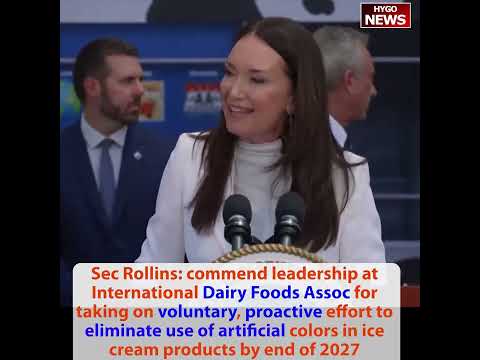
Rollins then praised the specific industry association behind the most visible commitment of the day. “I just want to commend the leadership Michael and the whole team and everyone you represent at IDFA and all the dairy farmers and ice cream producers they represent for taking on this voluntary proactive effort to eliminate the use of artificial colors and ice cream products by the end of 2027.”
“Michael” is likely Michael Dykes, the President and CEO of IDFA (the International Dairy Foods Association). The end-of-2027 deadline for artificial colors in ice cream gives the industry about 18 months of reformulation work — time to replace artificial colorings with natural alternatives (beet juice, turmeric, annatto, etc.) at the required scale.
“Because of this historic partnership between USDA and HHS and I will say it is an unprecedented partnership but also because of leadership of organizations like IDFA and and again all the farmers and producers they represent we are driving meaningful change to make America healthy again.”
The Partner Companies
Rollins named a long list of additional corporate partners. “I also want to acknowledge a lot of other partners the consumer brands association Tyson foods PepsiCo, JM Smucker, Nestle, Hershey, Conagra Brands, Kraft Heinz and General Mills each of which have recently made similar commitments to remove artificial colors from their products.”
That list reads like a who’s who of American packaged food. Tyson is the largest protein processor. PepsiCo and Nestle are among the largest global food companies. Hershey dominates chocolate. Conagra, Kraft Heinz, and General Mills control substantial portions of the center aisles of American grocery stores. Each of them committing to remove artificial colors is a structural shift in what the American food supply looks like.
“Just last week the consumer brands association announced a voluntary commitment to encourage the makers of America’s food and beverage products to remove certified food, drug and cosmetic colors from products served in our schools by the start of next year’s school year 2026.”
Schools as the first venue. The 2026 school year deadline for artificial-color-free school food is the closest-dated of the commitments — and arguably the highest-impact, because school meals reach tens of millions of American children whose parents do not have the time or money to scrutinize every food label.
The Voluntary Mechanism
One detail matters for understanding the MAHA approach. The commitments are described as “voluntary.” The administration is not issuing regulations banning artificial colors. It is orchestrating industry-led commitments that arrive at the same outcome without the regulatory rulemaking process.
The voluntary mechanism has advantages and disadvantages. Advantages: faster timeline (regulations take years), less legal exposure (voluntary commitments cannot be challenged in court the way regulations can), political durability (a future administration cannot simply rescind the commitments the way it can rescind regulations).
Disadvantages: enforceability. Voluntary commitments rely on corporate follow-through. If a company misses its 2026 or 2027 deadline, there is no direct legal penalty. The administration is betting that industry commitments, once made publicly, will be followed through on for reputational reasons.
A Bipartisan Opportunity
One quiet feature of the MAHA agenda is that it does not cleanly fit the standard partisan framework. Concerns about food additives, artificial dyes, and processed food’s role in childhood obesity have supporters across the political spectrum. The Kennedy family’s historic association with progressive politics, combined with RFK Jr.’s move to the Trump administration, creates a policy space that progressive parents and conservative parents can both support.
That bipartisan possibility is part of the administration’s theory of the case. MAHA is a cross-cutting issue. Getting artificial dyes out of school lunches is not a culture-war fight. It is a public-health effort that, executed through voluntary industry commitments with clear deadlines, can demonstrate competent cabinet coordination to a broad audience.
Key Takeaways
- The U.S. Senate confirmed the first judicial nominee of Trump’s second term — the beginning of a substantial judicial pipeline.
- USDA Secretary Brooke Rollins cited a stark MAHA statistic: “three out of our four kids couldn’t pass the military readiness test today something has to change.”
- HHS Secretary RFK Jr. announced the dairy industry has committed to eliminating all nine petroleum-based synthetic dyes by end of 2026, pushing 40% of the food industry to that commitment.
- The International Dairy Foods Association pledged voluntary elimination of artificial colors in ice cream products by end of 2027 — Tyson, PepsiCo, Nestle, Hershey, Conagra, Kraft Heinz, and General Mills made similar commitments.
- The Consumer Brands Association announced a commitment to remove “certified food, drug and cosmetic colors from products served in our schools by the start of next year’s school year 2026” — the closest-dated of the MAHA commitments.