 HYGO News
 Sec. Rollins: USDA Canceled 3,600+ Contracts -- '$1M BIPOC Culinary Program, $625K Russian Biodiversity'; Vance at Nucor Steel; Trump: Tax Cuts
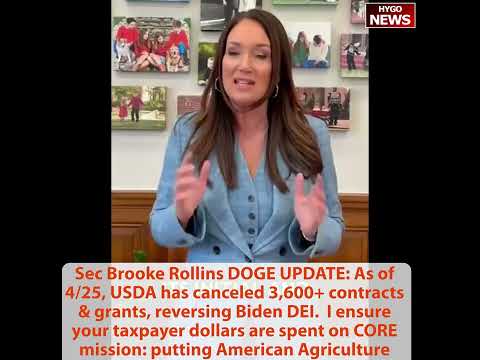
Sec. Rollins: USDA Canceled 3,600+ Contracts — “$1M BIPOC Culinary Program, $625K Russian Biodiversity”; Vance at Nucor Steel; Trump: Tax Cuts
Agriculture Secretary Brooke Rollins delivered a DOGE update in May 2025 revealing that USDA had canceled 3,092 contracts and 597 grants totaling “billions and billions of taxpayer dollars.” She listed examples: “$995,000 for a BIPOC culinary program, $625,000 for a Russian Far East Biodiversity Partnership, $100,000 for climate resilience in Ghana.” VP Vance visited Nucor Steel in South Carolina, praising the tariff-driven revival: “A West Virginia facility sat idle for years under Biden’s environmental regulations. I’m proud we’re 101 days into an administration that wants to build the future with you.” Trump previewed the tax bill: “The biggest tax cuts in history — 100% expensing, no tax on tips, no tax on overtime, no tax on Social Security.”
Rollins: 3,600+ Canceled
Rollins presented the USDA’s contribution to the DOGE mission.
“As of April 25, 2025, here at USDA, we have canceled 3,092 contracts,” Rollins announced. “We have canceled 597 grants. Both of those combined equal billions and billions of taxpayer dollars.”
She highlighted recent finds: “Some of this that we have canceled — DEI, climate-related — almost $90 million just in the month of April.”
She listed three examples that captured the absurdity.
“Number one: $995,000 — a million dollars — for a BIPOC culinary program,” Rollins said.
“Number two: a $625,000 contract for a Russian Far East Biodiversity Partnership.”
“Number three: $100,000 contract or grant that was canceled for climate resilience and sustainable agriculture in Ghana.”
She described the cultural cleansing: “We are continuing to fight the DEI, the transgender, the ideology that has really seeped into this department over the last four years under the prior administration.”
She stated the mission: “We are working to get all of it out as quickly as possible and to realign the USDA with its initial and most important goal — with our farmers and our ranchers in supporting the incredible work they do for this great country.”
The three examples Rollins chose were devastating in their specificity. The USDA — the United States Department of Agriculture, whose mission was to support American farmers and ensure food safety — had been spending nearly a million dollars on a “BIPOC culinary program,” over half a million on Russian biodiversity research, and $100,000 on Ghanaian agriculture. None of these expenditures had any connection to American agriculture, American farmers, or American food security.
The BIPOC culinary program exemplified how DEI ideology had infiltrated every corner of federal spending. A program ostensibly about cooking was funded not because of its agricultural merit but because of its racial classification — “Black, Indigenous, and People of Color” being a progressive categorization that determined funding eligibility based on race rather than need or relevance.
The Russian Far East Biodiversity Partnership was arguably the most absurd of the three. The USDA was funding environmental research in Russia — a country the United States was simultaneously sanctioning over its invasion of Ukraine. American taxpayer dollars were flowing to Russian biodiversity projects while American troops and intelligence assets were supporting Ukraine’s defense against Russian aggression.
Vance at Nucor Steel
VP Vance visited Nucor Steel’s facility in Berkeley, South Carolina, connecting the tariff strategy to real-world manufacturing outcomes.
“Even this company, Nucor Steel — you know what the leadership told me just a couple of short minutes ago?” Vance said. “There was a West Virginia facility, a beautiful high-tech Nucor manufacturing facility making great American steel and giving workers good jobs in the process.”
He described the obstruction: “That steel facility, that project sat idle for years under the Biden administration’s crushing environmental regulations and environmental rules.”
He drew the lesson: “When our leadership decides that Americans don’t want to make anything, you know what we do? We cost great businesses and great corporations like Nucor a lot of money. We cost great workers their wages and we cost a lot of people their jobs.”
He stated the contrast: “That was the policy of the administration that came before us, but I’m proud that we are now 101 days into an administration that wants to invest in you, that wants to build the future with you.”
He delivered the vision: “When Americans see a beautiful bridge or a beautiful building, we all ought to look at it and say that was made with American hands and built with great American steel.”
The Nucor example was a case study in how regulation killed manufacturing. A steel facility — already designed, already funded, ready to produce American steel and employ American workers — had sat idle because the Biden administration’s environmental regulations made it impossible to operate. The facility didn’t need government money; it needed the government to get out of the way.
Trump’s tariff on foreign steel (25%) combined with the regulatory relief that allowed facilities like Nucor’s to operate created a domestic steel renaissance. American steel mills that had been shuttered or idled were coming back online because the economic conditions finally favored domestic production.
Trump: “Biggest Tax Cuts in History”
Trump outlined the tax provisions with his trademark repetition.
“These will be the biggest tax cuts in American history,” Trump said.
He described expensing: “100% expensing for companies investing in America.”
He cited the family impact: “Increasing take-home pay for the typical family by thousands of dollars a year.”
He listed the exemptions: “There’ll be no tax on tips, no tax on overtime, no tax for the great seniors on Social Security.”
He announced the auto incentive: “Full deduction for interest. If you buy a car that’s made in America, you get an interest rate deduction.”
He drew the line: “It’s got to be made in America. If it’s not made in America, we really don’t care if you buy it or not. But if it’s made in America, we want you to buy it.”
He added: “We make the best cars anyway.”
The auto interest deductibility provision was the newest addition to the tax bill’s consumer-facing benefits. By making interest payments on American-made car loans tax-deductible, the administration was creating a direct financial incentive for consumers to buy domestic vehicles. A family financing a $40,000 American-made car could deduct thousands in interest payments from their taxes — a benefit unavailable for imported vehicles.
The conditional nature of the benefit — “made in America” only — was consistent with the entire tariff and tax framework. Every incentive pointed in the same direction: build here, buy here, employ here.
Key Takeaways
- Rollins: USDA canceled 3,092 contracts and 597 grants totaling billions. Examples: $1M BIPOC culinary program, $625K Russian biodiversity, $100K Ghana climate.
- She’s “fighting to get DEI, transgender ideology out of USDA and realign with farmers and ranchers.”
- Vance at Nucor Steel: a West Virginia facility “sat idle for years under Biden’s regulations.” Now 101 days of an administration “that wants to build the future with you.”
- Trump: “Biggest tax cuts in history. 100% expensing. No tax on tips, overtime, Social Security. Interest deduction for American-made cars.”
- Vance’s vision: “When Americans see a bridge or building, we should say it was made with American hands and great American steel.”