 HYGO News
 Rollins: Canceled 'Queer Farmer' Contracts, Eggs Down 53%; Vance: Biden 'Did Absolutely Nothing' With Abraham Accords
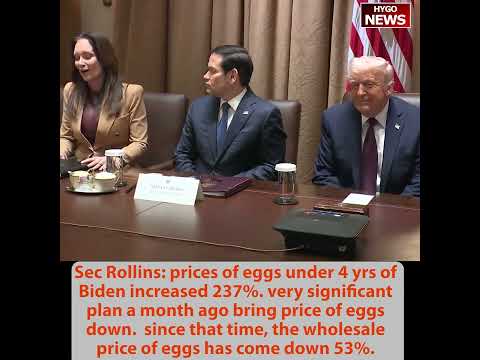
Rollins: Canceled “Queer Farmer” Contracts, Eggs Down 53%; Vance: Biden “Did Absolutely Nothing” With Abraham Accords
A March 2025 cabinet meeting featured Agriculture Secretary Brooke Rollins detailing absurd USDA contracts she had canceled — including one “educating transgender and queer farmers on food justice” in San Francisco and a $600,000 study on “menstrual cycles of transgender men” — while announcing that egg prices had fallen 53% since the administration released its five-prong plan. VP JD Vance delivered a forceful statement on the Abraham Accords, saying the Biden administration “did absolutely nothing with it, built on it not at all, added zero additional countries, purely out of political spite.”
Rollins: The Contracts
Agriculture Secretary Rollins opened with the specific contract cancellations that illustrated what Biden-era USDA spending had looked like.
“At the US Department of Agriculture, we’ve canceled a $300,000 contract educating on food justice for queer and transgender farmers in San Francisco,” Rollins said.
She continued: “A similar contract we canceled in New York — again educating transgender and queer farmers on food justice and food equality. I’m not even sure what that means, but apparently the last administration wanted to put our taxpayer dollars towards that.”
The contracts escalated: “We canceled a $600,000 contract out of Louisiana that was studying the menstrual cycles of transgender men. A $600,000 contract.”
And more: “We canceled another contract out of a university in the middle of the country that focused on getting more diversity, equity, and inclusion into our pest management industry.”
Rollins offered her assessment: “Again, these are nonsensical. It makes zero sense to use taxpayer dollars to fund these. I know these are just a few examples of the hundreds and hundreds that we have found.”
The contracts were individually absurd and collectively damning. The Department of Agriculture — an agency whose core mission was ensuring America’s food supply and supporting farmers — had been funding studies on transgender menstrual cycles, DEI in pest management, and “food justice” workshops. None of these had any connection to the department’s agricultural mission. They represented the ideological capture Rollins was describing: government agencies redirecting taxpayer money toward political priorities that had nothing to do with their statutory responsibilities.
The “food justice for queer and transgender farmers” contract was particularly illustrative because it combined two of the Biden administration’s ideological priorities — DEI and gender ideology — with a nominal connection to agriculture that was so tenuous as to be satirical. The concept of “food justice” and “food equality” for farmers categorized by gender identity was not a recognizable agricultural policy; it was an academic exercise funded with public money.
Eggs: 237% Under Biden, Down 53% Under Trump
Rollins then pivoted to the issue that had come to symbolize the cost-of-living crisis.
“The prices of eggs under the four years of Joe Biden increased 237 percent,” Rollins said. “237 percent in those four years. And yet it wasn’t covered in the press at all. No one talked about the price of eggs.”
She noted the media double standard: “In the summer of last year, for example, from the media. So of course the president wins and he is inaugurated, and the next day everyone is yelling about why the price of eggs are so high.”
Rollins provided the broader agricultural context: “Under the four years of Joe Biden, we had the cost of input go up 30% for all of our agriculture products. At the same time, the trade deficit increased $49 billion. So it was zero under the first Trump administration, and then under Joe Biden we sold $49 billion less of our ag products around the world.”
She then described the administration’s response: “The president, under his vision and support, we released about a month ago a very significant plan on how to bring the price of eggs down. It included five prongs — I won’t go into it now because I don’t want to bore everyone.”
The results: “But since that day, since we released that plan regarding biosecurity, repopulation, importing eggs, research, and then deregulating — taking those onerous rules off of our farmers, our egg-laying farmers — since that time, the wholesale price of eggs has come down 53%.”
A 53% decline in wholesale egg prices in approximately one month was a dramatic reversal. The five-prong approach — biosecurity to address avian flu, repopulation of flocks, egg imports to supplement supply, research funding, and deregulation of egg farmers — attacked the problem from multiple angles simultaneously rather than relying on any single intervention.
Rollins acknowledged the ongoing challenge: “It’s not something you solve overnight. Avian bird flu and some of the other animal diseases — we’re working across the government, several partners in the cabinet on that, especially my friend Secretary Kennedy over at HHS.”
Vance: Abraham Accords and “Political Spite”
VP Vance delivered the foreign policy portion of the cabinet meeting, and his assessment of the Biden administration’s handling of the Abraham Accords was unsparing.
“When you think about what happened with the Abraham Accords — one of the great diplomatic breakthroughs under the first Trump administration, really in the last 30 or 40 years of American history in the Middle East — and the Biden administration did absolutely nothing with it,” Vance said.
He itemized the failure: “Built on it not at all. Added zero additional countries. Purely out of political spite.”
The “political spite” characterization was the most damaging accusation. Vance was not arguing that the Biden administration had tried and failed to expand the Abraham Accords, or that circumstances had prevented progress. He was arguing that Biden’s team had deliberately abandoned a successful peace initiative because it bore Trump’s name. The Abraham Accords had been allowed to stagnate not because they were flawed but because their success would have validated Trump’s foreign policy.
Vance then described what had changed: “That has changed. Luckily, about two months ago we got a new president, and that president has given us the task of building out the Abraham Accords, adding new countries to it.”
He articulated the motivation driving potential new members: “And really what you see is a lot of these countries that have historical ethnic or religious hatreds want to build. They want to build new artificial intelligence. They want to build new real estate projects. They want their citizens to become rich and prosperous and peaceful. And they’re setting to the side some of those old hatreds under the leadership of President Trump.”
The framing was optimistic and practical. Peace was not being imposed through moralizing or threat; it was emerging because nations recognized that economic development required stability, and stability required setting aside generational conflicts. The Abraham Accords framework offered a template: normalize relations, open trade, and let shared prosperity create the foundation for lasting peace.
Vance concluded: “So it’s early, but we made a lot of progress, and we’ll keep on making progress, sir.”
Key Takeaways
- Rollins canceled USDA contracts including $300K for “queer and transgender farmer food justice” in San Francisco, $600K for studying “menstrual cycles of transgender men,” and DEI in pest management.
- Egg prices rose 237% under Biden’s four years; since Trump’s five-prong plan (biosecurity, repopulation, imports, research, deregulation), wholesale prices fell 53%.
- The agriculture trade deficit went from zero under Trump’s first term to $49 billion under Biden, while input costs rose 30%.
- VP Vance said Biden “did absolutely nothing” with the Abraham Accords, adding “zero additional countries, purely out of political spite.”
- Vance said countries now “want to build AI, real estate projects, and make their citizens rich and prosperous — setting aside old hatreds under Trump’s leadership.”