 HYGO News
 Lutnick: 'April 2 Is American Liberation Day'; Zeldin: EPA Canceled $22B -- '$2B to Stacey Abrams NGO'; McMahon: Education 'Cornerstone'
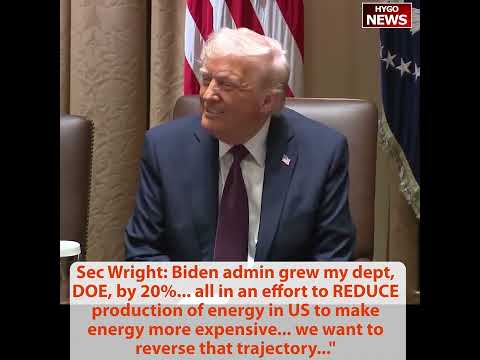
Lutnick: “April 2 Is American Liberation Day”; Zeldin: EPA Canceled $22B — “$2B to Stacey Abrams NGO”; McMahon: Education “Cornerstone”
Four cabinet members delivered detailed reports at a March 2025 cabinet meeting, each revealing the scale of the Trump administration’s restructuring. Commerce Secretary Howard Lutnick previewed April 2 as “American Liberation Day” when reciprocal tariffs would launch. EPA Administrator Lee Zeldin announced the cancellation of over $22 billion in contracts, revealing that “$2 billion went to this NGO that Stacey Abrams was tied to — they received only $100 in 2023 and then the Biden administration gave them $2 billion.” Energy Secretary Chris Wright said Biden had grown the Department of Energy by 20% “all in an effort to reduce the production of energy.” Education Secretary Linda McMahon warned: “If we don’t address the issues in education now, where are we going to find our next generation?”
Lutnick: “American Liberation Day”
Commerce Secretary Lutnick opened with the announcement that would dominate economic coverage for the following week.
“What is so exciting is April 2nd is just around the corner, and that’s American Liberation Day,” Lutnick said. “That’s the day when the rest of the world starts to treat America with respect.”
He connected the tariff announcement to the broader administration framework: “And your leadership, understanding how the rest of the world treats us and what balance and what fair trade finally is going to be, is going to take care of America.”
Lutnick then introduced a new institutional concept: “It’s going to launch the external revenue service to start to build the power and prestige of America back. And I’m honored to be helping you on that course.”
The “External Revenue Service” was a deliberate parallel to the Internal Revenue Service — the idea being that just as the IRS collected revenue from American taxpayers, the ERS would collect revenue from foreign countries through tariffs. The framing transformed tariffs from a trade policy into a revenue mechanism, suggesting that the burden of funding government could be shifted from domestic taxpayers to foreign producers.
The “American Liberation Day” branding was quintessential Trump messaging. Rather than announcing a tariff schedule — a technical, bureaucratic action — the administration was declaring a national event. April 2 was not the date tariffs took effect; it was the day America was liberated from unfair trade practices.
Zeldin: “$22 Billion” in EPA Contract Cancellations
EPA Administrator Lee Zeldin delivered the most shocking numbers of the cabinet meeting.
“EPA has now canceled over $22 billion worth of contracts,” Zeldin said.
He then detailed the most egregious example: “$2 billion going to this NGO that Stacey Abrams was tied to. They received only $100 in 2023, and then the Biden administration gave them $2 billion.”
The $100-to-$2-billion pipeline was the kind of detail that crystallized the waste argument. An organization that had $100 in receipts one year received $2 billion from the federal government the next. No legitimate organization scales from $100 to $2 billion in twelve months. The transaction suggested not a grant to an established organization but a political payoff to a political ally.
Zeldin continued with another example: “The director of the Greenhouse Gas Reduction Fund saw his former employer get $5 billion.” The revolving door between government officials and the organizations they funded was, in Zeldin’s telling, not an incidental conflict of interest but a systemic feature.
He summarized the concentration of funds: “So $20 billion went to just eight NGOs, and they’re all pass-throughs, and then they were giving it to other entities. Many of them were pass-throughs, and what you have is all these extra middlemen. They’re taking their cut, and the taxpayer ends up getting screwed.”
The “$20 billion to eight NGOs” structure described a system designed to minimize accountability and maximize extraction. Each layer of pass-through took an administrative fee, each intermediary hired staff and rented offices, and by the time money reached its ostensible purpose — reducing greenhouse gas emissions — a significant portion had been consumed by the bureaucratic infrastructure created to distribute it.
Zeldin credited the partnership with DOGE: “Their team is very talented. We wouldn’t have been able to do it without them, and of course this mandate from President Trump to make sure that we identify every last penny — whether we’re saving $50,000, $5 million, or $22 billion. We will not rest until every last penny is saved.”
Wright: Department of Energy “Grew 20%”
Energy Secretary Chris Wright provided the context for his department’s restructuring.
“Mr. President, I want to say energy is the infrastructure that makes our country run and drives our national security,” Wright began.
He then described what he had inherited: “The Biden administration grew my department, the Department of Energy, by 20% — and expenditure much more than that — all in an effort to reduce the production of energy in the United States and to make energy more expensive.”
Wright articulated the administration’s counter-philosophy: “We are stewards of the American taxpayer dollars. That’s the job of everyone around this table, led by you. We want to reverse that trajectory and care about every dollar an American taxpayer gives us.”
He provided a specific example of the previous administration’s priorities: “Puerto Rico, an American territory, had its electricity grid destroyed. They had billions of dollars in the Department of Energy to help Puerto Rico, yet they didn’t spend that money because that money would have meant more energy, more jobs, more prosperity in Puerto Rico.”
The reason for the withholding: “They wanted to have them as a poster child of wind and solar. ‘This island should run on wind and solar.’ That just doesn’t work. But they cared about politics more than the American people, and they didn’t treat the dollars like they were their dollars.”
Wright concluded with the new approach: “This table, the team you have assembled, we’re treating the American dollars like they’re our dollars.”
The Puerto Rico example was particularly powerful because it involved American citizens suffering from a natural disaster. The Department of Energy had the funds to restore reliable power but chose instead to pursue an ideological agenda of renewable energy transition on an island whose immediate need was functioning electricity.
McMahon: “The Cornerstone of Our Culture”
Education Secretary Linda McMahon delivered the most philosophical case for the administration’s education reform.
“If we think about education — if we don’t address the issues in education now and start getting our scores up — where are we going to find our next generation and the generation after that?” McMahon asked.
She connected education to every other administration priority: “Where are our engineers, our doctors, our lawyers, our scientists, our AI and technical experts going to come from? We will go farther and farther down.”
McMahon linked the education crisis to the economic agenda: “And with everything else we’re doing within our country — building manufacturing, bringing all of that back — if we don’t educate in the best way we can, we will be lost, and those generations will be lost.”
She called education “the cornerstone of our culture and what we need to focus on.”
McMahon then outlined the path forward: “By having education at the best place where it can be — which is the states, the local levels, with governors, with best practices and tools, which I hope the Department of Education can help supply for them — we’ll do it.”
The argument was that factories without educated workers would fail just as surely as schools without accountability. The $4 trillion in companies moving back to America needed a workforce capable of operating advanced manufacturing equipment, designing AI systems, and managing complex supply chains. The education crisis was not just a social issue; it was an existential threat to the economic revival.
Key Takeaways
- Commerce Secretary Lutnick previewed April 2 as “American Liberation Day” when reciprocal tariffs would launch, establishing an “External Revenue Service.”
- EPA’s Zeldin canceled $22 billion in contracts, revealing an NGO tied to Stacey Abrams went from $100 in receipts to a $2 billion federal grant. $20 billion went to just eight NGOs as “pass-throughs.”
- Energy Secretary Wright said Biden grew the Department of Energy by 20% “to reduce energy production” and withheld Puerto Rico disaster funds to push wind and solar.
- Education Secretary McMahon warned: “If we don’t address education now, where are our engineers, doctors, scientists going to come from? We will go farther and farther down.”
- Zeldin credited DOGE: “We wouldn’t have been able to do it without them. We will not rest until every last penny is saved.”