 HYGO News
 RFK Jr.: 'We Want the Dyes Out'; Launches Review to Eliminate GRAS Standards -- '10,000 Ingredients vs. Europe's 400'
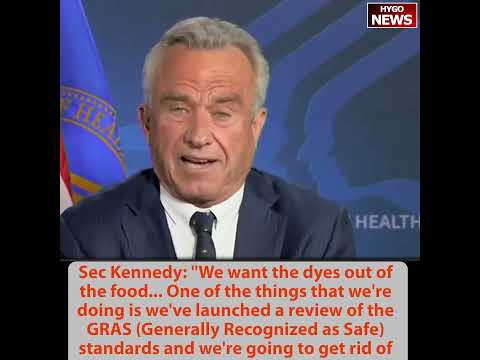
RFK Jr.: “We Want the Dyes Out”; Launches Review to Eliminate GRAS Standards — “10,000 Ingredients vs. Europe’s 400”
HHS Secretary Robert F. Kennedy Jr. announced in March 2025 that his department had launched a review of the GRAS (Generally Recognized as Safe) standards and would eliminate the designation for most products. “We told them that we wanted the dyes out of the food,” Kennedy said. “The science on the dyes is so overwhelming.” He cited the staggering disparity between the United States and its peers: “We have 10,000 ingredients in our food in this country. In Europe, they only have 400. And we have the worst chronic disease burden of any country in the world.” Kennedy specifically called out products like Froot Loops that contain dyes in American versions but not in Canadian or European ones.
”The Science Is So Overwhelming”
Kennedy opened with the bluntest possible statement of the administration’s position on food dyes.
“We told them that we wanted the dyes out of the food,” Kennedy said. “The science on the dyes is so overwhelming.”
The statement carried particular weight because of who was making it. Kennedy had spent decades as an advocate for food safety and environmental health, and his appointment as HHS Secretary had been one of the Trump administration’s most consequential personnel decisions. The critics who had called Kennedy a fringe figure were now watching him implement policy from one of the most powerful positions in the federal government.
Kennedy used a specific, relatable example to illustrate the problem: “They’re making products now in this country that have the dyes in them — like Froot Loops, for example. And you buy the same product in Canada and it doesn’t have the dyes. You buy the same product in Europe and it doesn’t have the dyes.”
The Froot Loops comparison was devastatingly effective because it eliminated every possible defense. The same company, making the same product, for the same market segment, had already proven it could manufacture the product without artificial dyes. It chose to include dyes in the American version because American regulators allowed it, not because the dyes were necessary. The reformulated versions existed on shelves in Toronto and London. The only reason Americans were eating dyes was that the FDA had never required their removal.
The GRAS Loophole: From Flour to 10,000 Chemicals
Kennedy then delivered what was effectively a short history of how American food regulation had failed.
“One of the things that we’re doing is we’ve launched a review of the GRAS standards, and we’re going to get rid of the GRAS standards for most products,” Kennedy announced.
He explained the origin: “The GRAS standard is a standard that was adopted in 1958. It was adopted because when FDA was created to regulate food, there were foods that were generally recognized as safe — G-R-A-S, generally recognized as safe — like flour, like dairy, like eggs. And they didn’t want to make companies test those products.”
The original logic was sensible. When the FDA began regulating food safety, it made no sense to require scientific testing to prove that flour was safe to eat. Certain basic food ingredients had been consumed for centuries, and their safety record spoke for itself. The GRAS designation was designed to exempt these obviously safe ingredients from the costly and time-consuming testing process.
But then the system was exploited: “That designation was expanded by industry,” Kennedy explained. “It began taking advantage of it so that any new chemical that they want to add to our food is generally recognized as safe and gets out of review.”
The transformation was remarkable. A designation originally created for flour and eggs had been stretched to cover thousands of synthetic chemicals that no one had consumed before they were invented in laboratories. Companies had discovered that by declaring a new chemical “generally recognized as safe,” they could bypass the FDA’s review process entirely. The loophole had become the standard operating procedure.
”10,000 Ingredients… Europe Has 400”
Kennedy delivered the statistic that crystallized the entire argument.
“That’s why we have 10,000 ingredients in our food in this country,” he said. “In Europe, they only have 400.”
The disparity — 25 to 1 — was not a matter of European countries being less innovative or having less variety in their food supply. European consumers ate the same types of products, made by the same multinational companies, in the same categories. The difference was regulatory: European food safety agencies required proof of safety before ingredients could be used, while the American GRAS system allowed companies to self-certify safety.
Kennedy connected the ingredient count to the health outcome: “And we have the worst chronic disease burden of any country in the world.”
The causal argument — that the 10,000 untested ingredients were contributing to chronic disease — was the foundational claim of Kennedy’s “Make America Healthy Again” agenda. Whether the relationship between food ingredients and chronic disease was as direct as Kennedy suggested was debated in scientific literature, but the correlation was undeniable: the country with the most permissive food ingredient regulations also had the highest rates of obesity, diabetes, autoimmune disorders, and other chronic conditions.
The Reform: Review Everything, Grandfather Nothing
Kennedy outlined the two-pronged approach the administration would take.
First, new products: “We are going to get rid of the GRAS standards for new products.” This meant that companies would no longer be able to add novel chemicals to the food supply by self-certifying them as safe. New ingredients would require actual scientific review — the standard that most Americans assumed already existed.
Second, existing products: “We’re going to go back and review all of these old ingredients to make sure that they are safe.”
The retroactive review was the more ambitious and controversial element. Thousands of ingredients had entered the food supply under the GRAS designation over decades. Reviewing them all would require scientific resources, time, and the willingness to confront industries that had built their products around specific formulations. Companies that had used certain chemicals for years would argue that their track record proved safety; Kennedy’s position was that absence of documented harm was not the same as proof of safety, especially when the harm might manifest as chronic disease over decades.
Kennedy’s final statement captured the administration’s approach: “And we’re going to encourage these companies to get rid of them as quickly as possible.”
The word “encourage” was notable. Kennedy was not announcing an immediate ban on all GRAS-designated ingredients. He was signaling that the administration would create regulatory pressure — through the review process, through public attention, and through the implicit threat of future bans — that would incentivize companies to reformulate voluntarily. The Froot Loops example had already demonstrated that the reformulations were possible; the question was whether American companies would make them without being forced.
The Broader MAHA Agenda
Kennedy’s food dye announcement was one piece of the broader Make America Healthy Again initiative that had been a central promise of his alignment with the Trump campaign. The GRAS review represented the institutional mechanism through which that agenda would be implemented — not through dramatic executive orders or congressional legislation, but through the methodical review and revision of decades-old regulatory standards that had allowed the American food supply to become a delivery system for untested chemicals.
The reform had the potential to be one of the most consequential regulatory changes of the Trump administration. If the GRAS loophole was closed and existing ingredients were subjected to genuine safety review, the composition of American food could change more dramatically than at any point since the FDA’s creation.
Key Takeaways
- HHS Secretary Kennedy announced the launch of a review to eliminate the GRAS (Generally Recognized as Safe) standards for most food products.
- He cited Froot Loops as an example: the same product is made without dyes in Canada and Europe but contains dyes in the United States.
- Kennedy explained that GRAS, created in 1958 for basic ingredients like “flour, dairy, eggs,” was expanded by industry to self-certify thousands of synthetic chemicals.
- The result: “10,000 ingredients in our food in this country. In Europe, they only have 400. And we have the worst chronic disease burden of any country in the world.”
- The administration will eliminate GRAS for new products and retroactively review all existing GRAS-designated ingredients.