 HYGO News
 Sec Gen NATO: For too long US carried too much of burden; Trump: 5% GDP very historic milestone
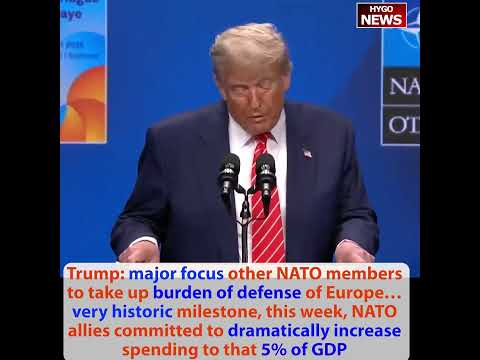
Sec Gen NATO: For too long US carried too much of burden; Trump: 5% GDP very historic milestone
The NATO summit at The Hague produced the kind of headline deliverable that defines historical moments. The alliance formally committed to 5% of GDP in defense spending — a threshold that, before today, no NATO member had fully embraced. NATO Secretary General Mark Rutte framed the moment in civilizational terms, stating that “for too long, one ally, the United States, carried too much of the burden” and that the summit’s decisions “will produce trillions more for our common defense.” Trump called the commitment “the Hague defense commitment” and estimated it would add more than $1 trillion a year to collective NATO defense spending. The moment, as Trump himself summarized, is “a big win for Europe and for actually Western civilization."
"Too Long, One Ally Carried Too Much”
Rutte’s framing of the moment was direct. “For too long, one ally, the United States, carried too much of the burden of that commitment. And that changes today.”
The admission is striking. NATO’s secretary general is publicly acknowledging that the alliance’s burden-sharing had been fundamentally unfair for decades. Previous secretaries general had addressed the issue diplomatically, usually avoiding direct acknowledgment that the imbalance was as severe as Trump had long claimed. Rutte is making the acknowledgment in the plainest possible terms.
“And that changes today” is the hinge. The new commitment fundamentally reshapes the burden-sharing framework. Going forward, Americans will no longer carry disproportionate shares of the alliance’s collective defense budget.
”President Trump, Dear Donald, You Made This Change Possible”
Rutte again used the personal form of address. “President Trump, dear Donald, you made this change possible. Your leadership on this has already produced one trillion dollars in extra spending from European allies since 2016. And the decisions today will produce trillions more for our common defense to make us stronger and fairer by equalizing spending between America and America’s allies.”
The personal credit attribution — “you made this change possible” — is the public acknowledgment that Trump’s pressure has succeeded where previous American diplomatic efforts had failed. The $1 trillion figure is the measurable outcome of the first-term pressure. The “trillions more” figure projects the outcome of the commitment being made today.
”Stronger And Fairer”
Rutte’s “stronger and fairer” formulation captures the dual benefit. Stronger — because higher spending produces more capable forces. Fairer — because equalized spending addresses the decades-long American grievance about carrying disproportionate burden. The combination is what makes the commitment politically sustainable across the alliance.
”He’s A Good Friend”
Rutte then offered a personal characterization. “He’s a good friend. And when he is doing stuff, which is forcing us to, for example, when it comes to making more investments, would you ever think that this would be the result of this summit if he would not have been reelected president?”
The rhetorical question is the argument. Rutte is inviting anyone who opposed Trump’s reelection to consider whether the current NATO achievement would have been possible under any other administration. His implicit answer is no. The specific increases in European defense commitments, according to Rutte, are the product of Trump’s second term and would not have materialized otherwise.
”Somewhere In The 2030s”
Rutte recounted the before-picture. “Do you really think that seven or eight countries who said, yes, somewhere in the 2030s, we might meet the 2 percent? You have now all decided in the last four or five months to get to 2 percent.”
The time-compression is the key insight. Countries that had publicly indicated they would eventually reach 2% of GDP by sometime in the 2030s have now, in the past four to five months, committed to reaching 2% this year. That is a nearly decade compression of the timeline. The pressure that produced the compression is, in Rutte’s framing, Trump.
”Doesn’t He Deserve Some Praise?”
Rutte closed with the question he was implicitly asking his European audience. “So doesn’t he deserve some praise? And when it comes to Iran, the fact that he took this decisive action very targeted to make sure that Iran would not be able to get his hands on a nuclear capability, I think he deserves all the praise.”
The question “doesn’t he deserve some praise?” is addressed to the European political class that has, by and large, found Trump difficult to work with. Rutte is asking them to acknowledge the specific achievements — the defense spending transformation, the Iran nuclear resolution — regardless of their broader political discomfort with Trump’s posture.
“All the praise” on Iran is strong language. Rutte is not hedging. He is saying Trump deserves full credit for the Iran outcome, not a share of credit.
Trump’s Summary Of The Summit
Trump then delivered his own summary in a separate appearance. “A major focus of our conversations at the summit was the need for other NATO members to take up the burden of the defense of Europe. And that included the financial burden. As you know, it was 2 percent. We got it up to 5 percent.”
The progression — from 2% to 5% — captures the arc. The 2% target was the Wales Summit goal from 2014, finally being fulfilled by all members this year. The 5% target is the next-generation goal, commitment made today for implementation over coming years.
”20 Years To Get Up To 3 Percent”
Trump recounted a specific conversation. “And they said a couple of them came up to me, one in particular, said, sir, we’ve been trying to get it up to 3 percent for 20 years, and we haven’t been able to. And you got it up to 5 percent.”
The anecdote captures the domestic political challenge that European defense spending increases represent. European political systems, with their coalition governments and their social spending commitments, face enormous friction when defense budgets need to increase. A specific country had been trying to reach 3% for 20 years without success. Trump’s pressure has now produced a 5% commitment.
Whether the commitment translates into actual spending depends on domestic political implementation. But the commitment itself is meaningful as an aspirational anchor.
The American Share
Trump laid out the baseline. “The United States accounts for two-thirds of all NATO defense spending. Since I began pushing for additional commitments in 2017, believe it or not, our allies have increased spending by $700 billion.”
The “two-thirds” figure captures the historical imbalance. The United States spends dramatically more on defense than all other NATO members combined. That imbalance has been the foundation of Trump’s long-running argument that burden-sharing needs to change.
The $700 billion figure is the measurable outcome of the first-term pressure. It is slightly lower than the $1 trillion Rutte cited, but both figures capture the substantial European defense spending increase that has already occurred.
”I Said To People, You Don’t Have Any Money”
Trump’s characterization of the early negotiations was characteristic. “I said to people, you don’t have any money. And a lot of them weren’t paying. And so I started the process. And I picked it up as soon as I got back, which is six months ago. During my election last November, almost all have accelerated plans to reach the 2 percent, 3 percent, 4 percent, and then ultimately very quickly 5 percent.”
The framing is informal. Trump is describing the negotiations in the conversational register of someone telling a story about how he negotiated with difficult counterparties. The counterparty that “didn’t have any money” was being told that the inability to pay was not acceptable.
”Very Quickly 5 Percent”
The pace of movement Trump describes is remarkable. “2 percent, 3 percent, 4 percent, and then ultimately very quickly 5 percent. All of this is going to be done very quickly, almost immediately.”
“Almost immediately” is the compressed timeline. European governments are, in Trump’s telling, moving through intermediate commitment levels — 2%, 3%, 4% — on their way to 5%. The progression is not over decades. It is over the coming years.
”You Did It, Sir”
Trump quoted what allies said to him. “A very historic milestone this week. The NATO allies committed to dramatically increase their defense spending to that 5 percent of GDP, something that no one really thought possible. And they said, you did it, sir. You did it.”
“You did it, sir” is the credit attribution Trump received in his private conversations with European leaders. Rutte’s public statement captured a version of the same sentiment. Trump wants the acknowledgment to travel — the private conversations are useful, but the public acknowledgment is politically valuable.
”I Don’t Know If I Did It, But I Think I Did”
Trump’s own evaluation was characteristic. “Well, I don’t know if I did it, but I think I did.”
The mock modesty is Trump’s standard verbal tic when accepting credit. He is acknowledging that he deserves it while performing the social ritual of not claiming full credit. The practical effect is that he accepts the credit without appearing to be grasping for it.
”The Hague Defense Commitment”
Trump then named the agreement. “This will be known as the Hague defense commitment, which is pretty good, pretty appropriate.”
The naming matters historically. Major international agreements are often known by the location where they were signed — the Wales Summit, the Lisbon Treaty, the Paris Accord. “The Hague defense commitment” places this agreement in that lineage. Historians writing about NATO’s defense spending transformation will refer to the Hague commitment as the critical turning point.
”More Than $1 Trillion A Year”
Trump laid out the financial scale. “When the allies reach this number, it will add more than $1 trillion a year. Think of that $1 trillion per year to our common defense.”
$1 trillion per year in additional NATO defense spending is the financial scale of the commitment. That spending, if it materializes, transforms European defense capability. New weapons systems can be developed. Aging equipment can be replaced. Personnel can be recruited and trained. The European defense industrial base can expand.
The cumulative effect over years is even larger. $1 trillion per year over a decade is $10 trillion in additional cumulative spending. That is a fundamental reshaping of global defense economics.
”A Monument To Victory”
Trump’s framing of the historical significance was direct. “And this is a monument really to victory, but it’s a monumental win for the United States because we were carrying much more than our fair share. It was quite unfair, actually. But this is a big win for Europe and for actually Western civilization.”
“A monument to victory” is elevated language. Trump is positioning the commitment not as an incremental diplomatic improvement but as a foundational achievement comparable to major historical milestones.
“Unfair, actually” is the characterization of the prior arrangement. The burden-sharing imbalance was not merely inefficient — it was unjust. Addressing the injustice is the moral dimension of the summit’s achievement.
”Western Civilization”
Trump’s invocation of Western civilization is substantive. The NATO alliance has, since its founding in 1949, been the primary security framework for the advanced democratic societies of Europe and North America. Its defense posture is the defense posture of Western civilization in its 20th and 21st-century form.
The commitment to adequately fund that defense is, in Trump’s framing, a civilizational question. If Western civilization is worth defending, Western democracies must be willing to fund the defense. The 5% commitment is the practical expression of that willingness.
The Implementation Question
Behind the celebratory framing, the implementation question remains. Commitments made at summits must be translated into national budget legislation. National legislatures, facing their own domestic spending priorities, may prove reluctant to implement the full commitments made in The Hague.
The accountability mechanism for NATO defense spending commitments is informal. Members are expected to report progress toward the target annually. Secretariat staff track the reporting. But no member can be formally compelled to meet the commitment. The only enforcement is political — commitments made publicly are expected to be honored publicly.
Trump’s continued pressure will likely be the informal enforcement mechanism over the coming years. European leaders who signed the Hague commitment will face annual scrutiny from the American president about whether their implementation is keeping pace with their commitment.
Key Takeaways
- Rutte: “For too long, one ally, the United States, carried too much of the burden of that commitment — and that changes today. President Trump, dear Donald, you made this change possible.”
- The summit trajectory: countries that had said they would reach 2% “somewhere in the 2030s” committed in “the last four or five months to get to 2 percent.”
- Trump: “I said to people, you don’t have any money. And a lot of them weren’t paying. And so I started the process.”
- “The Hague defense commitment”: “When the allies reach this number, it will add more than $1 trillion a year.”
- “This is a monument really to victory, but it’s a monumental win for the United States…a big win for Europe and for actually Western civilization.”