 HYGO News
 Sec Duffy: WILL see mass chaos; Bessent: unusual for SCOTUS to overrule, SCOTUS gave Obama Obamacare
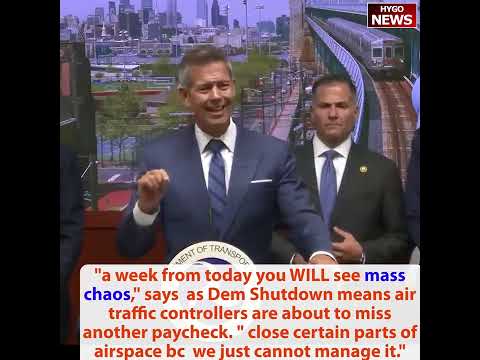
Sec Duffy: WILL see mass chaos; Bessent: unusual for SCOTUS to overrule, SCOTUS gave Obama Obamacare
Three senior Cabinet officials delivered urgent shutdown-related messages. Transportation Secretary Sean Duffy warned that air traffic controllers would see “zero paystubs” on Thursday and that if the shutdown continued another week “you will see mass chaos” including mass flight delays, cancellations, and potential airspace closures because not enough controllers would be available. Treasury Secretary Scott Bessent laid out the administration’s Supreme Court strategy for upholding Trump’s emergency tariff authority, citing three actual emergencies IEEPA had addressed: the fentanyl crisis (bringing China to the table on precursor chemicals), trade deficits (China deficit down 25%), and China’s October 8 rare-earth export controls (resolved via Trump’s 100% tariff threat leading to the Kuala Lumpur and Korea deals). Bessent framed tariffs as comparable to Obamacare for Obama — a signature policy SCOTUS historically defers to. Labor Secretary Lori Chavez-DeRemer said Democrats had stopped workforce momentum in its tracks — 250,000 registered apprentices coming to a “screeching halt” — and begged Democrats to reopen the government. Duffy: “If you bring us to a week from today, Democrats, you will see mass chaos. You will see mass flight delays. You’ll see mass cancellations. And you may see us close certain parts of the airspace because we just cannot manage it.” Bessent: “The Supreme Court gave president Obama a lot of room on Obamacare.” Chavez-DeRemer: “I am begging these Democrats to show up, do their job, and open up this government. 35 days is far too long.”
Duffy on Controllers
Transportation Secretary Sean Duffy opened with the air traffic controller pay situation. “The controllers got 90% of one payment, 80% to 90% of one payment. They missed the second paycheck.”
The math: controllers received partial pay on their first post-shutdown pay cycle (stretched from existing funds). The second cycle had no funds available. 100% missed second paycheck.
“On Thursday, they get an email paystub that’ll show what their next payment is going to be. So this Thursday, they’ll get an email that shows that their paystub is a big, fat zero.”
The psychological impact matters as much as the financial. Receiving a $0 paystub — while continuing to work full duty shifts — creates predictable morale and retention consequences.
”Can’t Manage Two”
“Many of the controllers said, a lot of us can navigate missing one paycheck. Not everybody, but a lot of us can. None of us can manage missing two paychecks.”
Controllers have some financial reserves to cover one missed paycheck. Two missed paychecks breaks almost everyone. Rent, mortgages, utilities, food, childcare — these bills don’t pause because government shuts down.
“So if you bring us to a week from today, Democrats, you will see mass chaos.”
Duffy’s direct framework: one week from now, if Democrats still haven’t acted, the consequences scale dramatically.
”Mass Chaos”
“You will see mass flight delays. You’ll see mass cancellations. And you may see us close certain parts of the airspace because we just cannot manage it, because we don’t have the air traffic controllers.”
The cascade:
- Controllers call out (mental health, financial stress, looking for other jobs)
- FAA reduces capacity due to staffing shortages
- Airlines cancel or delay flights
- Selected airspace sectors may close entirely
- Major airports may see substantial reductions
“Close certain parts of the airspace” is serious. FAA doesn’t casually close airspace. Duffy was signaling the administration was already preparing for the worst-case scenario.
Bessent on Supreme Court
Treasury Secretary Scott Bessent then addressed the tariff case before the Supreme Court. “The matter of national security, this is one of the president’s signature policies, and it’d be very unusual for the Supreme Court to overrule president’s signature policy.”
Bessent’s framework: Trump’s tariff authority is a signature policy. Courts generally defer to presidential signature policies on matters with national security dimensions.
“Supreme Court gave president Obama a lot of room on Obamacare, and president Trump’s two signature policies have been securing the border, which has been a credible success. It has been the terror policy rebalancing U.S. trade, its economic security.”
The Obamacare comparison is intentional. The Supreme Court upheld Obamacare against multiple legal challenges during Obama’s term — the 5-4 NFIB v. Sebelius ruling (2012), King v. Burwell (2015), and others. The Court gave Obama’s signature policy “a lot of room” despite legal vulnerabilities.
The framework: if the Court gave Obama’s signature deference, they should give Trump’s signature policy similar deference.
Three Emergencies
“We’ve had three emergencies here. First emergency has been the fentanyl crisis.”
Fentanyl deaths peaked around 70,000 annually in the U.S. Most precursor chemicals come from China. The emergency was deaths at war-scale rates.
“President was able to use IEPA to bring the Chinese to the table on the precursor chemicals.”
IEEPA (International Emergency Economic Powers Act) tariff threats on Chinese imports motivated Chinese government action on fentanyl precursor exports. The linkage is direct:
- Trump threatens tariffs under IEEPA
- China acts to reduce precursor exports to avoid tariffs
- Fentanyl supply reduced
- Emergency mitigated
“Second emergency was our trade deficits. We are bringing those down. The deficit with China is down 25%.”
The U.S. trade deficit with China has been structurally massive for decades. Bessent’s framework: tariffs as IEEPA emergency response brought the deficit down 25% — substantial progress on a chronic structural imbalance.
Rare Earth Emergency
“And then number three, the president, after the Chinese said that they were going to put export controls on rare earth minerals for the globe. On October 8th, president was able to use his IEPA emergency powers to threaten 100% tariffs, bring the Chinese to the table in Kuala Lumpur and Korea, get the rare earth to flow.”
The rare earth situation in early October 2025:
- China announced export controls on rare earth minerals
- Rare earths are essential for electronics, EVs, missile systems, AI chips
- Global supply dependence on China
- Potential worldwide manufacturing crisis
Trump’s October 8 threat of 100% tariffs on China, using IEEPA emergency authority, immediately brought China to the negotiating table. The subsequent framework (Kuala Lumpur discussions, then Korea Xi meeting) resolved the issue.
“And if that hadn’t happened, the manufacturing facilities, not only the U.S., but around the world would shut down.”
The stakes: global manufacturing shutdown if Chinese rare earth exports stopped. IEEPA tariff authority prevented the crisis.
“So, you know, this is an emergency power that he has used during emergencies.”
Bessent’s framework: IEEPA hasn’t been abused. It’s been used for actual emergencies with actual resolutions.
Chavez-DeRemer on Workers
Labor Secretary Lori Chavez-DeRemer pivoted to workforce impact. “The future of the American economy is on my shoulders, on this administration’s shoulders, and the Democrats have stopped all the momentum that we have put in in the last nine months.”
Trump’s second-term workforce initiatives had built momentum across multiple areas. The shutdown stopped progress across all of them simultaneously.
“Registered apprenticeships, the future workforce, not only are we hurting the current workforce, it’s the future workforce. We are trying to educate our young people. We’re trying to register one million active apprentices across this country. We had almost 250,000 registered, and now that has come to a screeching halt.”
The apprenticeship numbers:
- Target: 1 million active apprentices
- Progress: 250,000 registered at shutdown start
- Current status: halted
- Impact: young people waiting to start careers in skilled trades
Registered apprenticeships affect manufacturing, construction, healthcare, energy, and other growth sectors. Workforce development can’t restart instantly when funding returns.
AI Education
“We’re trying to educate our young Americans on AI. Pilot approaches for workforce challenges in AI, the uncertainty.”
AI education initiatives targeting K-12 through workforce development. Melania Trump’s AI Education Task Force fits here. The shutdown halts federal support for these programs.
“American workers deserve to know that they are going to have a job in this country, and the Democrats have chosen to play those political games."
"13 Times”
“But many of our efforts have been stopped 13 times, they had an opportunity to say yes, just like I did, just like my colleagues have done. Enough is enough.”
Chavez-DeRemer noted she had voted “yes” on the CR. “Like my colleagues” — bipartisan group of senators voting yes. Democrats collectively voted no.
“President Trump has done his job, not only has he leveled the playing field with tariffs, not only has he welcomed great trade agreements, he has worked most recently with South Korea and Japan to bring hundreds of millions of dollars back to this country for the shipbuilding trades.”
Trump’s Japan and Korea deals included major shipbuilding investments. Both countries have advanced shipbuilding capabilities (Japanese yards, Korean yards — Hyundai Heavy Industries, Samsung Heavy, Daewoo). Bringing those capabilities partially to the U.S. addresses Navy shipbuilding shortfalls and commercial shipping needs.
”Begging”
“I have working around the clock to make sure that we can protect our national security for this country, and now that has also come to a stop. We are hurting American workers. We need to get them back to work, we need to grow this economy, we need to get their paychecks back in their hands so they can provide for their families, put gas in their cars, pay their mortgages, turn on their lights.”
Chavez-DeRemer’s direct message to workers: the shutdown is hurting you. The administration is trying to help. Democrats are blocking.
“I’m talking to all of you American workers out there. We’re here for you, we’re gonna continue to fight through this shutdown, and I am begging these Democrats to show up, do their job, and open up this government. 35 days is far too long for the American people. Enough is enough.”
Day 35 of the shutdown. Chavez-DeRemer explicitly begging Democrats to end it — not rhetorical begging but actual pleading from a Cabinet secretary.
Significance
The Cabinet unity on shutdown messaging was striking. Duffy (Transportation), Bessent (Treasury), Chavez-DeRemer (Labor) — three senior officials delivering coordinated messages on:
- Operational consequences (air traffic)
- Legal implications (Supreme Court tariff case)
- Worker impact (apprenticeships halted)
The framework deliberately constructed: Republicans want government open, Democrats are blocking, the consequences are measurable and severe, and the Supreme Court case is a separate but related test of Trump’s ability to execute policy.
The Obamacare parallel Bessent drew is legally substantive. If SCOTUS would defer to Obama on signature policy with constitutional questions, they should defer to Trump on signature policy with statutory interpretation questions. IEEPA tariff authority is statutory, which should face less scrutiny than Obamacare’s constitutional questions did.
Key Takeaways
- Duffy on controllers: “This Thursday, they’ll get an email that shows that their paystub is a big, fat zero. Many of the controllers said, a lot of us can navigate missing one paycheck. Not everybody, but a lot of us can. None of us can manage missing two paychecks. So if you bring us to a week from today, Democrats, you will see mass chaos.”
- Duffy on airspace: “You may see us close certain parts of the airspace because we just cannot manage it, because we don’t have the air traffic controllers.”
- Bessent on SCOTUS: “It would be very unusual for the Supreme Court to overrule president’s signature policy. Supreme Court gave president Obama a lot of room on Obamacare.”
- Bessent on IEEPA emergencies: “Three emergencies here. First emergency has been the fentanyl crisis … Second emergency was our trade deficits … the deficit with China is down 25% … number three, after the Chinese said that they were going to put export controls on rare earth minerals for the globe … President was able to use his IEPA emergency powers to threaten 100% tariffs, bring the Chinese to the table in Kuala Lumpur and Korea.”
- Chavez-DeRemer on workers: “We’re trying to register one million active apprentices across this country. We had almost 250,000 registered, and now that has come to a screeching halt … I am begging these Democrats to show up, do their job, and open up this government. 35 days is far too long for the American people.”