 HYGO News
 Sec Def: not regime change. not seek war, Peace Through Strength, Iranian nuclear obliterated
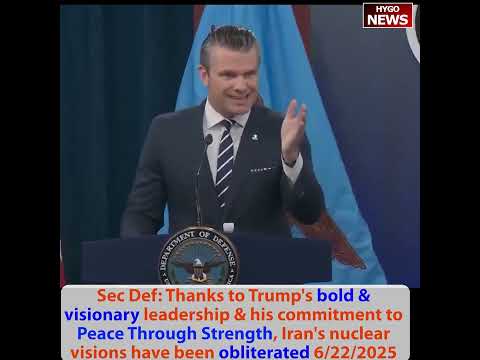
Sec Def: not regime change. not seek war, Peace Through Strength, Iranian nuclear obliterated
The morning after the strikes, Secretary of Defense Pete Hegseth and Joint Chiefs of Staff Chairman General Dan Caine addressed the nation from the Pentagon briefing room. Hegseth’s framing was calibrated to accomplish three things simultaneously: tell Iran what the mission was, tell Americans what the mission was not, and tell the world that American deterrence is operational. “This mission was not and has not been about regime change,” Hegseth stated flatly. “The President authorized a precision operation to neutralize the threats to our national interests posed by the Iranian nuclear program and the collective self-defense of our troops and our ally Israel.” The briefing made clear that the administration is prepared to escalate if Iran retaliates, but equally prepared to accept Iranian willingness to negotiate if that willingness now materializes.
”Not About Regime Change”
Hegseth’s opening was the most important diplomatic signal of the briefing. “This mission was not and has not been about regime change. The president authorized a precision operation to neutralize the threats to our national interests posed by the Iranian nuclear program and the collective self-defense of our troops and our ally Israel.”
The “not about regime change” framing matters for several reasons.
First, it gives Tehran a face-saving off-ramp. If the strikes were narrowly targeted at the nuclear program rather than aimed at toppling the government, the Supreme Leader can consider a settlement that preserves the regime while dismantling the nuclear capability. A regime change framing would have foreclosed that possibility by telling Tehran that accepting the settlement would not save the government.
Second, it constrains the American military objective. Regime change operations — as the United States learned in Iraq, Afghanistan, and Libya — are enormously expensive, long-duration, and prone to failure. By publicly limiting the objective to nuclear neutralization, the administration also implicitly limits the scope of what American forces will be asked to do.
Third, it reassures domestic constituencies. Many Americans — including significant portions of Trump’s base — are skeptical of forever-war dynamics. The “not regime change” framing is a specific commitment that the strikes are not a first step toward extended American ground involvement in Iran.
”The United States Does Not Seek War”
Hegseth’s second calibration was equally important. “As President Trump has stated, the United States does not seek war. But let me be clear, we will act swiftly and decisively when our people, our partners or our interests are threatened.”
The formulation is classic peace-through-strength doctrine. Peace is the preferred state. Force is the instrument when peace is violated by others. American action is defensive in character — responding to threats rather than initiating aggression.
The “act swiftly and decisively” half is the operational message to Tehran. The overnight strikes demonstrated what swift and decisive action looks like. Further swift and decisive action is available if Iran chooses the path that requires it.
”Iran Should Listen”
Hegseth’s direct message to Tehran was blunt. “Iran should listen to the president of the United States and know that he means it every word.”
The message addresses the Iranian regime’s long history of treating American presidential statements as bluffs. Throughout the Obama and Biden administrations, Iranian strategy assumed that American red lines were, in practice, negotiable. The second Trump administration has sought, from the beginning, to reset that expectation. The strikes are the most concrete expression of the reset.
“He means it every word” is the American message delivered by the Secretary of Defense in public: when Trump says something, Iran should calibrate its behavior as though the statement will be enforced. The past American posture of statements that were not enforced is over.
Credit To The Commander In Chief
Hegseth acknowledged Trump’s leadership. “I want to give congratulations to our commander in chief. It was an honor to watch him lead last night and throughout and to our great American warriors on this successful operation.”
The acknowledgment is significant because it signals the working relationship. Secretary of Defense and President have functioned as a coordinated pair throughout the Iran crisis. Hegseth is not distancing himself from the decision. He is publicly owning it alongside the president.
”Glory To God For His Providence”
Hegseth’s theological framing was direct. “God bless our troops. God bless America. And we give glory to God for his providence and continue to ask for his protection.”
The invocation of providence is a particular framing. Providence, in Christian theology, is the idea that God actively directs events toward intended outcomes. Giving glory to God for providence is thanking Him specifically for the outcome of the operation — the “spectacular” success, in the administration’s framing.
Hegseth is a public Christian, and his willingness to invoke divine providence in a Defense Department briefing is consistent with his longstanding public posture. Whether every American shares the theological framework is a separate question. The framework itself is transparent.
”Many Presidents Have Dreamed”
Hegseth’s historical framing of the operation was expansive. “Thanks to President Trump’s bold and visionary leadership and his commitment to peace through strength, Iran’s nuclear ambitions have been obliterated. Many presidents have dreamed of delivering the final blow to Iran’s nuclear program, and none could until President Trump.”
The claim is historically specific. George W. Bush confronted the Iranian nuclear program. Barack Obama negotiated the JCPOA framework. Donald Trump in his first term withdrew from the JCPOA. Joe Biden’s administration attempted to negotiate reentry. Each of them, in Hegseth’s framing, addressed the issue without resolving it.
The second Trump administration, according to Hegseth, has delivered what the prior four administrations could not — the destruction of Iran’s nuclear enrichment capability. Whether the destruction holds, whether Iran reconstitutes, whether subsequent events modify the assessment — all are open questions. But the first-order claim, the claim about what the overnight operation accomplished, is the one Hegseth is making.
”American Deterrence Is Back”
Hegseth then made the deterrence argument. “The operation President Trump planned was bold and it was brilliant, showing the world that American deterrence is back.”
“American deterrence is back” is a claim about the credibility of American threats. During the post-2021 period, various adversaries — Russia in Ukraine, Iran through proxies, China in the Pacific — conducted operations that suggested they did not believe American deterrence was credible. Hegseth’s claim is that the strikes have restored that credibility.
Whether adversaries agree is the question that matters. Russia, China, Iran, and North Korea will adjust their calculations based on what they observed overnight. If their conclusion is that the Americans will now use force decisively to enforce declared red lines, the deterrence claim is validated. If they conclude that the operation was a one-off, the deterrence claim is weaker.
”When This President Speaks”
Hegseth’s formulation of the new posture was direct. “When this president speaks, the world should listen. And the US military, we can back it up. The most powerful military the world has ever known.”
The formulation compresses the deterrence doctrine into a single thought. The president speaks. The world listens. If the world does not listen, the military backs up the words. The sequence is designed to prevent adversaries from testing the American posture, because the cost of testing has now been demonstrated.
”Soleimani Found Out”
Hegseth referenced the Trump administration’s first-term operation against Iranian General Qassem Soleimani. “Just like Soleimani found out in the first term. Iran found out when POTUS says 60 days that he seeks peace and negotiation. He means 60 days of peace and negotiation. Otherwise, that nuclear program, that nuclear capability will not exist. He meant it.”
The Soleimani reference is deliberate. The January 2020 strike that killed Soleimani was the signature national security action of Trump’s first term. It established a template: when Iran crosses a line, the American response is the physical elimination of those responsible. Iran’s subsequent behavior — particularly in the 2020-2024 period — suggested that the template had not fully deterred Iranian escalation.
Hegseth is arguing that the overnight strikes have reinforced the template. Iran’s next calculation should incorporate both the Soleimani precedent and the nuclear-infrastructure precedent.
”This Is Not The Previous Administration”
Hegseth’s final framing was political as well as operational. “This is not the previous administration.”
The contrast with the Biden administration is explicit. Under the previous administration, according to Hegseth’s framing, Iranian red-line crossings did not produce decisive responses. Under the current administration, they do. The difference is not in the stated American position — both administrations opposed Iranian nuclear weapons — but in the willingness to use force to enforce the position.
”Fully Postured To Respond”
Hegseth addressed the question of Iranian retaliation. “Our forces remain on high alert and are fully postured to respond to any Iranian retaliation or proxy attacks, which would be an incredibly poor choice.”
The “incredibly poor choice” framing is the direct warning to Tehran. Iranian retaliation will be met with response. The operation is not complete. American forces are in theater, prepared to execute whatever follow-on operations are ordered.
”Safety Of Our Service Members And Civilians”
Joint Chiefs Chairman Dan Caine provided the operational complement. “The safety of our service members and civilians remains our highest priority. This mission demonstrates the unmatched reach, coordination and capability of the United States military.”
The focus on servicemember safety is the professional military’s consistent priority. Generals do not celebrate operations primarily in terms of strategic effect. They celebrate operations primarily in terms of bringing their people home safely. Caine’s framing — “safety of our service members and civilians remains our highest priority” — is the military professional’s emphasis on the lives under his care.
”Strategic Planning To Global Execution”
Caine then addressed the operational tempo. “In just a matter of weeks, this went from strategic planning to global execution. This operation underscores the unmatched capabilities and global reach of the United States military.”
“A matter of weeks” from planning to execution is the measure of American military responsiveness. Major operations of this complexity typically require months of planning in other countries’ militaries. The American ability to move from strategic direction to global execution in weeks is the force-multiplier that allows the United States to impose its will on timelines that adversaries cannot match.
”No Other Military In The World”
Caine’s close echoed Trump’s assertion from the night before. “As the president clearly said last night, no other military in the world could have done this.”
The repetition across the Commander-in-Chief and the Joint Chiefs Chairman is coordinated. Both are making the same point — the operation demonstrates capabilities no other country possesses. The message is aimed at potential imitators, at American taxpayers funding the military, and at allies considering whether to continue depending on American security guarantees.
The Coordinated Signaling
The briefing, taken as a whole, is the administration speaking with a single voice. President, Secretary of Defense, and Joint Chiefs Chairman delivered the same core messages: operation succeeded, objective achieved, capability unique, deterrence restored, retaliation discouraged, peace available. Each speaker delivered the same substantive content in slightly different emphasis.
That kind of coordinated messaging is itself a signal. Adversaries and allies watching the briefing know that the American government is operating as a unified team. There are no leaks of dissent, no cabinet members implying different positions, no military leaders questioning the president’s decision. The unified front is the posture the administration has chosen to present.
Key Takeaways
- Hegseth’s key framing: “This mission was not and has not been about regime change” — giving Tehran a face-saving path to settlement.
- The doctrine restatement: “The United States does not seek war. But let me be clear, we will act swiftly and decisively when our people, our partners or our interests are threatened.”
- The historical claim: “Many presidents have dreamed of delivering the final blow to Iran’s nuclear program, and none could until President Trump.”
- The deterrence restoration: “Showing the world that American deterrence is back. When this president speaks, the world should listen.”
- Joint Chiefs Chairman Caine: “In just a matter of weeks, this went from strategic planning to global execution. This operation underscores the unmatched capabilities and global reach of the United States military.”