 HYGO News
 Sec Def Hegseth at Arlington Memorial Day 2025: 'Throughout Time Civilizations Have Honored the Powerful -- Yet in America We Honor the Anonymous Soldier'; 'American Soldier Fights Because He Loves What's Behind Him -- Eternal Vigilance the Price of Freedom'
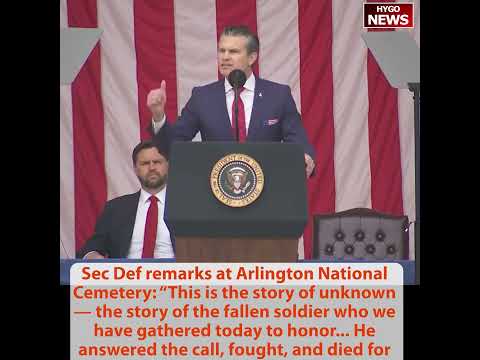
Sec Def Hegseth at Arlington Memorial Day 2025: “Throughout Time Civilizations Have Honored the Powerful — Yet in America We Honor the Anonymous Soldier”; “American Soldier Fights Because He Loves What’s Behind Him — Eternal Vigilance the Price of Freedom”
Secretary of Defense Pete Hegseth delivered Memorial Day 2025 remarks at Arlington National Cemetery, weaving together historical reflection with personal conviction. Hegseth: “Throughout time civilizations have honored the powerful, the well-connected, and the well-born. Emperors and kings have built magnificent shrines to their own royal greatness. Yet in America, with our great experiment in self-government, it is fitting that the most honored and closely guarded tomb in the land is that of an anonymous soldier of an unknown rank.” On the 1921 tradition: “When the first unknown soldier was selected for burial in 1921, he laid in state at the capital Rotunda. Throngs of Americans paid their respects. When the tomb was dedicated on November 11, Veterans Day, the unknown received the Medal of Honor.” On the American warrior: “The American soldier fights not because he hates what’s in front of him, but because he loves what’s behind him.” On ongoing obligation: “Eternal vigilance, eternal vigilance, the price of freedom. That’s the job of the chairman and I and so many others at the Defense Department. Each and every day, we will never be complacent.” He closed: “249 years on, we stand on the shoulders of great men and on the shoulders of those great men in those graves and may we live worthy of it."
"Emperors and Kings Have Built Magnificent Shrines”
Hegseth opened with a historical comparative.
“You know throughout time civilizations have honored the powerful, the well connected, and the well born,” Hegseth said.
He gave the historical pattern: “Emperors and kings have built magnificent shrines to their own royal greatness.”
The historical reality was as Hegseth described. Throughout human history, the monumental honored spaces had been:
- Egyptian pyramids: Tombs of pharaohs, containing vast wealth and slave-labor construction
- Roman mausoleums: Memorials to emperors and wealthy patrons
- Napoleonic tombs: The dome of Les Invalides in Paris
- Asian imperial tombs: Qin Shi Huang’s terracotta army, Tokugawa mausoleums
- European royal cathedrals: Kings buried in Westminster Abbey, Saint-Denis
Power and status had determined who received posthumous honor. Common soldiers had been buried in mass graves on battlefields or in anonymous plots. Their contributions to civilization-building had been forgotten within a generation.
”The Most Honored Tomb… An Anonymous Soldier”
Hegseth made the American distinction.
“Yet in America, with our great experiment in self-government, it is fitting that the most honored and closely guarded tomb in the land is that of an anonymous soldier of an unknown rank,” Hegseth said.
The inversion Hegseth described was profound. In America:
- Presidents’ burial sites (while respected) were less elaborate than the Tomb of the Unknown Soldier
- The Tomb of the Unknown had 24/7 military guard in all weather
- Changing of the guard was one of the most formal American ceremonies
- Maintenance and protection received dedicated military resources
- The position of Tomb Guard was among the most selectively awarded military assignments
This was not accidental. Americans had explicitly chosen to honor the unknown ordinary soldier above all other historical figures. The Tomb of the Unknown Soldier represented:
- Democratic equality of sacrifice
- Honor independent of rank or recognition
- Acknowledgment that anonymous service was the foundation of freedom
- Respect for the most humble military contribution
The 1921 Dedication
Hegseth cited specific historical detail.
“When the first unknown soldier was selected for burial in 1921, he laid in state at the capital Rotunda,” Hegseth said. “Throngs of Americans paid their respects.”
He noted the Medal of Honor: “When the tomb was dedicated on November 11, Veterans Day, the unknown received the Medal of Honor.”
The 1921 context was significant. World War I had ended in 1918 with massive American casualties — approximately 116,000 American dead. Many had been buried in France where identification was impossible due to combat conditions. The concept of an Unknown Soldier monument had emerged as a way to honor all unidentified American dead.
The selection process was solemn:
- Four unknown American soldiers were exhumed from different American cemeteries in France
- A highly decorated American soldier made the final selection
- The selected unknown was brought to America by warship
- The body lay in state in the Capitol Rotunda
- Crowds spanning miles paid respects
- The dedication ceremony on Veterans Day 1921 was attended by President Harding
The Medal of Honor presentation was the culmination. The Medal of Honor was America’s highest military decoration, awarded for conspicuous gallantry above and beyond the call of duty. By presenting the Medal of Honor to an unidentified soldier, the United States was declaring that:
- Any American soldier’s sacrifice deserved the highest honor
- Anonymous service was equal to named heroism
- The fallen unknown represented all American military dead
- Their collective valor deserved recognition
”Uniquely American Tradition”
Hegseth emphasized the American distinctiveness.
“It is a uniquely American tradition that we honor anonymous sacrifice above worldly greatness,” Hegseth said.
The claim of unique American tradition was debatable but substantially correct. Other countries had:
- British Tomb of Unknown Warrior: In Westminster Abbey, dedicated 1920
- French Tomb of Unknown Soldier: Under Arc de Triomphe, dedicated 1921
- German Neue Wache: Memorial for unknown dead
- Various other national unknown soldier memorials
But the American approach had several distinctive features:
- The Tomb of the Unknown Soldier’s location at Arlington (rather than in a national cathedral)
- The continuous military guard (many other nations had ceremonial rather than functional guards)
- The explicit Medal of Honor presentation
- The scale of associated ceremony
- The Tomb Guard’s extraordinary selection process and standards
American Memorial Day rhetoric had also developed in ways that emphasized anonymous sacrifice over named leadership. Presidents and generals had their monuments and memorials, but Memorial Day specifically honored the anonymous many rather than the decorated few.
”The Story of Every Soldier”
Hegseth told the universal story.
“While we don’t know the unknown’s identity, race, or creed, we know his story,” Hegseth said.
He identified the universality: “It’s the story of every soldier, every warrior. It’s a simple story, as old as war.”
He narrated the narrative: “A young man with hopes and dreams and loves who’s called by his country, leaves behind his hometown, his parents, his siblings, his sweetheart, all that he knows to go fight a war that he may or may not understand.”
He identified the tragic ending: “This is the story of the unknown. The story of the fallen soldier who we have gathered today to honor. It is the story of the American warrior.”
He described the fundamental service: “He answered the call, fought, and died for this republic, the ultimate sacrifice of a free people.”
The narrative Hegseth described applied to countless Americans throughout history:
- Young men leaving small towns to fight at Gettysburg
- Young Marines leaving families to storm Iwo Jima
- Young soldiers leaving universities to fight in Korea
- Young draftees leaving small towns to fight in Vietnam
- Young volunteers leaving careers to fight in Iraq and Afghanistan
The universality was meaningful. Despite vast differences in:
- Weapons and technology
- Political contexts
- Geographic locations
- Length and nature of service
- Ideological framings
The essential human experience remained constant. Young people left what they knew, engaged with violence for national purposes, and either came home changed or did not come home at all.
”Loves What’s Behind Him”
Hegseth delivered one of the speech’s most memorable lines.
“The American soldier fights not because he hates what’s in front of him, but because he loves what’s behind him,” Hegseth said.
This formulation captured something essential about American military motivation. While some soldiers had indeed developed hatred for specific enemies, the fundamental motivation for most was:
- Love of home and family
- Commitment to community
- Devotion to country
- Faith in fellow service members
- Belief in American values
The “behind him” framing included:
- The family they had left
- The community they represented
- The country that had raised them
- The values they had been taught
- The future generations who would benefit
This was distinct from ideologically-motivated warriors who fought because of hatred for specific groups or beliefs. American military motivation had historically been about defense of home and values, not destruction of enemies for their own sake. This distinction had practical implications:
- More willing to accept casualties for defensive purposes
- Less willing to commit atrocities against civilians
- More amenable to post-conflict reconciliation
- More capable of ending wars with restraint
- More likely to serve with honor rather than cruelty
”Eternal Vigilance… The Price of Freedom”
Hegseth invoked the classical principle.
“We owe eternal vigilance, eternal vigilance, the price of freedom,” Hegseth said.
“That’s the job of the chairman and I and so many others at the Defense Department.”
He described the ongoing commitment: “Each and every day, we will never, on behalf of those who’ve given so much, we will never be complacent.”
He elevated the obligation: “We owe these men nothing less. Our lives, our fortunes, and our sacred honor.”
The “eternal vigilance is the price of freedom” quote was often attributed to Thomas Jefferson but was actually from a speech by Irish statesman John Philpot Curran in 1790. The principle had been incorporated into American political thought throughout history.
The specific application to current defense responsibilities was apt. The Department of Defense’s ongoing mission was eternal vigilance — maintaining American military capability against all threats, at all times, in all places. This required:
- Continuous intelligence gathering and analysis
- Sustained military readiness
- Ongoing training and modernization
- Strategic planning against evolving threats
- Diplomatic coordination with allies
The “lives, fortunes, and sacred honor” reference was to the concluding words of the Declaration of Independence: “And for the support of this Declaration, with a firm reliance on the protection of divine Providence, we mutually pledge to each other our Lives, our Fortunes and our sacred Honor.”
By invoking these words, Hegseth was connecting his Memorial Day remarks to the founding moment of the American Republic. The signers of the Declaration had pledged their personal welfare to support American independence. Service members had similarly pledged their lives in defense of American freedom. Civilian leaders at the Department of Defense had continuing obligation to honor these sacrifices.
”249 Years On”
Hegseth closed with historical framing.
“So on this Memorial Day, in honor of the unknown soldiers and the known, let us rededicate ourselves to God and country,” Hegseth said.
“To our great republic, 249 years on, we stand on the shoulders of great men and on the shoulders of those great men in those graves and may we live worthy of it.”
He closed: “Thank you. God bless our warriors and may God bless our fallen. And amen. Amen.”
The “249 years on” referenced American independence in 1776. By Memorial Day 2025, American independence was entering its 250th year. The bicentennial-plus-50 was approaching in July 2026.
The “standing on the shoulders of great men” referenced the famous Newton quote but was inverted for the context. Rather than standing on the shoulders of intellectual giants to see further, Hegseth’s Americans were standing on the shoulders of military predecessors whose sacrifices had preserved the Republic.
“May we live worthy of it” was the fundamental Memorial Day obligation. If previous generations had paid the ultimate price to preserve American freedom, current generations had corresponding obligations:
- To exercise their freedom responsibly
- To maintain the institutions they inherited
- To support the military that continued the tradition
- To pass on intact to future generations what they had received
This was a civic and spiritual charge, not merely a political position. American freedom was a sacred trust, inherited through sacrifice and required to be honored through responsible exercise.
The Hegseth Style
The speech reflected specific characteristics of Pete Hegseth’s rhetorical style:
Historical depth: Rather than merely expressing sentiment, Hegseth provided historical context (1921 dedication, World War I casualties).
Theological grounding: Reference to God and country, sacred honor, and “amen” closure reflected his Christian conservative worldview.
Martial sensibility: As a combat veteran, Hegseth spoke from lived experience about military service rather than abstract appreciation.
Classical references: Eternal vigilance, sacred honor, living worthy of sacrifice reflected classical American political rhetoric.
Direct emotional connection: The simple narrative of the young soldier leaving home resonated with military families’ actual experience.
Leadership framing: Casting himself and the chairman as stewards of tradition gave the speech institutional weight.
This style had proven effective in connecting with military audiences and military families. Hegseth’s ability to articulate military values in language that felt authentic rather than performative had been central to his broader appeal as Defense Secretary.
The Broader Memorial Day Coverage
The Trump administration’s Memorial Day observances had been extensive:
- President’s ceremony at Tomb of Unknown Soldier
- Vice President’s participation
- Secretary of Defense’s keynote speech
- Chief of Naval Operations at Navy Memorial
- Chief of Staff of the Army at West Point
- Coordinated messaging across multiple venues
- Social media engagement celebrating individual service members
- Policy announcements connecting to military priorities
This scale of Memorial Day observance reflected the administration’s prioritization of military culture and veterans affairs. Unlike administrations that had treated Memorial Day as one of many ceremonial obligations, the Trump administration had made Memorial Day a signature annual focus.
Key Takeaways
- Hegseth: “Throughout time civilizations have honored the powerful. Yet in America we honor the anonymous soldier of unknown rank.”
- 1921 dedication: “When the first unknown soldier was selected, he lay in state at the Capitol Rotunda. He received the Medal of Honor.”
- The American warrior: “Fights not because he hates what’s in front of him, but because he loves what’s behind him.”
- “Eternal vigilance, eternal vigilance, the price of freedom. The Department of Defense will never be complacent.”
- “249 years on, we stand on the shoulders of great men in those graves, and may we live worthy of it.”