 HYGO News
 Burgum: $830M for 10-Question Surveys -- 'A Fraud'; Bessent: 'Re-Privatizing the Economy'; Duffy: New Air Traffic Control in 3 Years
Burgum: $830M for 10-Question Surveys — “A Fraud”; Bessent: “Re-Privatizing the Economy”; Duffy: New Air Traffic Control in 3 Years
Three cabinet secretaries delivered reports at a March 2025 cabinet meeting that illustrated the scale of government waste and the administration’s plans to redirect the economy. Interior Secretary Doug Burgum revealed an $830 million contract for surveys consisting of “an 8.5 by 11 sheet of paper with 10 questions that anyone’s child in junior high could have put together.” Treasury Secretary Scott Bessent outlined the administration’s economic vision: “We are re-privatizing the economy, bringing down government spending, bringing down excess employment in the government sector.” Transportation Secretary Sean Duffy announced plans to build a “state-of-the-art, brand new, best technology, envy of the world” air traffic control system — in three years.
Burgum: “$830 Million for Surveys”
Interior Secretary Burgum delivered the anecdote that would become one of DOGE’s most cited examples of government waste.
“There’s a federal consulting group which was a group inside of Interior, but it was managing contracts from many different agencies that flowed through here,” Burgum explained. “One of those contracts was to do surveys of individuals. $830 million for surveys.”
He described what happened when the department actually requested to see what they were paying for: “Part of the question was, hey, could we actually see the surveys?”
The answer was damning: “And then the surveys came back, and a survey was like an 8.5 by 11 sheet of paper with 10 questions that anyone’s child in junior high could have put together, or AI could have done for free.”
He confirmed the action taken: “$830 million — so that’s one that we’ve stopped.”
Burgum added a detail that made the waste even more egregious: “And that contract was going out after you were inaugurated, sir.”
Trump’s response was succinct: “It’s a fraud.”
The $830 million survey contract was the kind of government spending story that was almost impossible to believe and therefore almost impossible to defend. A single-page survey with 10 basic questions — the kind of document a middle school student could draft in an afternoon or an AI tool could generate in seconds — had been the subject of a contract worth nearly a billion dollars. The money was not paying for the surveys themselves; it was paying for the bureaucratic infrastructure of contract management, consulting fees, and administrative overhead that existed to produce them.
The fact that the contract was being executed after Trump’s inauguration — meaning it had been approved during the Biden-to-Trump transition period — suggested either deliberate effort to lock in spending before the new administration could review it, or a system so automated that hundreds of millions of dollars flowed out without anyone questioning whether the expenditure was justified.
Bessent: “Re-Privatizing the Economy”
Treasury Secretary Bessent provided the most comprehensive summary of the administration’s economic philosophy in a single statement.
“We are, under your direction, re-privatizing the economy,” Bessent said. “We’re bringing down government spending. We’re bringing down excess employment in the government sector.”
He then outlined the other side of the equation: “On the other side, we’re going to re-leverage the banking system. We’re going to have all the new manufacturing jobs.”
Bessent connected the two tracks: “So everyone who’s laid off from the government will have an opportunity to go into the private sector.”
He described the expected result: “And that is going to lead to disinflation. Inflation is under control. We’re going to get the affordability crisis fixed.”
The mechanism was clear: “Lower energy, deregulation, more private sector jobs — that will naturally get interest rates down.”
Bessent then cited the data already supporting the thesis: “Interest rates are down. Mortgage rates are down almost every week since January 20th. The energy costs are down about 15%. Crude oil is down about 15%.”
He traced the cascading benefits: “And as we keep that going, interest rates are going to keep declining. It’ll be good for mortgages. It’ll be good for credit card debt. It’ll be great for auto loans.”
The “re-privatizing the economy” framework was the most intellectually coherent articulation of what the administration was attempting. The Biden era had been characterized by expanding government employment, increasing government spending, and using government agencies to direct economic activity through regulations, subsidies, and mandates. Bessent was describing the reversal: shrink government, grow the private sector, and let market forces — rather than bureaucratic directives — allocate resources.
The promise that displaced government workers would find private sector employment was the answer to critics who argued that DOGE’s workforce reductions would create mass unemployment. In Bessent’s framework, the same tariff and deregulation policies that were bringing manufacturing back to the United States would create demand for workers who were no longer needed in a smaller federal government. The transition was not from employment to unemployment but from government employment to private sector employment.
Duffy: Air Traffic Control in Three Years
Transportation Secretary Sean Duffy delivered perhaps the most ambitious infrastructure promise of the cabinet meeting.
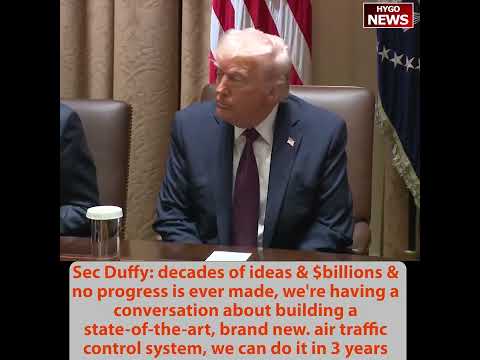
“We had a conversation on Friday,” Duffy said. “Again, our air traffic control system — as we talked about, maybe privately or publicly with all of you — but we have decades of ideas and billions of dollars, and no progress is ever made on any of these initiatives.”
He described the problem as DOGE saw it: “And so we’re having a conversation about building a state-of-the-art, brand new, best technology, envy of the world air traffic control system. And what’s interesting from the DOGE team is they’ll look and say, ‘Well, what is the problem? Why hasn’t this been built? This is about safety. This is about people’s lives. All of you fly. Your family flies. Why hasn’t it been done?’”
Duffy identified the structural obstacle: “And the problem is in government, it takes way too long. So technology changes and money changes and administrations change.”
His solution was to compress the timeline radically: “We have to do this fast, which is why we need the partnership from the Congress to give us the money up front. The best ideas and the best technology available in the world — we’re going to build this system.”
Then the timeline: “I think, Mr. President, we can do it in three years.”
Duffy drew a comparison that appealed to Trump’s identity: “I think Trump Tower was built in three or three and a half years. I think we could match the Trump Tower timeframe.”
He acknowledged the operational complexity: “We have to choreograph — because our towers are operational, keeping planes in the air. So we’ve got to choreograph this. But we can do it in short order.”
The air traffic control system had been a notorious example of government technology failure. Previous modernization efforts — most notably the FAA’s NextGen program — had consumed billions of dollars and decades of time while delivering incremental improvements rather than the transformative upgrade that technology made possible. The system still relied on radar technology developed in the 1950s and 1960s, supplemented by GPS-based systems that had been layered on top rather than built from scratch.
Duffy’s three-year promise was audacious. But the DOGE approach — asking “why hasn’t this been done?” rather than accepting the established timeline — was exactly the kind of first-principles thinking that had built the private sector’s most impressive infrastructure projects on compressed schedules.
The Cabinet Meeting as a Whole
The three secretaries’ reports — Burgum’s waste discovery, Bessent’s economic framework, and Duffy’s infrastructure promise — formed a coherent picture. The government was wasting hundreds of millions on 10-question surveys (Burgum identified the waste), the economy was being restructured to grow the private sector while shrinking government (Bessent described the framework), and the savings and efficiency gains would be redirected toward infrastructure that the government had failed to build for decades (Duffy proposed the investment).
The common thread was a government that had lost the ability to execute its basic functions — conducting surveys that any AI could do for free, managing an economy that produced inflation instead of prosperity, and operating an air traffic control system built on 1950s technology. The Trump administration’s answer was not to reform these systems but to rebuild them from the ground up with private sector efficiency and DOGE oversight.
Key Takeaways
- Interior Secretary Burgum revealed an $830 million survey contract for 10-question forms “anyone’s child in junior high could have put together.” Trump called it “a fraud.”
- Treasury Secretary Bessent outlined the economic vision: “Re-privatizing the economy,” reducing government employment, and channeling workers into new manufacturing jobs.
- Bessent cited progress: mortgage rates down almost every week since January 20th, crude oil down 15%, with further interest rate declines expected.
- Transportation Secretary Duffy proposed building a “state-of-the-art” air traffic control system in three years, asking DOGE’s core question: “Why hasn’t this been built?”
- Duffy said Congress must “give us the money up front” to avoid the decades-long cycle of changing technology, budgets, and administrations that had stalled previous efforts.