 HYGO News
 Bessent: 'One-Third of Treasury Payments Had No Tracking Number -- That's Why They Can't Pass an Audit'; 'CBDC Is Weakness, Not Strength'
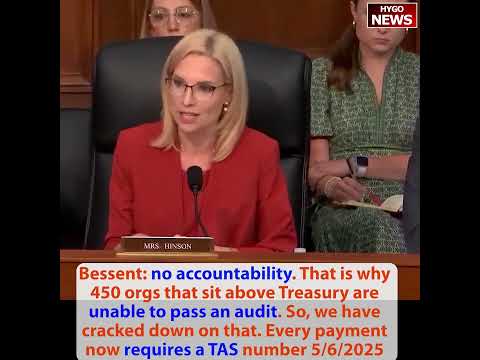
Bessent: “One-Third of Treasury Payments Had No Tracking Number — That’s Why They Can’t Pass an Audit”; “CBDC Is Weakness, Not Strength”
Treasury Secretary Scott Bessent testified before Congress in May 2025, revealing a staggering accountability failure: “Of the 1.5 billion payments we send out every year, more than one-third did not have a TAS number — the Treasury Account Symbol. How can a payment be tracked back to an appropriation? That is why 450 organizations are unable to pass an audit.” He announced that every payment now required a TAS number. On central bank digital currency: “My personal view is that a CBDC is a sign of weakness, not strength. Digital assets belong in the private sector.” On trade: “Perhaps as early as this week we will be announcing trade deals with some of our largest partners. I’d be surprised if we don’t have 80-90% wrapped up by the end of the year."
"One-Third Had No Tracking”
Bessent’s testimony revealed a fundamental failure in federal financial accountability.
“Of the 1.5 billion payments we send out every year, they’re required to have something called a TAS — the Treasury Account Symbol,” Bessent said.
He revealed the finding: “We discovered that more than one-third of those payments did not have a TAS number.”
He explained the consequence: “As the Appropriations Committee, you should be shocked by that, because how can a payment be tracked back to an appropriation? Only through the TAS number.”
He stated the diagnosis: “There was no accountability. That is why the 450 organizations that sit above Treasury, where Treasury acts as the paymaster, are unable to pass an audit.”
He described the fix: “We have cracked down on that. Every payment now requires a TAS number. Very simple.”
He described the staff reaction: “The mid-level employees who I’ve had come into Treasury to talk to me feel liberated. They tell me, ‘I’ve been here 20 years. I’ve always wanted to do this.’ They feel as though they now have agency and are making a difference.”
The TAS number revelation was DOGE’s most systemically important discovery. The Treasury Account Symbol was the basic identifier that connected a federal payment to its congressional appropriation. Without it, there was no way to determine what any given payment was for, which budget it came from, or whether it had been authorized by Congress.
More than one-third of 1.5 billion annual payments — roughly 500 million payments — lacked this basic identifier. This meant that roughly $1.5-2 trillion in annual spending was completely untrackable. Congress could not audit it. Inspectors general could not review it. The GAO could not analyze it. The money simply disappeared into the federal system with no record of its purpose.
The fix — requiring a TAS number on every payment — was so simple that it highlighted the absurdity of the previous system. The tracking number already existed as a requirement. It simply wasn’t being enforced. The fact that “mid-level employees” had wanted to enforce it for years but were prevented by “complacent upper-level management” suggested that the lack of tracking was not accidental but tolerated because it benefited those who preferred untrackable spending.
”CBDC Is Weakness”
Bessent delivered the administration’s definitive position on central bank digital currency.
“Sir, we believe that digital assets belong in the private sector,” Bessent said.
He stated his personal view: “My personal view is that having a central bank digital currency is a sign of weakness, not strength.”
He explained: “Really, the reason — if a reserve manager or foreign central bank holds U.S. dollars, there is a wide variety of U.S. assets they can invest in.”
He argued: “You would create a central bank digital currency just for ease of use because there are no good choices for underlying assets.”
When asked directly: “You would not be in favor of the Federal Reserve issuing such a currency?”
“No, sir,” Bessent confirmed.
The “weakness, not strength” assessment inverted the narrative promoted by CBDC advocates. Countries like China that were developing state-controlled digital currencies were doing so because their financial systems lacked the depth and trustworthiness of the American system. The U.S. dollar’s dominance was built on a broad, liquid market of Treasury bonds, equities, and real estate that foreign holders could invest in. A CBDC added nothing to that ecosystem and risked government surveillance of private transactions.
Trade Deals “This Week”
Bessent previewed imminent announcements.
“Approximately 97 or 98% of our trade deficit is with 15 countries,” Bessent said. “18 of the countries are our major trading partners.”
He set expectations: “I would be surprised if we don’t have more than 80 or 90% of those wrapped up by the end of the year. That may be much sooner.”
He made the announcement: “Perhaps as early as this week we will be announcing trade deals with some of our largest trading partners. They have come to us with very good offers.”
He noted the irony: “In negotiating with some of them, they may not like the tariffs President Trump has put up, but they have them. So if tariffs are so bad, why do they like them?”
He identified the real barrier: “More insidious are the non-tariff barriers. If you look prior to the escalation, Chinese tariffs were only 5%. So clearly there is something else going on if they are accumulating these gigantic surpluses.”
The “as early as this week” timeline confirmed Trump’s earlier hints about imminent deals. Bessent’s specification that 80-90% of major trading relationships would be resolved by year-end provided the most concrete timeline any official had offered for the trade restructuring.
His observation about non-tariff barriers was economically crucial. China’s official tariff rate of 5% was misleading because the real barriers to American exports were not tariffs but regulatory obstacles, licensing requirements, intellectual property theft, subsidies to domestic competitors, and currency manipulation. These non-tariff barriers were harder to quantify but often more effective at blocking trade than explicit tariffs.
Key Takeaways
- Bessent revealed one-third of Treasury’s 1.5 billion annual payments lacked tracking numbers — “that’s why 450 organizations can’t pass an audit.”
- Fix implemented: every payment now requires a TAS number. Career staff “feel liberated — they’ve wanted this for 20 years.”
- On CBDC: “A sign of weakness, not strength. Digital assets belong in the private sector.” The Fed should not issue one.
- Trade deals “as early as this week with some of our largest partners. 80-90% wrapped up by end of year.”
- On China: “Official tariffs were only 5%. Something else is going on if they’re accumulating gigantic surpluses” — non-tariff barriers.