 HYGO News
 Bessent Blasts IMF: 'Whistling Past the Graveyard' on Climate and Gender; Demands China 'Needs to Change' Its Export Model
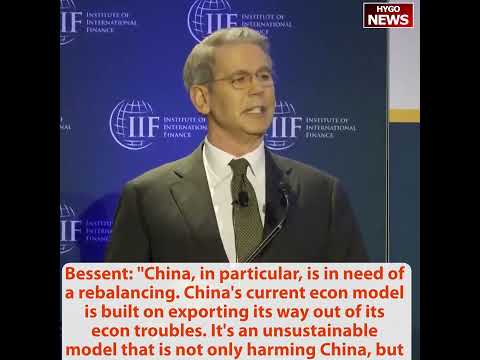
Bessent Blasts IMF: “Whistling Past the Graveyard” on Climate and Gender; Demands China “Needs to Change” Its Export Model
Treasury Secretary Scott Bessent delivered a blistering address to the International Monetary Fund in April 2025, accusing the institution of abandoning its core mission. “The IMF was once unwavering in promoting global monetary cooperation and financial stability,” Bessent said. “Now it devotes disproportionate time and resources to climate change, gender, and social issues. These issues are not the IMF’s mission.” He demanded the IMF “be a brutal truth teller” about China’s “globally distortive policies and opaque currency practices,” declaring: “China’s current economic model is built on exporting its way out of its economic troubles. It’s an unsustainable model harming not only China but the entire world.” He closed with the defining formulation: “America First does not mean America alone. It is a call for deeper collaboration and mutual respect."
"Whistling Past the Graveyard”
Bessent opened with a diagnosis of institutional failure.
“The IMF was once unwavering in its mission of promoting global monetary cooperation and financial stability,” he said. “Now it devotes disproportionate time and resources to work on climate change, gender, and social issues.”
He stated the consequence: “These issues are not the IMF’s mission. And the IMF’s focus in these areas is crowding out its work on critical macroeconomic issues.”
He set the standard: “The IMF must be a brutal truth teller, and not just to some members.”
He delivered the verdict: “Today, the IMF has been whistling past the graveyard.”
He cited specific evidence: “Its 2024 external sector report was entitled ‘Imbalances Receding.’ This Pollyanna’s outlook is symptomatic of an institution more dedicated to preserving the status quo than answering the hard questions.”
The “whistling past the graveyard” metaphor captured the administration’s assessment of international institutions that had been captured by progressive ideology at the expense of their original mandates. The IMF had been created in 1944 at the Bretton Woods conference with a specific mission: maintaining global monetary stability, facilitating international trade, and providing financial assistance to countries in crisis.
Instead, the institution had increasingly devoted its resources, staff, and publications to climate change analysis, gender equality metrics, and social justice programming. While these might be worthy topics for other organizations, they were not the IMF’s mandate — and every hour spent on climate modeling was an hour not spent analyzing currency manipulation, trade imbalances, and sovereign debt sustainability.
Bessent’s accusation that the IMF had called imbalances “receding” when they were actually worsening was the most specific charge. China’s trade surplus with the world had grown to record levels. The U.S. trade deficit had expanded to nearly $2 trillion. Currency manipulation was rampant among developing nations. For the IMF to characterize this environment as one of “receding imbalances” was either incompetent analysis or deliberate deception.
”China Needs to Change”
Bessent directed the most sustained criticism at China’s economic model.
“In line with its core mandate, the IMF needs to call out countries like China that have pursued globally distortive policies and opaque currency practices for many decades,” Bessent said.
He added a broader demand: “I also expect the IMF to call out unsustainable lending practices by certain creditor countries.”
He focused the critique: “China in particular is in need of a rebalancing. Recent data shows the Chinese economy tilting even further away from consumption toward manufacturing.”
He described the structural problem: “China’s economic system, with growth driven by manufacturing exports, will continue to create even more serious imbalances with its trading partners if the status quo is allowed to continue.”
He stated the core diagnosis: “China’s current economic model is built on exporting its way out of its economic troubles. It’s an unsustainable model that is not only harming China, but the entire world.”
He demanded action: “China needs to change. The country knows it needs to change. Everyone knows it needs to change, and we want to help it change because we need rebalancing too.”
He prescribed the solution: “China can start by moving its economy away from export overcapacity and toward supporting its own consumers and domestic demand. Such a shift would help with the global rebalancing that the world desperately needs.”
The “exporting its way out of economic troubles” diagnosis was the most important economic observation in the speech. China’s domestic economy was struggling — a real estate crisis, youth unemployment, and declining consumer confidence. Rather than addressing these internal problems through domestic reform, China was flooding global markets with subsidized manufactured goods, suppressing domestic consumption to maintain export competitiveness.
This strategy worked for China in the short term but devastated trading partners. When China exported below-cost steel, it destroyed steel industries in the United States, Europe, and developing nations. When China exported subsidized solar panels, it eliminated domestic solar manufacturing in countries that might otherwise have built their own industries. The global economy was being distorted by a single country’s decision to solve its internal problems by offloading them onto the rest of the world.
The American Fiscal Acknowledgment
Bessent demonstrated intellectual honesty by acknowledging America’s own problems.
“Here in the United States, we know we need to get our fiscal house in order,” he said. “The last administration ran up the largest peacetime deficit in our nation’s history. The current administration is committed to fixing this.”
He then set the terms: “We are open to critique, but we will not abide the IMF failing to critique the countries that most need it. Principally surplus countries.”
The willingness to acknowledge America’s fiscal problems while demanding accountability from others was a departure from both Trump’s first-term approach and the Obama-Biden approach. Previous administrations had either ignored America’s deficits (Biden) or ignored other countries’ surpluses (Obama). Bessent was doing neither — acknowledging the deficit problem while demanding that surplus countries like China receive equal scrutiny.
The phrase “principally surplus countries” was diplomatic language for China, Germany, and a handful of other nations that ran persistent trade surpluses with the rest of the world. These surpluses were the mirror image of America’s deficits. For every dollar America overspent on imports, a surplus country received a dollar of excess export revenue. Addressing global imbalances required both sides to adjust — America reducing its deficits and surplus countries boosting domestic consumption.
”America First Does Not Mean America Alone”
Bessent closed with the most important reframing of the administration’s international posture.
“I wish to be clear: America First does not mean America alone,” he said. “To the contrary, it is a call for deeper collaboration and mutual respect among trade partners.”
He continued: “Far from stepping back, America First seeks to expand U.S. leadership in international institutions like the IMF and the World Bank.”
He concluded: “By embracing a stronger leadership role, America First seeks to restore fairness to the international economic system.”
The “not America alone” formulation addressed the most common criticism of the Trump administration’s trade and foreign policy: that America First was isolationist, that tariffs would trigger trade wars, and that withdrawing from multilateral consensus would leave America without allies.
Bessent was arguing the opposite. America First was not a retreat from international institutions but a demand that those institutions serve their intended purposes. The IMF should analyze trade imbalances, not climate change. The World Bank should fund development, not DEI programs. International trade should be fair and reciprocal, not rigged against America. By insisting on these reforms, the United States was not abandoning international cooperation — it was demanding that international cooperation actually work.
Key Takeaways
- Bessent accused the IMF of abandoning its mission: “Disproportionate time on climate change, gender, and social issues. These are not the IMF’s mission.”
- He called the IMF “whistling past the graveyard” for claiming imbalances were receding when they were growing.
- On China: “Its model is built on exporting its way out of economic troubles. It’s unsustainable, harming China and the entire world. China needs to change.”
- Bessent acknowledged U.S. deficits: “We know we need to get our fiscal house in order. The last administration ran the largest peacetime deficit in history.”
- Defining statement: “America First does not mean America alone. It is a call for deeper collaboration and mutual respect among trade partners.”