 HYGO News
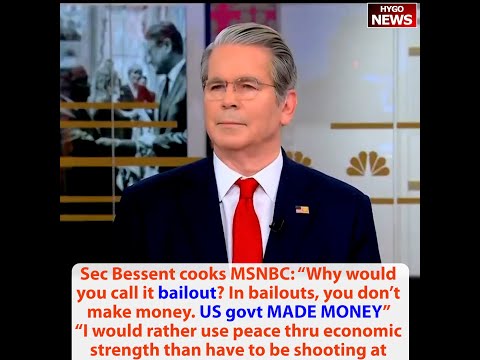
 Sec Bessent cooks MSNBC: bailout? US govt MADE MONEY; Bernie Sanders: more far-left like Mamdani
Sec Bessent cooks MSNBC: bailout? US govt MADE MONEY; Bernie Sanders: more far-left like Mamdani
Treasury Secretary Scott Bessent decisively rebuked MSNBC’s “$20 billion bailout” framing of U.S.-Argentina currency stabilization. Bessent’s counter: the transaction was a currency swap line, not a bailout — the U.S. government made money. The stabilization helped Argentina’s President Milei win reelection in a landslide, preventing regime change that would have required expensive drug interdiction elsewhere. “Peace through economic strength” is cheaper than shooting narco boats. Bessent noted a generational opportunity in Latin America: Bolivia, Colombia, Ecuador, Chile all moving right. Bernie Sanders announced Democrats would push more far-left candidates like Zohran Mamdani — three Senate candidates identified, plus many House candidates, building the Mamdani model nationally. Rep. Ro Khanna called for Schumer to resign, citing Schumer’s Iraq War support, Netanyahu blank check, and two shutdown losses: “It’s time for you to gracefully make way for a new generation.” Khanna acknowledged Schumer’s CHIPS Act and IRA accomplishments but said Schumer has “lost touch with where the base of the party is.” Sen. Chris Murphy called the shutdown resolution “capitulation to Trump” because Democrats “lose leverage” — treating American suffering as political leverage. Bessent: “Why would you call it a bailout? In most bailouts, you don’t make money. The US government made money.” Sanders: “We’re going to build that movement, grassroots movement to do what Mamdani did in New York City all over this country.” Khanna: “It’s time for you to gracefully make way for a new generation.”
Argentina “Bailout” Mischaracterization
MSNBC reporter’s framing. “How does a $20 billion bailout of Argentina help Americans? You’re the president’s point person on that. Can you explain to those here who are feeling the pinch, including America’s farmers, why the United States is helping out Argentina?”
The framing is a political attack dressed as a question:
- “Bailout” (contentious term)
- “$20 billion” (specific large number)
- “Help Americans” (skeptical framing)
- American farmers feeling pinch (positioned as being denied)
- Why helping Argentina (over American priorities)
Bessent’s Technical Response
“Well, can you, do you know what a swap line is? It’s currency swap, yes.”
Bessent opened with a question testing the reporter’s basic knowledge.
“Yes, but what is that? That’s, you’re the Treasury Secretary. Yes, but why would you call it a bailout?”
Bessent’s point: the reporter is framing this as “bailout” without understanding what actually happened. A swap line is not a bailout. The terminology itself is politically loaded.
“That is how… In most bailouts, you don’t make money. The US government made money.”
The devastating specific: in a bailout, the U.S. loses money or exposes itself to loss. In this Argentina transaction, the U.S. government profited.
Currency Swap Mechanics
“We use their financial balance sheet to stabilize the government, our one of our great allies in Latin America, during an election, the president, they’re one, they’re in a landslide, the government’s going to make money.”
The structure:
- U.S. extends swap line (credit line)
- Argentina uses it to stabilize peso
- Stabilized peso allows Milei to win election
- Stabilization maintained as Milei’s reforms continue
- Interest and fees flow to U.S. Treasury
The U.S. didn’t give Argentina $20 billion. The U.S. extended a credit facility — Argentina draws on it when needed, pays interest and fees, the U.S. treasury earns returns.
“I would rather use peace through economic strength than have to be shooting at narco boats coming offshore if the government collapsed."
"Peace Through Economic Strength”
Bessent’s framework: if Argentina had collapsed economically:
- Milei’s reform government fails
- Leftist government returns
- Corruption and narco-trafficking resume
- Drugs flow north through Argentina to U.S.
- U.S. must expand drug interdiction operations
The cost: failed Argentina = more expensive drug war. Stabilized Argentina = cheaper overall.
The “peace through economic strength” framework parallels Trump’s “peace through strength” — financial leverage achieves stability at lower cost than military action.
Generational Opportunity
“We have a generational opportunity in Latin America to create allies.”
Bessent’s framework: Latin America is moving right. U.S. should capitalize.
“We just saw an election in Bolivia, we’re probably going to see an election in Colombia, we’ve seen them in Ecuador, we’re going to see them in Chile.”
The Latin American political trajectory:
- Bolivia: Rodrigo Paz (center-right) won, ending MAS/socialist dominance
- Colombia: Petro (leftist) president, but coming election could shift
- Ecuador: Daniel Noboa (center-right) succeeding in reelection
- Chile: moving from Boric (leftist) potentially to right
Combined with Milei’s consolidation in Argentina, Latin America could become majority center-right within a few years. This reverses a 25-year “pink tide” of leftist dominance.
“So by stabilizing the economy there and making a profit, then that’s a very good deal for the American people.”
Farmer Deflection
“There’s a lot we could have been doing for American farmers, but Democrats closed the government.”
Bessent turned back to the reporter’s framing. American farmers feeling pinch? Not because of Argentina support — because Democrats closed the government, preventing farm programs, disaster aid, and trade promotion funds.
Bernie Sanders on Mamdani Model
Bernie Sanders then delivered extraordinary framework. “So what we have got to do is go above and beyond what happened yesterday, that terrible, terrible vote and understand that yes, you are parts of the democratic establishment, well, way, way out of touch with where the American people are or where we have got to go.”
The “terrible vote” was the Senate vote ending the shutdown — Democrats “capitulating” (per Sanders’s framework) to reopen the government.
Sanders’ diagnosis: Democratic establishment is out of touch.
“And our job is to build a political movement, we are doing it with the three candidates for the Senate, I expect more to come with many candidates in the house, candidates all over this country running for local office.”
Sanders outlined specific electoral strategy:
- 3 Senate candidates (Mamdani-style progressives)
- Many House candidates
- Local office candidates
- National movement
“We’re going to build that movement, grassroots movement to do what Mamdani did in New York City all over this country.”
The Mamdani model:
- Socialist policy platform (rent freezes, city-owned groceries, wealth taxes)
- Grassroots organizing
- Young voter mobilization
- Aggressive social media
- Progressive primary challenges
Sanders’ framework: replicate Mamdani’s NYC success nationally. Build the Democratic Socialists of America (DSA) into a dominant force in Democratic primaries.
Khanna vs Schumer
Rep. Ro Khanna (D-CA) was asked about Schumer’s leadership. “If Chuck Schumer called you today, or he dropped by your office or you went by his office, what would you say to him?”
“I’d say, look, Senator, it’s not personal, I respect some of the things you’ve accomplished in your career.”
Khanna’s framework opens politely.
“I get that we would not have had the Chips and Science Act if it weren’t for your leadership. I get that we would not have had the Inflation Reduction Act, but for your leadership. I appreciated what you did with the bipartisan infrastructure bill.”
Khanna credited Schumer’s legitimate accomplishments:
- CHIPS and Science Act (2022) — semiconductor manufacturing incentives
- Inflation Reduction Act (2022) — climate/energy/healthcare
- Bipartisan Infrastructure Framework (2021)
“Lost Touch”
“You know what? You’ve just lost touch with where the base of the party is. You’ve lost touch on foreign policy where you supported the war in Iraq and then a blank check to Netanyahu and you refused to endorse Mamdani.”
Khanna’s charges against Schumer:
- Iraq War support (2003 vote in favor)
- “Blank check” to Israeli PM Netanyahu (unconditional support)
- Refused to endorse Mamdani (NYC mayor-elect)
These are progressive grievances. The Iraq War vote is ancient history but still held against politicians by Bernie-aligned progressives. Israel support — Schumer is one of the most pro-Israel senators — conflicts with progressive sympathy for Palestinians. Mamdani refusal reflects Schumer’s moderate instincts.
“And then this is the second time you’ve had the shutdown fight and you’ve caved both times. And it’s time for you to gracefully make way for a new generation.”
Khanna’s final charge: Schumer caved twice on shutdowns. The 2025 shutdown resolution (Democrats voting to end it with 5 senators crossing over) was Schumer’s second cave. Progressive wing wanted continued resistance.
“Gracefully make way for a new generation” = resign.
Murphy on “Leverage”
Sen. Chris Murphy (D-CT) was asked about fellow Sen. Tim Kaine (D-VA) supporting the deal.
Interviewer: “Senator Kain laid out his reasons for supporting the deal. He says it ends the pain that Americans are feeling, gets a path to a healthcare vote. And he says previously, there was no evidence Republicans would even talk about a healthcare vote without the government back open. Is he wrong?”
Kaine’s framework: end shutdown pain, get healthcare vote anyway. Murphy was asked to explain his disagreement.
“Well, Tim and I just have a disagreement about this. I think we actually lose leverage in our fight for Americans now that we have capitulated down Trump without any real protections for people’s healthcare or our democracy in the short term funding bill.”
Murphy’s framework:
- Ending shutdown = “capitulated to Trump”
- Losing leverage on healthcare
- No “real protections for people’s healthcare”
- Also no “protections for our democracy”
Murphy characterizes resolving the crisis as surrender. The “leverage” framework (even after Democrats were losing the blame war) still dominates his thinking.
Significance
The day captured Democratic Party internal fracturing:
-
Bessent’s expertise vs media narratives: Bessent systematically destroyed MSNBC’s Argentina framing. The technical facts favor Trump administration strategy.
-
Sanders’ progressive push: Mamdani as national model means Democrats moving further left. Already unpopular shutdown stance reflects this.
-
Khanna’s call for Schumer resignation: Progressive wing openly demanding Schumer ouster. Progressive-moderate split widening.
-
Murphy’s continued leverage framework: Despite lost battle, some Democrats still think suffering Americans = leverage.
The shutdown resolution was underway as these statements were made. The Democratic post-mortem would be bitter. Schumer’s leadership was under attack from progressives (Khanna) while centrists (Kelly) dodged questions about his future. Murphy wanted to continue fighting; Kaine had voted to end the fight.
Republicans were unified. Democrats were fracturing. This is what post-crisis politics often looks like — unity in opposition collapses into internal accountability conflicts.
Key Takeaways
- Bessent to MSNBC on Argentina: “Why would you call it a bailout? In most bailouts, you don’t make money. The US government made money … I would rather use peace through economic strength than have to be shooting at narco boats coming offshore if the government collapsed.”
- Bessent on Latin America: “We have a generational opportunity in Latin America to create allies. We just saw an election in Bolivia, we’re probably going to see an election in Colombia, we’ve seen them in Ecuador, we’re going to see them in Chile.”
- Sanders on Mamdani national model: “We’re going to build that movement, grassroots movement to do what Mamdani did in New York City all over this country.”
- Khanna to Schumer: “You’ve just lost touch with where the base of the party is. You’ve lost touch on foreign policy where you supported the war in Iraq and then a blank check to Netanyahu and you refused to endorse Mamdani. And then this is the second time you’ve had the shutdown fight and you’ve caved both times. And it’s time for you to gracefully make way for a new generation.”
- Murphy on ending shutdown: “I think we actually lose leverage in our fight for Americans now that we have capitulated down Trump without any real protections for people’s healthcare or our democracy.”