 HYGO News
 Dr. Sean Conley & Team Update: Trump could return to WH 'as early as tomorrow' 10/4/2020
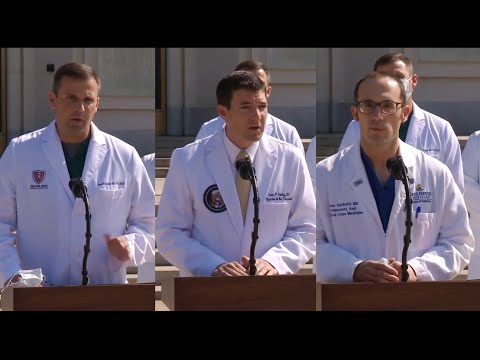
Dr. Sean Conley & Team Update: Trump Could Return to White House ‘as Early as Tomorrow’
On October 4, 2020, White House physician Dr. Sean Conley led a medical team briefing at Walter Reed National Military Medical Center and acknowledged that he had previously withheld information about two episodes of transient drops in President Trump’s blood oxygen saturation. Conley admitted that during Saturday’s briefing he omitted the alarming oxygen drops because he wanted to “reflect the upbeat attitude” of the team and the president and did not want to “give any information that might steer the course of illness in another direction.” Despite the transparency controversy, the team reported significant improvement and said they hoped to plan for a discharge to the White House as early as the following day.
Conley Admits Omitting Oxygen Details
The most consequential moment of the briefing came when Dr. Conley directly addressed questions about why he had not disclosed the president’s oxygen episodes during Saturday’s press conference. Reporters had noted that minutes after Saturday’s briefing, White House Chief of Staff Mark Meadows had told reporters that the president’s vitals were “very concerning over the past 24 hours,” directly contradicting the optimistic picture Conley had presented.
Conley explained his reasoning: “I was trying to reflect the upbeat attitude that the team, the president, that his course of illness has had, didn’t want to give any information that might steer the course of illness in another direction. And in doing so, you know, it came off that we were trying to hide something, which wasn’t necessarily true.”
When asked whose statements the American people should believe, Conley said Meadows’s remarks had been “misconstrued” and that what Meadows meant was that 24 hours earlier, “there was that momentary episode of the high fever and that temporary drop in the saturation, which prompted us to act expediently to move him up here.”
Two Episodes of Oxygen Drops
Conley provided a detailed clinical timeline of the president’s illness. He revealed that over the course of Trump’s hospitalization, the president had experienced two separate episodes of transient drops in oxygen saturation.
The first and more significant episode occurred late Friday morning. Conley described it in clinical terms: “Late Friday morning when I returned to the bedside, the president had a high fever and his oxygen saturation was transiently dipping below 94 percent. Given these two developments, I was concerned for possible rapid progression of the illness.”
Conley said he recommended supplemental oxygen but that Trump “was fairly adamant that he didn’t need it. He was not short of breath. He was tired, had the fever and that was about it.” After approximately one minute on two liters of supplemental oxygen, Trump’s saturation levels returned above 90 percent. He remained on oxygen for about an hour before it was removed.
The second episode occurred on Saturday. “Yesterday there was another episode where he dropped down about 93 percent,” Conley reported. “He doesn’t ever feel short of breath. We watched it and it returned back up.” When asked whether the president had received supplemental oxygen during the second episode, Conley said, “I’d have to check with the nursing staff. I don’t think that if he did, it was very limited, but it’s not on oxygen.” He confirmed that at the time of the briefing, Trump’s oxygen saturation was at 98 percent.
Conley was also asked whether oxygen levels had ever dipped below 90 percent. “No, it was below 94 percent. It wasn’t down into the low 80s or anything,” he confirmed.
Dexamethasone Therapy Initiated
In response to the oxygen episodes and the timeline of the illness, the medical team initiated dexamethasone therapy. Conley explained that the team “debated whether we’d even start it” and “decided that in this case, the potential benefits early on the course probably outweighed any risks at this time.” Trump received his first dose of dexamethasone on Saturday.
The decision to use dexamethasone drew scrutiny because clinical guidelines at the time generally recommended the steroid for patients with more serious illness requiring oxygen support, raising questions about the severity of Trump’s condition.
Dr. Dooley: Stable Vital Signs and Organ Function
Dr. Sean Dooley, a pulmonologist at Walter Reed, provided an update on the president’s broader clinical status. He reported that Trump had remained without a fever since Friday morning and that his vital signs were stable. “From a pulmonary standpoint, he remains on room air this morning and is not complaining of shortness of breath or other significant respiratory symptoms,” Dooley said.
Dooley confirmed that monitoring of cardiac, liver, and kidney function showed “continued normal findings or improving findings.” He added that the president was “ambulating himself, walking around the White House medical unit without limitation or disability.”
When asked about lung imaging, Conley noted there were “some expected findings but nothing of any major clinical concern.” On lung function testing, he said, “He’s maxing it out. We told him, see what you can do, and it’s over 2,500 milliliters each time.”
Dr. Garibaldi: Remdesivir Course Continues
Dr. Brian Garibaldi of Johns Hopkins Hospital in Baltimore reported that Trump had completed his second dose of remdesivir the previous evening and had tolerated the infusion well with no detectable side effects. His team planned to continue with a five-day treatment course.
Garibaldi outlined the plan for the day: “Today he feels well. He’s been up and around. Our plan for today is to have him to eat and drink, be up out of bed as much as possible, to be mobile. And if he continues to look and feel as well as he does today, our hope is that we can plan for a discharge as early as tomorrow to the White House where he can continue his treatment course.”
Key Takeaways
- Dr. Conley admitted he had omitted information about the president’s oxygen drops during Saturday’s briefing to “reflect the upbeat attitude” of the team, acknowledging that “it came off that we were trying to hide something.”
- Trump experienced two transient episodes of oxygen desaturation, dipping below 94 percent on Friday and to about 93 percent on Saturday, prompting the initiation of dexamethasone therapy in addition to his ongoing remdesivir course.
- The medical team reported that by Sunday morning Trump’s oxygen was at 98 percent with normal organ function, and they expressed hope for a possible discharge to the White House the following day to continue treatment.