 HYGO News
 Schumer: strong GDP number are 'mirage'; Trump: lower interest rates, no inflation, 8/1 very big day
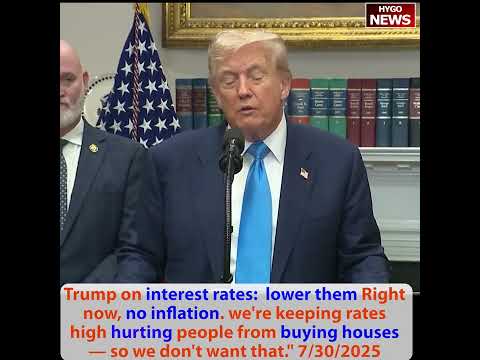
Schumer: strong GDP number are ‘mirage’; Trump: lower interest rates, no inflation, 8/1 very big day
Senator Chuck Schumer dismissed the strong Q2 GDP figure as a “mirage” — citing a 3.1% drop in business investment as the underlying worry — and warned “Donald Trump’s tariffs are weighing down the U.S. economy.” Trump’s response cataloged the incoming tariff revenue and investment commitments: Japan’s $550 billion, the EU’s $750 billion + $400 billion + $300 billion components, plus many other countries. And Trump restated the interest-rate case: “Each point that this gentleman keeps up costs us $365 billion a year … We’re 38, number 38 because of the Fed. It’s all because of the Fed.” Trump on the pace: Powell has a meeting today but apparently will not cut until September: “For what reason? Nobody knows. But Europe, as you know, cut their rates 11 times in the last short period of time.” August 1 “is a very big day for this country because money is going to pour into the United States like we’ve never seen before."
"GDP Number Is a Mirage”
Schumer’s characterization. “And while the Trump administration will try to wave rosy headlines about the Q2 number, today’s GDP number is in fact a mirage because some ominous numbers lurk under the hood.”
“Mirage.” That is the Democratic framing for the 3.0% Q2 GDP growth. Not a real economic win. A surface-level number masking underlying problems.
“Business investment plunged in the second quarter by 3.1 percent. The fact that business investment plunged so starkly is very troubling.”
Business investment down 3.1%. That is the specific underlying data point Schumer is citing. If businesses are not investing, future growth is compromised. Lower capital formation produces lower productivity, slower job growth, and weaker long-term economic capacity.
“It shows that already businesses are worried about growing their operations, worried about hiring more workers, worried about trading with their international partners, and worried in general about the future.”
That is Schumer’s interpretation of the investment drop. Businesses are making decisions that reflect anxiety about the future. If those anxious businesses are correct in their concerns, the current GDP growth cannot be sustained.
”Tariffs Are Weighing Down the Economy”
“And this number is another data point in a larger pattern. Donald Trump’s tariffs are weighing down the U.S. economy, spiking costs for small businesses and families alike.”
Tariffs as the cause. That is Schumer’s causal claim. Whatever the actual economic data shows, Schumer attributes negative elements to tariff policy and positive elements to other factors.
“And if Donald Trump keeps up the chaos, the dangers for the economy will continue to get worse.”
“Chaos” is the characterization. Trump’s trade policy, in Schumer’s framing, is not rational policymaking. It is chaotic behavior that threatens the economy.
The counter-view, from the administration: the policy is coherent. It has specific objectives (reshoring, tariff revenue, market opening). It is producing measurable results (strong GDP, low inflation, investment commitments, trade deals). Schumer’s “chaos” framing is political characterization rather than empirical description.
The Business-Investment Puzzle
The drop in business investment has multiple possible interpretations:
Schumer’s interpretation: businesses are worried about tariffs, so they are holding back on investment.
Alternative interpretation: businesses made large investments earlier (including in Q1 2025 and the prior quarters) in anticipation of the tariff regime, and Q2 represents the expected moderation as those earlier investments converted to operational phases.
Another alternative: specific industry slowdowns (say, real estate construction due to high rates) are pulling down the aggregate investment figure while other categories (manufacturing, tech) continue strong.
Which interpretation is correct will be revealed in subsequent quarters’ data. But Schumer’s interpretation is not the only reading, and the broader indicators — record stock markets, GDP growth, low inflation, strong tariff revenue — do not suggest an economy in distress.
”August 1st Is a Very Big Day”
Trump’s framing of the upcoming tariff escalation. “The biggest versus a very big day for this country because money is going to pour into the United States like we’ve never seen before.”
August 1 is the date the expanded tariff schedule fully activates for countries that have not negotiated bilateral deals. The countries that did negotiate (Japan, EU, UK, Indonesia, Philippines, etc.) get their specific deal terms. Everyone else pays the unilateral tariff rates.
“Money is going to pour into the United States like we’ve never seen before.” That is the revenue projection. Tariff collections at annualized scales in the hundreds of billions, combined with the investment commitments from the bilateral deals, produce a scale of inflow that Trump is characterizing as historically unprecedented.
”Right Now There’s No Inflation”
Trump on interest rates. “What you do is you lower them and let’s see if there’s inflation. Right now there’s no inflation. Everybody thought there would be.”
“No inflation” is Trump’s summary of the current data. Headline CPI near target. Core CPI below expectations. PPI flat. Those are the measurements. The pre-tariff predictions of inflation spikes have not materialized.
“Everybody thought there would be” is the contrast. The consensus economic forecast — from Wall Street economists, academic economists, IMF analyses, and similar — was that tariffs would drive inflation. That forecast was wrong.
“All we have is billions of dollars of cash pouring into our country from other countries that took advantage of us for many, many years.”
That is Trump’s characterization of the tariff dynamic. Not inflation. Not consumer harm. Revenue inflow. Foreign countries paying what they should have been paying for years of asymmetric trade treatment.
”The Stupid People”
“They were taken advantage of. We were like the stupid people that didn’t know what they were doing. They took advantage of us. The country’s friend and foe. And by the way, the friend was oftentimes much worse than the foe when it comes to trade.”
“The friend was oftentimes much worse than the foe.” That is Trump’s characterization of the trade asymmetry. Allies like Germany, Japan, South Korea, Canada — countries the U.S. defends militarily at significant cost — have been the biggest beneficiaries of asymmetric trade treatment. Hostile countries like China and Russia have different postures that have received more political attention, but the largest commercial asymmetries have been with allies.
That framing is provocative. It reframes longstanding diplomatic arrangements as exploitative. It positions allies as having benefited from American generosity while returning unfavorable trade terms. Whether European or Asian allies accept that characterization varies — some do, some don’t. But the framing captures something real about the economic arithmetic.
”We Should Be Lowering the Rates”
“So if that happens, what you do is you raise your rates and you do what you have to do to stop inflation. But we’re keeping the rates high and it’s hurting people from buying houses.”
That is Trump’s monetary-policy theory. Raise rates when inflation threatens. Lower rates when inflation is absent. Current data suggests inflation is absent. Therefore current policy should be lower rates.
“We don’t want that if for any reason that happened in a year or two, if there’s some signs of inflation coming back, right now there’s not.”
Trump acknowledging the contingency. If inflation returns in the future, the Fed can raise rates again. But right now, there is no inflation, so there is no reason to maintain rates at levels that constrain mortgage markets.
“We have a great thing going. I think we’re going to have the richest economy you’ve ever seen. We have money coming in that we’ve never even thought about at numbers that nobody’s ever seen before.”
The Investment Commitments
Trump cataloged the incoming commitments. “We have a deal with Japan where they’re going to pay us $550 billion. We have a deal with Europe where they’re doing $750 billion plus $400 billion plus $300 billion. And many other countries, it’s likewise, you know, relatively, those are two big ones, but likewise.”
Japan: $550 billion. EU: $750 billion (energy) + $400 billion (military, per some calculations) + $300 billion (other investments). That aggregates to approximately $1.45 trillion from the EU alone, with Japan’s $550 billion on top.
“So we have a lot of money coming in and we have no inflation and we’re very strong and we should be lowering the rates."
"$365 Billion a Year”
Trump’s interest-rate cost arithmetic. “You know, each point that this gentleman keeps up costs us $365 billion a year. Think of that. One point, $365 billion. If you bring it down a point, we save $365 billion.”
$365 billion per percentage point of federal borrowing cost. Applied against the stock of federal debt, each percentage point of interest-rate difference produces about $365 billion in annual federal interest expense.
“We should be the lowest interest rate. And we’re not. We’re 38, number 38 because of the Fed. It’s all because of the Fed.”
“Number 38” is Trump’s ranking of U.S. interest rates globally. 37 other countries have lower policy rates than the U.S. According to Trump, the U.S. economy’s strength warrants the lowest or near-lowest rates globally. The Fed’s refusal to cut is keeping the U.S. at number 38.
Powell: “I Call Him Too Late”
“He’s got a bad job. You know, he’s got a meeting today, but I call him too late. You know, he’s always too late. Even if he does it today, he probably won’t. I hear they’re going to do it in September, not today.”
“Too late” — Trump’s persistent characterization of Powell’s rate-cut timing. The Fed apparently has a meeting scheduled. Rumors suggest the cut will come in September, not at the current meeting.
“For what reason? Nobody knows.”
That is Trump’s frustration. The economy supports cuts. The data supports cuts. Inflation is absent. Yet the Fed is delaying. Trump cannot identify the analytical basis for the delay.
”Europe Cut Their Rates 11 Times”
“But Europe, as you know, cut their rates 11 times in the last short period of time. But the good news is we’re doing better than anybody, anywhere in the world. Nobody’s doing anything even close to us, even with the higher rates.”
The ECB comparison. The European Central Bank has cut rates 11 times in recent cycles. The Fed has held. Yet the U.S. is outperforming Europe economically, which suggests the U.S. economy can absorb rate cuts even more easily than the European economy that has already gotten them.
“The higher rates do affect housing, though, because people can’t go out and get a loan or refinance their house. And it would be nice to have them be able to do that. That would be just another check of a box that would be very important.”
The specific housing connection. American mortgage rates, tied to the 10-year Treasury yield which in turn reflects Fed policy, remain significantly elevated. Home buying is constrained. Refinancing is blocked for many households. Rate cuts would ease both problems.
Two Framings
Schumer says the economy is a mirage, tariffs are causing damage, business investment is dropping. Trump says the economy is the richest ever, tariffs are producing revenue and market openings, rates should be lower because inflation is absent.
Both framings cannot be correct. The underlying data — 3.0% GDP growth, contained inflation, record stock markets, strong tariff revenue — supports Trump’s framing more than Schumer’s. Business investment dropping 3.1% in a single quarter is a data point worth watching, but not the dominant indicator.
The test: does Q3 2025 and beyond confirm or disconfirm the strength of the current expansion? If growth continues, inflation stays low, and markets hold, Trump’s framing is vindicated. If business investment continues declining and slower growth follows, Schumer’s framing gains ground.
Key Takeaways
- Sen. Chuck Schumer called the 3.0% Q2 GDP number “a mirage” — citing “business investment plunged … by 3.1 percent” as underlying worry.
- Schumer: “Donald Trump’s tariffs are weighing down the U.S. economy, spiking costs for small businesses and families alike.”
- Trump: “August 1st is a very big day for this country because money is going to pour into the United States like we’ve never seen before.”
- Trump on rates: “What you do is you lower them … Right now there’s no inflation … we’re keeping the rates high and it’s hurting people from buying houses.”
- Interest-rate cost arithmetic: “Each point that this gentleman keeps up costs us $365 billion a year” — Trump citing U.S. as “number 38” in global rate rankings, with Europe having cut rates 11 times recently.