 HYGO News
 Schumer claims obviously no warnings in TX; Noem rips CNN : Absolutely trash; Rubio AI impersonator
Schumer claims obviously no warnings in TX; Noem rips CNN : Absolutely trash; Rubio AI impersonator
Senate Minority Leader Chuck Schumer claimed the Texas floods occurred without warnings — a claim contradicted by the specific NWS warning timeline that the administration has repeatedly provided. DHS Secretary Noem called CNN “absolutely trash” for accusing the administration of slowing the Texas flood response. And Secretary of State Rubio addressed a novel security threat — someone had used AI voice cloning technology to impersonate Rubio in Signal messages to other political figures. Rubio described the specific incident, noted that similar AI impersonation will affect other public figures, and observed that AI presents specific challenges alongside its beneficial applications.
Schumer’s NWS Claim
The video opened with Schumer’s framing. “It’s essential for all New Yorkers who need to be protected against extreme weather like flooding who need the warning which obviously didn’t occur in Texas.”
“Obviously didn’t occur in Texas” is Schumer’s specific claim. In his framing, warnings did not reach the affected populations in time to prevent the deaths. That framing places responsibility on the administration for the casualty count.
The problem with the Schumer framing is the specific NWS warning record. The administration has provided the specific timeline:
- July 2: Initial notices of potential weather and flooding risks.
- July 3, 1:18 PM: Flood watch.
- July 3, 6:10 PM: Excessive rainfall warning with high flash flood likelihood.
- July 3, 6:22 PM: Hydraulic warning highlighting considerable flooding risks.
- 11:41 PM: Flash flood alert.
- 1:14 AM: Flash flood alert.
- 4:03 AM: Flash flood emergency warning just before the flood hit.
The NWS issued warnings. The warnings were escalating. The warnings were specific. The claim that “warnings obviously didn’t occur” is contradicted by the documented record.
Why Schumer’s Framing Damages Democratic Credibility
Schumer’s specific claim is politically damaging to Democrats because it is empirically false in a way that is easily falsifiable. The NWS records are public. The specific warnings and their timestamps are documented. Americans who want to verify can do so directly.
When Democrats make empirically false claims about specific factual matters, the damage extends beyond the specific issue. Voters who discover that Democrats lied about NWS warnings may become skeptical of Democratic claims on other matters. The generalized credibility damage exceeds the specific issue damage.
Noem’s CNN Response
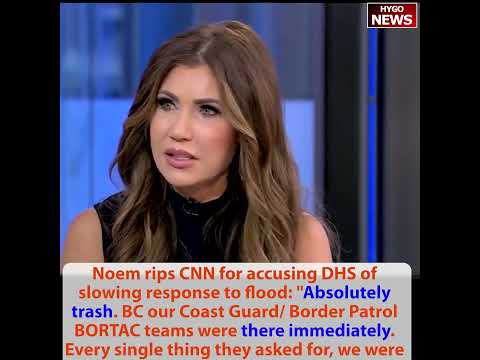
DHS Secretary Kristi Noem then addressed CNN specifically. “Well, there you go. Fake news CNN again is absolutely trash. What they are doing by saying that because our Coast Guard, our border patrol board tech teams were there immediately.”
“Absolutely trash” is strong language for a cabinet officer. CNN’s coverage had, in Noem’s view, crossed a specific line — making false claims about the administration’s flood response that contradict the documented operational record.
The specific federal response included Coast Guard teams, Border Patrol BORTAC (Border Patrol Tactical Unit) teams, and various other federal assets. Those assets arrived immediately. CNN’s characterization of slow response is contradicted by the specific operational facts.
”The Governor And The Emergency Management Director”
Noem continued with specific credit to state officials. “Every single thing I was on they asked for we were there the governor and the emergency management Director a NIM kid are fantastic and nobody there has said anything about that.”
Texas Governor Greg Abbott and the state emergency management director are identified as “fantastic.” The partnership between federal DHS and state emergency management produced the specific coordinated response that the Texas emergency required.
“Nobody there has said anything about that” is pointed. The actual people in Texas who are dealing with the emergency — state officials, local responders, community leaders — are not saying the administration’s response was slow. The critics making that claim are remote from the actual situation.
Other States
Noem noted the broader federal commitment. “But you know we’ve got flooding going on in New Mexico as well North Carolina so I’ve been visiting with their leadership team and spent quite a bit of time on the phone yesterday with the New Mexico governor getting them resources as well as well. And that’s what we do.”
Federal disaster response is national in scope. While Texas has received the most attention, New Mexico and North Carolina are also experiencing flooding emergencies. Noem is engaged with leadership in those states as well.
“That’s what we do” captures the operational reality. Federal emergency response is not selective by state or by political orientation. Governors of any party who have disaster situations receive federal support.
”Continuing To Be Political”
Noem’s characterization of CNN. “The fact that CNN is continuing to be political and push out fake information and false and information and lies is not shocking, but it’s a disservice to the country.”
“A disservice to the country” captures the specific cost. CNN’s reporting is not merely wrong on specific claims. It actively damages the country. Americans who rely on CNN for information get false information. That false information shapes their political views and their civic engagement in ways that reflect the false premises.
”People Start To Mistrust Everything”
Noem’s concern extends beyond CNN’s immediate impact. “It’s a real disservice to the country because people start to mistrust anything that comes out then over the news start and then.”
The broader concern is media credibility generally. When specific outlets like CNN produce demonstrably false coverage, American trust in all media is damaged. People who lose trust in CNN may lose trust in other outlets whose reporting has been more responsible. The damage to the overall media ecosystem exceeds the damage to CNN specifically.
”They Just Don’t Trust Anybody Anymore”
The observation continues. “They just don’t trust anybody anymore. No, I mean anybody that could happen to anybody may everybody it’s a especially if you’re a public figure.”
Americans across political orientations have been losing trust in institutions — media, government, universities, corporations, religious institutions, civic organizations. The specific mechanism varies by institution, but the cumulative effect is declining institutional trust across the society.
Media plays a specific role in that decline. When media outlets produce false reporting, they contribute to the broader erosion of institutional trust. Recovery requires specific accountability and demonstrable improvement in reporting quality — neither of which has been consistent in recent years.
The Rubio AI Impersonation
The video then pivoted to a separate story. “They just got to get enough like they could take the interview idea here today and change it around so as soon as I found out about it last week I referred it to the FBI diplomatic security and others.”
Rubio described a novel security incident. Someone had used AI voice cloning technology to impersonate Rubio. The impersonator had reached out to other political figures — senators, foreign ministers — in ways that could have produced specific diplomatic or political consequences if the impersonations had not been detected.
”A Senator Called Me”
Rubio described the specific discovery. “Somebody called me. It was a senator that called me and said hey did you just try to reach me and actually sent me a voice recording? It doesn’t sound right. It doesn’t really sound like me.”
A senator had received what appeared to be a message from Rubio. Something about the message did not sound right. The senator called Rubio directly to verify. The verification revealed that the message was not genuinely from Rubio.
The specific mechanism captures the challenge. AI-generated voice impersonations are good enough to sound like the target person but often have specific features that sound slightly off. Someone who knows the target person well may detect the difference. Someone who does not know them well may not.
”It Was On Signal, Right?”
The reporter’s follow-up. “So does this I don’t know how they got it or if it was a voicemail.”
Rubio: “No, it doesn’t matter what form you use Nobody doesn’t matter if it’s signal or anything No more secure methods that dying signal evening You can create an account with an email address.”
The Signal reference is specific. Signal is a supposedly secure messaging app used by government officials, journalists, and various others who want secure communications. Rubio’s point is that Signal’s security does not protect against AI voice cloning. The impersonator did not break into Rubio’s Signal account — they created a new Signal account that could send messages appearing to come from “Rubio.”
“You can create an account with an email address” captures the specific vulnerability. Signal accounts are tied to specific phone numbers, but verification is limited. Someone who wants to create a fake account can do so with relatively simple steps. The security Signal provides is for message encryption, not for identity verification.
”Foreign Ministers Calling The State Department”
Rubio extended the pattern. “I’ve had people in the past asked me if I texted him like within days of becoming Secretary of State. I had foreign ministers calling the State Department asking if I had just texted them.”
The pattern captures the specific targeting. Foreign ministers — who represent foreign governments and who are specific targets for American intelligence — have received communications claiming to be from Rubio. Those communications attempted to produce specific responses or actions from the foreign ministers.
If a foreign minister acted on a forged communication from “Rubio,” the consequences could be substantial. Specific diplomatic actions could be taken based on false information. Specific decisions could be influenced by specific forged communications.
The fact that foreign ministers routinely call the State Department to verify communications captures the current environment. Public figures and diplomats know they cannot trust communications that appear to be from other public figures without specific verification.
”This Is Just The Reality”
Rubio’s framing. “This is just the reality of the 21st century with AI and fake stuff that’s going on. It’s generally I communicate with my counterparts around the world through official channels for a reason and that’s to avoid this.”
“Official channels” are specific diplomatic communications that include institutional authentication. Embassy communications. Formal meetings. Documented correspondence. Those channels have specific verification procedures that ensure the communications are actually from the claimed senders.
Informal channels — text messages, Signal, phone calls — do not have those verification procedures. AI impersonation exploits that specific weakness. Rubio’s communicating through official channels for substantive matters is the specific defense.
”The Target Really Isn’t Me”
Rubio’s analysis of the attack pattern. “The target really isn’t me. The target is the people they’re reaching out to to try to trick them into a call or whatever and who knows what they do with it.”
The observation captures who is actually being attacked. The impersonation victims are the recipients of the forged communications — the senators, foreign ministers, and others who might be induced to take specific actions based on the forged content. Rubio’s reputation is not the target. The targets’ actions are the target.
That framing matters for understanding the threat. AI voice impersonation is not primarily about damaging the reputation of the impersonated person. It is about manipulating the behavior of the impersonation’s recipients. The specific response required is not reputation defense but recipient verification.
”You’re Gonna Hear About This For A Long Time”
Rubio’s prediction. “You’re gonna hear about this for a long time. I mean not just me it’ll happen to other people because all you need is a recording of someone’s voice and you can come up with it.”
The prediction is operationally correct. AI voice cloning technology requires only a relatively brief sample of the target person’s voice. Public figures — who give speeches, do interviews, make public statements — have extensive voice recordings available. Anyone with access to those recordings and to voice cloning technology can generate forged communications.
The technology is increasingly accessible. Specific tools are available to consumers for modest cost. The capability that was once limited to sophisticated intelligence services is now available to anyone who wants to pursue it. That democratization of the capability means that AI voice impersonation will continue to affect public figures broadly.
”AI Poses Great Challenges”
Rubio closed with the broader framing. “So one of the other great challenges posed to us by AI. I’m sure there’s a lot of positive aspects to AI as well, but this ain’t one of them.”
The acknowledgment is balanced. AI has substantial positive applications — medical research, scientific discovery, productivity improvements, educational tools, various other beneficial uses. The challenges — like voice impersonation — exist alongside those beneficial applications.
“But this ain’t one of them” captures the specific negative application. Voice impersonation, as implemented against Rubio, is not a beneficial use of AI. It is a specific abuse that serves specific purposes of specific bad actors.
The broader policy challenge is addressing the specific abuses while preserving the beneficial applications. That balance is difficult. AI governance policy is still developing at the federal, state, and international levels. The specific incidents Rubio describes inform those developing policy frameworks.
Why The Rubio Incident Matters
The Rubio incident captures a specific emerging threat category that will affect American politics, diplomacy, and commerce. Public figures across all three domains can be impersonated via AI voice cloning. Their communications can be forged. Their purported statements can influence recipient actions.
The specific response requires:
- Verification protocols for purported communications from public figures.
- Institutional skepticism about communications received through informal channels.
- Legal frameworks that address AI-generated impersonations specifically.
- Technical countermeasures that can detect AI-generated content.
Each of those responses is developing. None is fully implemented. The specific Rubio incident captures where the threat environment currently stands — beyond theoretical concern and into active operational reality.
The Political Framework
The video’s multiple threads — Schumer’s false claim, Noem’s CNN critique, Rubio’s AI impersonation — each reflect specific dimensions of the current political environment.
Information reliability — False claims about specific factual matters (the NWS warnings) damage political credibility when the false claims are easily verifiable.
Media accountability — News outlets that publish demonstrably false information damage their own credibility and the broader media ecosystem.
Technology challenges — AI tools enable new categories of deception that existing verification systems were not designed to address.
Each dimension requires specific response. The administration is engaging with each simultaneously. The cumulative response is a political environment in which specific claims must be verified against specific facts rather than accepted based on the identity of the claimant.
Key Takeaways
- Schumer’s false claim: “New Yorkers who need to be protected against extreme weather like flooding who need the warning which obviously didn’t occur in Texas” — contradicted by the detailed NWS warning timeline.
- Sec. Noem on CNN: “Fake news CNN again is absolutely trash…our Coast Guard, our Border Patrol BORTAC teams were there immediately.”
- Rubio on the AI impersonation: “A senator called me and said hey did you just try to reach me…It doesn’t really sound like me.”
- On foreign minister targeting: “I had foreign ministers calling the State Department asking if I had just texted them.”
- Rubio’s broader framing: “All you need is a recording of someone’s voice and you can come up with it…this is just one of the other great challenges posed to us by AI.”