 HYGO News
 Trump Announces Golden Dome Architecture: 'Intercept Missiles Even from Other Sides of World, Even from Space'; 'Completing Reagan's Vision from 40 Years Ago'; Canada Wants In; Schumer Big Mad About Green New Scam End
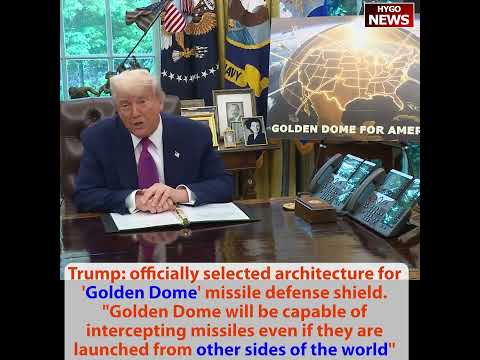
Trump Announces Golden Dome Architecture: “Intercept Missiles Even from Other Sides of World, Even from Space”; “Completing Reagan’s Vision from 40 Years Ago”; Canada Wants In; Schumer Big Mad About Green New Scam End
In a May 2025 Oval Office ceremony, President Trump announced that he had “officially selected an architecture” for the Golden Dome missile defense shield. The system would “deploy next-generation technologies across the land, sea and space, including space-based sensors and interceptors.” Once fully constructed, “Golden Dome will be capable of intercepting missiles even if they are launched from other sides of the world and even if they’re launched from space.” Capabilities include hypersonic missiles, ballistic missiles, and advanced cruise missiles. “Canada has called us and they want to be a part of it.” He framed the strategic significance: “We will truly be completing the job that President Reagan started 40 years ago, forever ending the missile threat to the American homeland.” Secretary of Defense Pete Hegseth: “It’s a generational investment in the security of America and Americans.” Meanwhile, Senate Minority Leader Chuck Schumer lamented the One Big Beautiful Bill ending clean energy subsidies: “This ideological obsession that the hard right led by the oil, gas and coal industry have against clean energy is going to be very harmful.”
Schumer on the “Green New Scam”
Minority Leader Chuck Schumer expressed his frustration with the OBBB’s energy provisions.
“Ten years from now because clean energy is the future,” Schumer said. “It’s cheaper and better.”
He made the harm claim: “It’s going to hurt our country, our families, our children in so many ways.”
He named the opposition: “This ideological obsession that the hard right led by the oil, gas and coal industry have against clean energy is going to be very harmful.”
He gave the severity assessment: “It’s going to be one of the worst. There are many, one of the worst things that this administration is doing.”
The OBBB’s energy provisions rolled back substantial portions of the Biden-era Inflation Reduction Act (IRA) subsidies for renewable energy. The IRA had committed approximately $370 billion over ten years to clean energy tax credits, subsidies for electric vehicles, and investments in renewable infrastructure. The OBBB would reduce or eliminate many of these subsidies.
Schumer’s “clean energy is the future” framing depended on specific assumptions. The actual economics of wind, solar, battery storage, and other renewable technologies had improved dramatically over the 2010s and 2020s but still depended substantially on government subsidies to compete with fossil fuels in most markets. Unsubsidized renewable energy was competitive in some specific circumstances (utility-scale solar in sunny regions, wind in windy regions with good transmission) but not generally competitive.
The “oil, gas and coal industry” framing attributed Trump’s policies to fossil fuel industry influence. But Trump’s political base also included working-class voters in regions economically dependent on fossil fuel industries (Pennsylvania, Ohio, West Virginia, Texas, North Dakota, Wyoming). These voters had been pushed toward Trump partly by the Biden administration’s energy policies, which had been seen as hostile to their economic interests.
The Trump administration’s framing — “Green New Scam” — characterized the IRA subsidies as corrupt rather than just ideologically misguided. The criticism was that substantial portions of the clean energy subsidies were flowing to politically connected companies and to foreign manufacturers (particularly Chinese solar panel and battery producers) rather than producing the promised American manufacturing renaissance.
The Golden Dome Architecture
Trump pivoted to the Golden Dome announcement.
“In the campaign, I promised the American people that I would build a cutting-edge missile defense shield to protect our homeland from the threat of foreign missile attack,” Trump said. “And that’s what we’re doing.”
He made the announcement: “Today I’m pleased to announce that we have officially selected an architecture for the state-of-the-art system that will deploy next-generation technologies across the land, sea and space, including space-based sensors and interceptors.”
He described international interest: “And Canada has called us and they want to be a part of it. So we’ll be talking to them. They want to have protection also. So as usual, we help Canada do the best we can.”
He gave the timeline: “This design for the Golden Dome will integrate with our existing defense capabilities and should be fully operational before the end of my term. So we’ll have it done in about three years.”
The “selected an architecture” phrase was the key technical announcement. For six months following Trump’s January executive order initiating the Golden Dome program, the Department of Defense had been evaluating various architectural approaches. The choice of architecture determined the fundamental design philosophy:
Land-based interceptors: Enhanced versions of existing Ground-Based Midcourse Defense (GMD) systems. Relatively proven technology but limited coverage.
Sea-based interceptors: Enhanced Aegis systems deployed on Navy ships. Mobile and flexible but limited to areas where ships could be deployed.
Space-based sensors: Satellite constellations for early detection and tracking of missile launches globally. Enabling layer that improved all other interceptor systems.
Space-based interceptors: The most ambitious and controversial component. Satellite-based systems that could engage missiles in boost phase (most vulnerable) before they reached their trajectory. Reagan’s original Strategic Defense Initiative had envisioned space-based interceptors, but 1980s technology could not support them.
The architecture Trump announced appeared to be comprehensive — “across the land, sea and space” — suggesting that multiple layers would be deployed simultaneously rather than choosing one approach over others. This was expensive but provided redundancy against various threat scenarios.
”Even from Space”
Trump described the system’s capabilities with increasing scope.
“Once fully constructed, the Golden Dome will be capable of intercepting missiles even if they are launched from other sides of the world and even if they’re launched from space,” Trump said.
He cited the Israeli precedent: “We will have the best system ever built. As you know, we helped Israel with theirs and it was very successful. And now we have technology that’s even far advanced from that.”
He listed the threat categories: “But including hypersonic missiles, ballistic missiles and advanced cruise missiles, all of them will be knocked out of the air.”
The “even from space” capability was particularly significant. Fractional Orbital Bombardment Systems (FOBS) and similar technologies — where weapons were first placed in orbit before de-orbiting to strike targets — had been developed by the Soviet Union and were being refined by Russia and China. Traditional missile defense systems could not engage FOBS because the threat trajectory was not a typical ballistic arc.
The “other sides of the world” framing addressed ICBM threats from locations like China or Russia, where the missile would transit through space on its trajectory to North America. Space-based sensors and interceptors could potentially engage such threats before they entered the terminal phase.
The hypersonic missile capability was the most technically challenging. Hypersonic glide vehicles and hypersonic cruise missiles maneuvered during flight in ways that made them difficult to track and intercept. Both Russia and China had deployed various hypersonic systems, and North Korea and Iran were developing their own capabilities.
”Completing Reagan’s Vision”
Trump placed the Golden Dome in historical context.
“We will truly be completing the job that President Reagan started 40 years ago,” Trump said, “forever ending the missile threat to the American homeland.”
He cited the performance standard: “And the success rate is very close to 100 percent, which is incredible when you think of it. You’re shooting bullets out of the air.”
The Reagan reference was to the Strategic Defense Initiative (SDI), announced by Reagan in 1983 and commonly called “Star Wars” by critics. SDI had envisioned a comprehensive space-based missile defense system that would render Soviet nuclear missiles impotent. The technology of the 1980s could not support such a system, and SDI had been scaled back substantially under subsequent administrations.
Trump’s framing was that Reagan had correctly identified the strategic need for missile defense, but the technology had not been ready. By 2025, technology had advanced to the point where the Reagan vision could finally be realized:
- Space-based sensors had become vastly more capable and affordable
- Launch costs had dropped dramatically due to SpaceX and other private providers
- AI and machine learning had enabled much faster threat identification and tracking
- Solid-state laser and directed-energy weapons had matured significantly
- Interceptor miniaturization had enabled smaller, more numerous space-based platforms
The “very close to 100 percent” success rate claim was ambitious but based on actual Israeli Iron Dome performance data against primitive threats. For short-range rockets, Iron Dome had achieved effective intercept rates of 90%+ in actual combat against Hamas and Hezbollah. Whether similar performance could be achieved against advanced Russian and Chinese threats was a different and much harder engineering challenge.
Hegseth: “Generational Investment”
Secretary of Defense Pete Hegseth provided the institutional framing.
“Mr. President, to add this to the long and growing list of promises made and promises kept,” Hegseth said.
He framed the significance: “Ultimately, this right here, the Golden Dome for America is game changer. It’s a generational investment in the security of America and Americans.”
He tied it to border security: “Mr. President, you said we’re to secure our southern border and get 100 percent operational control after the previous administration allowed an invasion of people into our country.”
He expanded on the Reagan reference: “President Reagan 40 years ago cast the vision for it. The technology wasn’t there. Now it is and you’re following through to say we will protect the homeland from cruise missiles, ballistic missiles, hypersonic missiles, drones, whether they’re conventional or nuclear.”
He cited the Space Force connection: “And it’s not lost on me sir also that you had the vision to start the space force. And here we are in the other side. We didn’t need it. Here we are in the Oval Office with one of the leaders of the space force in general, Gut Line, leading the charge on putting in place a game changing Golden Dome for America.”
The Space Force reference was significant. Trump had established the United States Space Force as the sixth branch of the armed forces during his first term, despite significant Democratic and media mockery of the decision. The Space Force was designed to organize military activities in space: satellite operations, space surveillance, anti-satellite defense, and related missions.
By 2025, the Space Force was proving its value. The Golden Dome architecture relied heavily on space-based systems that would be operated by the Space Force. Had Trump not established the Space Force in 2019, the capabilities Golden Dome required would have been developed more slowly and less coherently across the other military branches. The Space Force provided dedicated focus and dedicated budget for the space-based capabilities Golden Dome required.
The Timeline and Execution
Hegseth outlined the execution approach.
“So sir, it’s an honor to be a part of this bold initiative,” Hegseth said. “We’re going to get to work on it. We have been since you signed that executive order on January 27. We’ve been fast forward on this.”
He described the milestone: “We’re here on this day and this is just one stop in delivering this defense of the homeland, which is something you charge us with doing and we’ll keep going until it is complete, sir.”
Trump closed with appreciation: “Thank you, Peter. Peace and a great job by the way. Thank you very much.”
The three-year timeline Trump had outlined was ambitious. Historically, major defense systems had taken much longer to develop and deploy:
- The original SDI program spent billions over a decade without producing deployed systems
- The current GMD system took approximately 20 years from inception to initial operational capability
- Major radar and sensor systems typically required 10-15 years from initiation to deployment
Compressing this to three years would require:
- Parallel development rather than sequential approach
- Heavy use of commercial off-the-shelf technology rather than bespoke military systems
- Private sector partnerships (SpaceX, Anduril, Palantir, etc.) with commercial speed
- Political will to accept higher risk in exchange for faster deployment
- Budget authorization for unusually large upfront investments
Whether this timeline was achievable would depend on execution quality, congressional cooperation, and technical luck. But the willingness to commit to a three-year timeline — within Trump’s second term — indicated that the administration was willing to accept substantial political risk for delivering the capability.
Canada’s Interest
The Canadian interest was both practical and political.
Canada had long been integrated with American missile defense through NORAD (North American Aerospace Defense Command), which jointly monitored the continental airspace from Alaska through Canada to the northern United States. Canadian participation in American missile defense had been limited historically by political constraints — Canadian governments had been reluctant to formally endorse American missile defense programs.
The Golden Dome represented an opportunity to deepen Canadian integration. Canada faced the same geographic reality as the United States: ICBMs from Russia or North Korea would transit Canadian airspace en route to American targets. Effective missile defense required Canadian cooperation on sensor placement, trajectory tracking, and interceptor positioning.
Trump’s “as usual, we help Canada do the best we can” framing was characteristic. Rather than describing the arrangement as genuine partnership, Trump framed it as American assistance to Canada — consistent with his broader framing of U.S.-Canadian relations as America doing favors for Canada rather than a relationship of equals.
Key Takeaways
- Trump “officially selected architecture” for Golden Dome: land, sea, space-based sensors and interceptors.
- Capabilities: “Intercept missiles even from other sides of world, even from space. Hypersonics, ballistics, cruise missiles.”
- Timeline: “Fully operational before end of my term — about three years.”
- “Completing the job Reagan started 40 years ago” — success rate “very close to 100 percent.”
- Canada wants in; Space Force role “not lost on me” per Hegseth. Schumer “big mad” about IRA subsidy rollbacks.