 HYGO News
 Scalise: raid reserves, at least a plan to show how to refill? made in America but not oil
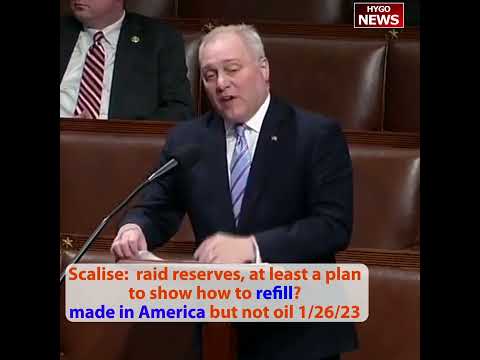
Scalise: Biden Team Wants “Made in America” Except for Energy — Bill Preserves Emergency SPR Use
In late January 2023, House Majority Leader Steve Scalise continued his SPR legislation messaging with substantive defense of the bill and attack on administration energy policy contradictions. “If you’re going to raid our reserves, won’t you at least put forward a plan to show how you will replace it?” Scalise asked. On administration contradictions: “They use the tagline a lot. You hear it all the time, made in America, except when it comes to making energy, they don’t want to make it in America. They make it harder to make it in America. They beg foreign countries to make our energy.” Defending the bill’s reasonableness: “This bill says, gives an exemption, except in the case of a severe energy supply interruption. So the president still got the ability, if there’s some actual emergency, to use the Strategic Petroleum Reserve the way it was intended in the 1970s."
"Raid Our Reserves”
Scalise framing:
“Raid” — Strong word.
“Our” reserves — Collective ownership.
Plan requirement — Reasonable.
Accountability — Through legislation.
Simple request — Framed.
Using “raid” to describe Biden’s SPR drawdown was charged language. The framing suggested improper use. Calling it “our” reserves invoked collective ownership and shared responsibility.
”At Least a Plan to Show How You Will Replace It”
The modest request. “Won’t you at least put forward a plan to show how you will replace it?” Scalise said.
The request:
Modest — Characterization.
Plan only — Not commitment.
Transparency — Served.
Accountability — Created.
Reasonable — Presented.
By characterizing legislation as just requiring plan, Scalise was making Biden’s veto look unreasonable. A plan wasn’t binding; it was documentation. Opposing this was harder to defend.
”White House Gets Nervous”
The framing. “Don’t worry, I know the White House gets nervous when you tell them that you’ve got to produce energy in America,” Scalise said.
The framing:
“Nervous” — Characterization.
Production — American.
Resistance — Administration’s.
Reluctance — Framed.
Political weakness — Implied.
Characterizing administration as “nervous” about American energy production was political framing. It positioned Biden as uncomfortable with domestic production rather than just making different policy choices.
”They Don’t Have a Problem With Foreign Countries Producing Energy”
The double standard. “They don’t have a problem, again, with foreign countries producing energy. They just don’t want it made in America,” Scalise said.
The double standard:
Foreign production — Accepted.
American production — Restricted.
Contradictory — Framed.
Political attack — Sharp.
Substantive point — Made.
The double standard framing had substantive merit. Biden had requested foreign production increases (Saudi Arabia) while restricting some domestic production. The contradiction was political vulnerability.
”Made in America”
The slogan turn. “They use the tagline a lot. You hear it all the time, made in America, except when it comes to making energy, they don’t want to make it in America,” Scalise said.
The turn:
Biden slogan — “Made in America.”
Applied broadly — By administration.
Exception noted — For energy.
Hypocrisy — Charged.
Slogan weaponized — Against Biden.
“Made in America” was Biden administration messaging theme. Scalise turning it around showed administration inconsistency. Using opponent’s words against them was effective.
”They Beg Foreign Countries to Make Our Energy”
The begging claim. “They make it harder to make it in America. They beg foreign countries to make our energy,” Scalise said.
The claim:
Begging — Dignity loss.
Foreign countries — Provider.
American energy — Made elsewhere.
Dependency — Framed.
Weakness — Political.
The “begging foreign countries” framing was strong. It invoked Biden’s Saudi trip and similar episodes. Made U.S. look weak and dependent. Political imagery powerful.
The Bill’s Exemption
Bill details. “This bill says, gives an exemption, except in the case of a severe energy supply interruption,” Scalise said.
The details:
Exemption provided — For emergencies.
“Severe” threshold — Required.
Emergency use — Preserved.
Flexibility — Maintained.
Reasonable structure — Presented.
By noting the bill preserved emergency use, Scalise was showing it wasn’t extreme. Administration could still use SPR for actual emergencies. Restrictions applied only to non-emergency use.
”The President Still Got the Ability”
Preservation emphasized. “So the president still got the ability, if there’s some actual emergency, to use the Strategic Petroleum Reserve the way it was intended in the 1970s,” Scalise said.
The preservation:
Authority preserved — For emergencies.
Original intent — Honored.
1970s — Historical reference.
Not preventing use — Clarified.
Reasonable — Shown.
The preservation of emergency authority made bill reasonable. It targeted non-emergency use that deviated from SPR’s original purpose. This made Biden’s veto harder to justify.
The 1970s Reference
1970s reference:
SPR created — 1975.
OPEC embargo — Context.
Emergency response — Purpose.
Historical intent — Invoked.
Original design — Honored.
The SPR had been created after 1973 OPEC embargo for emergency response. Scalise invoking original 1970s intent was accurate historical reference that supported bill’s approach.
”If Your Bad Policy Is Leading to Higher Gas Prices”
The conditional framing. “All this bill says is if your bad policy is leading to higher gas prices and people are getting angry about that, as they should,” Scalise said.
The framing:
“Bad policy” — Cause.
Higher gas prices — Effect.
People angry — Justified.
Administrative failing — Framed.
Political problem — Biden’s.
By conditioning bill’s restrictions on Biden’s own policy failures, Scalise was making Biden complicit in need for legislation. Bad policy leading to high prices leading to SPR misuse leading to restrictive legislation.
”As They Should”
Empathy framing. “As they should,” Scalise said about angry voters.
The empathy:
Voter anger — Validated.
Justified — By policy.
Solidarity — Shown.
Populist — Framing.
Connection — Made.
Validating voter anger was populist framing. Scalise was positioning himself as understanding voter frustration rather than dismissing it. This was effective political communication.
”You Can’t Go and Raid It Unless You Show a Plan”
The bill’s requirement. “You can’t go and raid it unless you show a plan as the bill says,” Scalise said.
The requirement:
Cannot raid — Without.
Plan required — Documentation.
Accountability — Created.
Administrative discipline — Forced.
Reasonable — Condition.
The requirement was procedural rather than substantive. Administration could still use SPR for price management, just had to document plan. This was accountability mechanism rather than prohibition.
The Political Packaging
Political packaging:
Reasonable bill — Framed.
Modest request — Characterized.
Emergency preserved — Noted.
Biden unreasonable — If vetoing.
Pressure built — Effectively.
The political packaging of bill was effective. It was portrayed as minimal reasonable request. Biden veto looked more extreme. Pressure was building on administration.
The Administration’s Dilemma
Administration dilemma:
Veto — Political cost.
Sign — Policy cost.
Either way — Loses something.
Deadlock — Political.
Strategic choice — Required.
Administration faced dilemma. Vetoing reasonable-looking bill was politically costly. Signing constrained administrative flexibility. Either choice had costs.
The “Bad Policy” Framing
Bad policy:
Gas prices — Rising.
SPR depletion — Substantial.
Dependency — Increased.
Various criticisms — Valid.
Political vulnerability — Real.
The “bad policy” characterization had traction because of specific policy failures. Rising prices, SPR depletion, increased dependency, various legitimate criticisms. Political vulnerability was real.
The Bipartisan Opportunity
Bipartisan opportunity:
Some Democrats — Concerned.
Energy states — Particularly.
Moderate caucus — Potentially.
Manchin — For example.
Coalition possible — On SPR.
The possibility of bipartisan coalition on SPR issues was real. Some Democrats from energy-producing states had concerns. Moderates might cross over. Manchin had shown independence.
The Messaging Effectiveness Continued
Messaging continues:
Multiple speeches — Scalise.
Consistent themes — Coordinated.
Memorable phrases — Created.
Data deployed — Repeatedly.
Cumulative effect — Building.
Scalise was delivering multiple speeches with coordinated messaging. Consistent themes, memorable phrases, specific data. Cumulative effect was building political narrative.
The Populist Framing
Populist framing:
Elite vs. people — Frame.
Davos — Elite symbol.
Private jets — Contrast.
Working families — Victims.
GOP alternative — For them.
The populist framing positioned GOP as people’s advocate against elite Biden administration. This was effective post-Trump Republican positioning. Voter resonance was strong.
The Energy Nationalism
Energy nationalism:
American production — Priority.
American jobs — Created.
American independence — Sought.
American resources — Available.
America first — Energy.
Energy nationalism had broad political appeal. Produce energy domestically, create American jobs, achieve independence from foreign sources. This was Trump-influenced GOP theme continuing.
The Environmental Argument
Environmental argument:
U.S. standards — Higher.
Production — Cleaner.
Transport — Less.
Better regulation — U.S.
Legitimate point — Overall.
The argument that U.S. produced energy cleanly than foreign sources had environmental merit. Higher regulations, better practices, shorter transport. This complicated pure environmental critique of production.
The Democratic Response
Democratic response:
Climate priority — Defended.
Transition — Needed.
Production — Actually high.
Data disputed — Context.
Attacks — Countered.
Democrats defended administration on multiple grounds. Climate priority required transition. Actual production was high. Data needed context. Attacks were political.
The Policy Tensions
Policy tensions:
Climate — Requires transition.
Consumer — Needs affordable.
Security — Needs independence.
Jobs — From production.
Tensions — Real.
Energy policy had genuine tensions between multiple legitimate goals. Climate transition, consumer prices, energy security, energy jobs. Political messaging often oversimplified these tensions.
The SPR Bill Prospects
Bill prospects:
House passage — Likely.
Senate consideration — Uncertain.
Biden veto — Threatened.
Override — Unlikely.
Political messaging — Main outcome.
The bill would likely pass House with some Democratic support. Senate consideration was uncertain. Biden veto was threatened. Override unlikely. Political messaging was main outcome.
The Political Benefits
Political benefits:
Each speech — Reinforcing.
Narrative building — Continuing.
Base energizing — Maintained.
Swing voters — Influenced.
2024 preparation — Advancing.
Each speech reinforced narrative. Base stayed energized. Swing voters received messages. 2024 preparation advanced. The political benefits of sustained messaging were real.
The Administration Counter Options
Counter options:
Veto and attack — Standard.
Negotiate modifications — Possible.
Accept and move on — Unlikely.
Strategic retreat — Considered.
Message discipline — Maintained.
Administration had limited counter options. Veto and attack was standard but costly. Negotiating modifications wasn’t occurring. Accepting would break messaging. Strategic retreat possible but unlikely.
The Refill Reality
Refill reality:
Plans existed — Some.
Implementation — Slow.
Prices high — Constraining.
Budget — Limited.
Timeline uncertain — Ongoing.
The actual refill reality was slow. Plans existed but implementation was constrained by prices and budget. Timeline was uncertain. Administration had genuine practical challenges.
The Political Reality Check
Reality check:
Rhetoric — Both sides strong.
Actual policy — More complex.
Compromise possible — In theory.
Polarization — Prevents.
Outcome uncertain — Usually.
Political rhetoric from both sides oversimplified complex policy reality. Compromise was possible in theory but polarization prevented it. Outcomes typically favored messaging over policy.
The 2024 Strategic Position
Strategic position:
GOP advantage — Energy issue.
Biden vulnerability — Real.
Building through 2024 — Continuing.
Electoral implications — Significant.
Messaging war — Favor GOP.
The 2024 strategic position on energy favored Republicans. Biden was vulnerable. Messaging war was being won by GOP. Electoral implications for key states (Pennsylvania, Ohio, etc.) were significant.
The Long-Term Trajectory
Long-term trajectory:
Energy transition — Ongoing.
Political battles — Continuing.
Policy evolution — Inevitable.
Compromise — Eventually needed.
Current — Polarized.
The long-term trajectory required energy transition while maintaining current energy needs. This required eventual bipartisan compromise. Current polarization prevented this but wouldn’t forever.
Key Takeaways
- House Majority Leader Scalise continued SPR legislation messaging with substantive defense of the bill.
- Modest request framing: “If you’re going to raid our reserves, won’t you at least put forward a plan to show how you will replace it?”
- Made in America turn: “You hear it all the time, made in America, except when it comes to making energy, they don’t want to make it in America.”
- Foreign begging charge: “They beg foreign countries to make our energy.”
- Bill’s reasonableness: “This bill says, gives an exemption, except in the case of a severe energy supply interruption.”
- Biden retains emergency authority: “The president still got the ability, if there’s some actual emergency, to use the Strategic Petroleum Reserve the way it was intended in the 1970s.”
Transcript Highlights
The following is transcribed from the video audio (unverified — AI-generated from audio).
- If you’re going to raid our reserves, won’t you at least put forward a plan to show how you will replace it?
- They don’t have a problem, again, with foreign countries producing energy. They just don’t want it made in America.
- They use the tagline a lot. You hear it all the time, made in America, except when it comes to making energy, they don’t want to make it in America.
- They beg foreign countries to make our energy.
- This bill says, gives an exemption, except in the case of a severe energy supply interruption.
- So the president still got the ability, if there’s some actual emergency, to use the Strategic Petroleum Reserve the way it was intended in the 1970s.
Full transcript: 192 words transcribed via Whisper AI.