 HYGO News
 Rubio schools Margaret nuclear: Why 60% enriched uranium? quickly make it 90%! close Hormuz Strait
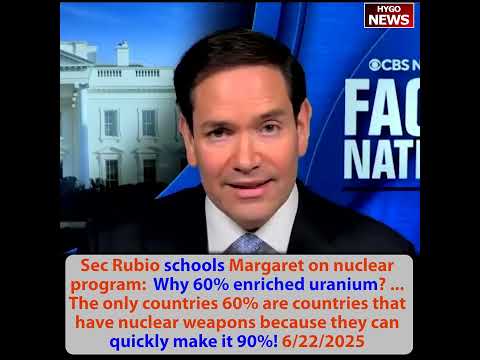
Rubio schools Margaret nuclear: Why 60% enriched uranium? quickly make it 90%! close Hormuz Strait
Secretary of State Marco Rubio’s combined Sunday-show appearances with Margaret Brennan on Face the Nation and Maria Bartiromo produced the most substantive public analysis of the Iran intelligence question that has taken place since the strikes. Brennan pressed Rubio on the distinction between Iran having the capability to weaponize and Iran having made the political decision to weaponize. Rubio’s response — that the distinction is irrelevant when the capability is in place — demolished the premise of much of the media questioning. He then addressed the Strait of Hormuz question, warning Tehran that closing the strait would be “economic suicide” and noting that China has its own reasons to discourage Iran from such a move. The interview is the clearest public articulation of the American intelligence argument for the strikes.
”That’s Irrelevant”
Brennan opened with what she presumably thought was the telling question. “Are you saying there that the United States did not see intelligence that the Supreme Leader had ordered weaponization?”
Rubio’s response was characteristically blunt. “That’s irrelevant. I see that question being asked on the media all that’s any relevant question. They have everything they need to build a weapon.”
The dismissal of the question as irrelevant is significant. Brennan was trying to establish, through negative phrasing, that the American intelligence community had not detected an Iranian political decision to weaponize. If true, she could argue, the strikes were premature — Iran had the capability but had not chosen to use it.
Rubio’s counter is that the distinction does not matter. If a country has the capability to build a nuclear weapon and can exercise that capability rapidly once the decision is made, the question of whether the decision has been made is a minor technical matter. The capability itself is the threat.
”The Political Decision Had Not Been Made”
Brennan tried to restate the point. “The political decision had not been made.”
Rubio: “No, I know that better than you know that and I know that that’s not the case.”
The exchange turns into a credentialing contest. Rubio is the Secretary of State of the United States. He has access to intelligence Brennan does not have. When Brennan says “the intelligence community said X,” Rubio is informed by the intelligence community itself — not by press characterizations of its products. His ability to contest her characterization is authoritative in a way her characterization is not.
”It Doesn’t Matter If The Order Was Given”
Brennan pressed. “But I’m asking whether the order was given.”
Rubio: “And the people who say that, it doesn’t matter if the order was given. They have everything they need to build nuclear weapons.”
This is the most important framing in the interview. The intelligence question about whether the order was given is a question. The policy question about whether action should be taken is a different question. Rubio is arguing that the policy question does not depend on the intelligence question. Even if the order has not yet been given, the capability to build weapons in a short window once the order is given is itself the threat.
”Why Would You Bury Things 300 Feet Underground?”
Rubio then made the observational case. “Why would you bury? Why would you bury things in a mountain 300 feet under the ground? Why would you bury six? Why do they have 60% enriched uranium? You don’t need 60% enriched uranium.”
The questions are rhetorical but devastating. A country engaged in purely peaceful nuclear activities does not bury facilities 300 feet under mountains. A country engaged in peaceful civilian nuclear power does not enrich uranium to 60%. Civilian power reactors use enrichment levels of 3-5%. Research reactors use enrichment levels of up to 20%. 60% has no civilian application. It is a stage toward weapons-grade material.
”The Only Countries In The World”
Rubio delivered the factual knockout. “The only countries in the world that have uranium at 60% are countries that have nuclear weapons because they can quickly make it 90.”
This is the empirical point. Every country that has enriched uranium to 60% is either a nuclear weapons state or a state that is transitioning toward becoming one. There are no counterexamples of a state that stopped at 60% for civilian purposes. The 60% enrichment is a signal that the weapons program is active, regardless of whether the formal political decision has been declared.
The ICBM Question
Rubio continued. “They have all the elements. They have why are they why do they have a space program? Is Iran going to go to the moon? No, they’re trying to build an ICBM.”
Iran’s space program is the other delivery-side indicator. Space launch vehicles and intercontinental ballistic missiles share substantial technology. A country that develops space launch capabilities develops much of what it needs for ICBM capability. Iran has been developing space launch vehicles under the cover of a civilian space program. The administration’s view is that the cover does not hide the underlying military application.
”How Do You Know What The Intelligence Assessment Says?”
Brennan tried to defend her framing. “That’s not how intelligence is read. That’s not how intelligence is used.”
Rubio pressed. “How do you know what the intelligence assessment says?”
Brennan: “I’m talking about the public March assessment.”
Rubio: “Well, that’s an inaccurate representation of it.”
The exchange is important because it reveals the limits of what journalists can credibly claim about intelligence. Brennan is working from a public summary released in March. Rubio is working from the full classified intelligence product. The summary is, by necessity, less complete than the full product. Journalists citing summaries as though they are complete assessments routinely oversimplify.
”Forget About Intelligence. What The IAEA Knows”
Rubio then pivoted to the observable evidence. “Here’s what the whole world knows. Forget about intelligence. What the IAEA knows, they are enriching uranium well beyond anything you need for a civil nuclear program.”
The IAEA — International Atomic Energy Agency — is the international inspection body. Its reports are public. They document Iranian enrichment activities. No classification protects the IAEA findings. Any American, any European, any Iranian can read them. What they document is enrichment activity inconsistent with civilian application.
By framing the argument in terms of IAEA observations rather than American intelligence, Rubio sidesteps the debate about classified assessments and places the case on ground that any interested observer can verify for themselves.
The Missile Inventory
Rubio laid out the Iranian missile arsenal. “Why are you developing ICBMs? Why do you have 8,000 short-range missiles and 2,000 to 3,000 long mid-range missiles that you continue to develop? Why do you do all these things?”
The Iranian missile inventory is substantial. 8,000 short-range missiles. 2,000-3,000 medium-range missiles. Continued development of longer-range systems. For what purpose does Iran maintain this inventory? The civilian uses of ballistic missiles are negligible. The delivery-vehicle development is coherent only in the context of an intent to deliver weapons — conventional and, in the limit, nuclear — against distant targets.
”Everything They Need For A Nuclear Weapon”
Rubio compressed the case into a sentence. “They have everything they need for a nuclear weapon. They have the delivery mechanisms. They have the enrichment capability. They have the highly enriched uranium that is stored. That’s all we need to see.”
The argument is operational. The three elements of a nuclear weapons capability are (1) weapons design, (2) fissile material production, (3) delivery systems. Iran has all three. The threshold for American concern, Rubio is arguing, is the presence of all three elements — not the presence of a specific political order triggering their combination.
”Especially In The Hands Of The Regime”
Rubio added the character judgment. “Especially in the hands of the regime that’s already involved in terrorism and proxies and all kinds of things around there. They are the source of all this. And no one’s disputing that.”
The regime’s character is the factor that elevates the concern. Not every nuclear-capable state is an equal threat. Britain, France, Israel, India — democracies with responsible deterrent doctrines — are not threats to American interests in the same way Iran would be. Iran’s record of state-sponsored terrorism, proxy warfare, and explicit threats against the United States and Israel is what makes Iranian nuclear capability particularly dangerous.
”Censured At The IAEA”
Rubio noted the international record. “And they were censured at the IAEA for that enrichment and for violating their nonproliferation agreements.”
The IAEA censure is the international body’s formal acknowledgment that Iran has violated its commitments. That is not an American political characterization. It is a multilateral institution speaking, including Russian and Chinese votes. Iran’s standing in the nonproliferation framework is compromised by its own conduct.
The Strait Of Hormuz
Bartiromo asked about Iranian options. “Do you expect Iran to move to close the Straight of Hormuz to try to disrupt oil transportation across the world?”
Rubio’s response blended warning and economic analysis. “Well, I encourage the Chinese government in Beijing to call them about that because they heavily depend on the straights of Hormuz for their oil. If they do that, it will be another terrible mistake. It’s economic suicide for them if they do it. And we retain options to deal with that."
"Beijing To Call Them About That”
The invocation of China is strategic. China is Iran’s largest oil customer. Iranian closure of the Strait of Hormuz would not only hurt Western economies — it would devastate Chinese oil supply. Beijing has, in the administration’s framing, direct self-interest in discouraging Iranian action on the strait. Rubio is telling Tehran that even their patron state will not support the move.
”Economic Suicide”
Rubio’s characterization of closure as “economic suicide” is accurate. Iran’s own oil export depends on the strait. Closing it would close off Iran’s primary revenue source while also hurting customers across Asia and Europe. The political cost to Iran — within the region, among its customers, and internationally — would be enormous.
”We Retain Options”
Rubio’s observation that “we retain options to deal with that” is the military warning. The United States has the naval assets and the operational experience to escort shipping through contested waters. The Fifth Fleet is positioned for exactly that kind of mission. If Iran attempts to close the strait, American forces can keep it open. The closure, if attempted, would not be durable.
”Massive Escalation”
Rubio framed the consequences. “It would be, I think, a massive escalation that would have merit a response, not just by us but from others.”
The “not just by us but from others” is important. Iranian closure of the strait would not be a bilateral American-Iranian dispute. It would implicate every state that depends on Persian Gulf oil. The response to such closure would be multilateral. Iran would be fighting not just the United States but the broader international coalition that depends on functioning global commerce.
Judging By Actions
Rubio’s close was measured. “They’re going to say what they need to say. These are the things that need to happen for their own internal politics and so forth. But in the end, we’re going to judge them by the actions that they take moving forward. We had three objectives. We struck those three objectives with decisive force. That was the point of this mission. And that’s what we achieved. What happens next will depend on what they do.”
The framework is clear. Iran’s rhetoric is one thing. Iran’s actions are what matter. The United States achieved its three objectives. What follows depends on Iranian choices.
”They Want To Get Cute, We Have Responses”
Rubio’s closing warning was characteristically direct. “They want to negotiate. We’re ready to negotiate. They want to get cute and do things that are dangerous. We have responses available that are devastating.”
The “get cute” framing is plain-spoken American. Iran attempting clever asymmetric responses — closing the strait, attacking American assets, escalating through proxies — will meet “devastating” responses. The administration is committed to the overwhelming-force posture Vance articulated.
Key Takeaways
- Rubio on the intelligence distinction: “That’s irrelevant…They have everything they need to build a weapon.”
- Rubio on 60% enrichment: “The only countries in the world that have uranium at 60% are countries that have nuclear weapons because they can quickly make it 90.”
- Rubio on the public-summary argument: “How do you know what the intelligence assessment says?…That’s an inaccurate representation of it.”
- On the Iranian missile inventory: “8,000 short-range missiles and 2,000 to 3,000 long mid-range missiles that you continue to develop? Why do you do all these things?”
- On the Strait of Hormuz: “It’s economic suicide for them if they do it. And we retain options to deal with that…I encourage the Chinese government in Beijing to call them about that.”