 HYGO News
 Rubio on Iran: Why does Hamas exist? Who built IEDs in Iraq? played every US president for 35 yrs
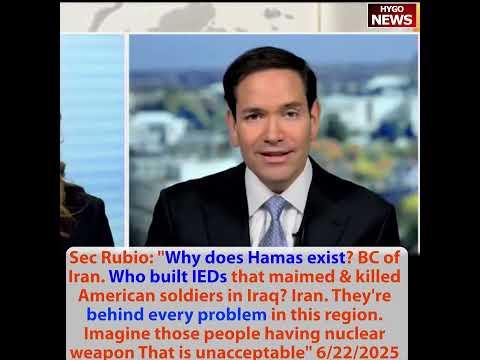
Rubio on Iran: Why does Hamas exist? Who built IEDs in Iraq? played every US president for 35 yrs
Secretary of State Marco Rubio delivered the fullest accounting yet of the historical Iranian record of regional destabilization, linking Iran directly to Hezbollah, Hamas, the Houthis, and the IEDs that killed American servicemembers in Iraq. Senator Tom Cotton, appearing on the same Sunday shows, amplified the warning about Iranian retaliation — including the possibility that Iranian sleeper cells are already inside the United States after the Biden-era open border. Cotton laid out the implicit message the strikes sent to Tehran: the Supreme Leader, energy infrastructure, and other critical assets were not targeted, meaning Iran still has assets that can be destroyed if the regime chooses continued escalation. Taken together, the interviews constitute the administration’s full public case for the strikes and for the posture that will follow.
”Why Do We Have Bases In Saudi Arabia, Kuwait, Qatar, UAE?”
Rubio opened with a question that reframes the entire American Middle East presence. “Listen, why do we have bases in Saudi Arabia and Kuwait and Qatar and UAE? All of those bases are there to help protect those countries from Iran.”
The observation is important because American military bases in the Persian Gulf region are often discussed as though they are American footprint in someone else’s region. Rubio’s framing is that the bases exist at the request of the regional states, and they exist because the regional states need protection. The threat against which they need protection is Iran. The bases are not American imperialism. They are regional security partnership.
”Why Did Hezbollah Exist? Because Of Iran”
Rubio then walked through the Iranian proxy network. “Why did Hezbollah exist? Because of Iran. What does Hamas exist? Because of Iran. How do the Houthis exist? Because of Iran.”
The inventory is accurate. Hezbollah was founded in the 1980s with Iranian funding, training, and direction; it remains an Iranian proxy force. Hamas has received Iranian financial and military support for decades; its recent military capabilities reflect Iranian provisioning. The Houthis have been supplied with advanced missiles and drones that require Iranian technological support.
Each of these organizations has produced massive regional destabilization. The Iran-Hezbollah axis has kept Lebanon in a state of perpetual political crisis. Hamas’s October 7, 2023 attack on Israel produced the ongoing Gaza war. The Houthis have been attacking commercial shipping in the Red Sea. All of it traces back to Tehran.
”Who Built The IEDs That Maimed And Killed American Soldiers In Iraq?”
Rubio then turned to the American military record. “Who built the IEDs that maimed and killed American soldiers in Iraq? Iran.”
Explosively formed penetrators (EFPs), supplied by Iranian Revolutionary Guard Corps entities to Shia militias in Iraq, were responsible for a substantial portion of American military casualties during the Iraq War. The technology required to manufacture EFPs is specialized. Only certain production lines can produce them. Iranian provisioning of these weapons was documented by American military intelligence at the time and was the subject of ongoing diplomatic protests. The consequences were measured in American lives.
”Sole Source Of Instability In The Entire Middle East”
Rubio compressed the case. “They’re behind every problem in this region. They are the sole source of instability in the entire Middle East, and the world’s been paying a price for this for 40-something years.”
“Sole source” may be debatable at the margins — other actors in the region have contributed to instability too — but the direction of Rubio’s observation is well supported. Iran’s revolutionary ideology has produced one consistent feature: the support of regional proxies aimed at destabilizing neighboring states. That support is the through-line connecting disparate conflicts across the Middle East.
”Imagine Those People Having A Nuclear Weapon”
Rubio delivered the stakes argument. “Imagine those people having a nuclear weapon, just one, just one nuclear weapon, or even the capability to being on the threshold of having a nuclear weapon. That’s what the world was facing. That is unacceptable.”
The repetition — “just one, just one nuclear weapon” — is rhetorical emphasis. The point is that the threshold for concern is not 100 weapons, not 10 weapons, not 5 weapons. One weapon is enough. Given Iranian intent, given Iranian proxies, given Iranian willingness to use force beyond its borders, one weapon in Iranian hands is a transformational threat.
”Trump Did The World A Favor”
Rubio’s verdict on the strikes was expansive. “President Trump did the world a favor last night, and now the Iranian regime should wake up and say, okay, if we really want nuclear energy in our country, there’s a way to do it. We’re there. We’re prepared to talk to them tomorrow and start working on that.”
The “world a favor” framing positions the strikes as a global public good. Iran with a nuclear weapon would be a threat to everyone — Israel, Saudi Arabia, Europe, Asia. Preventing the weapon served everyone’s interests, not just America’s.
“We’re prepared to talk to them tomorrow” is the off-ramp. The United States is not refusing negotiations. The United States is simply refusing to negotiate while Iran pursues a weapons program. With the program destroyed, negotiations on civilian nuclear energy — if Iran genuinely wants it — can proceed.
”Steve Witkoff”
Rubio noted the diplomatic track record. “Steve Witkoff has traveled extensively around the world trying to reach that deal with them, but they play too many games. They play way too many games, and now they’ve found out.”
Steve Witkoff, special envoy, has been the face of the diplomatic track. His extensive travel and engagement with Iranian representatives establishes that the diplomatic effort was real. The “games” framing describes what that engagement revealed: Iranian tactics aimed at delay rather than resolution.
“Now they’ve found out” is the consequence. The strikes are the Iranian discovery of the cost of continued gamesmanship.
”Not At War With Iran”
Rubio echoed the vice president’s framing. “Are we now at war with Iran? No, we’re not. This is not a war against Iran. This is very simple.”
The repetition across the administration — Trump, Vance, Rubio, Hegseth, Leavitt — of the “not at war” framing is coordinated messaging. Every senior official is speaking from the same framework. The strikes did not initiate a war. They addressed a specific threat. Iran remains, in principle, a potential partner in de-escalation.
The 67-Day Letter
Rubio provided a specific chronological anchor. “67 days ago, the president of the United States sent the Iranians a letter, and it said, you’re not going to have nuclear weapons. You’re not going to have a militarized nuclear program. Let’s negotiate. I want to do this diplomatically. I want to do this peacefully.”
The 67-day window is the full timeline of the administration’s diplomatic effort on Iran’s nuclear program. The letter articulated the American position. The subsequent weeks saw the six rounds of negotiations Leavitt had referenced. The execution of the strikes is the product of 67 days of Iranian refusal to accept the American terms.
”Played Every American President For 35 Years”
Rubio then delivered the historical framing. “They tried to play him along the way they’ve played every American president for the last 35 years.”
The claim is specific. Every American president from Reagan onward has, in Rubio’s framing, been played by the Iranians. Each president has attempted to address the nuclear issue and each has been led through extended negotiations that produced no resolution. The pattern has worked because the Iranian calculation was that American patience would always exceed Iranian progress.
Trump, in Rubio’s framing, broke the pattern.
”Handle It Differently”
Rubio delivered Trump’s line to Tehran. “The president told them, if we don’t get a deal, which is what he wanted, then I’ll have to handle it differently. And that’s what he did last night.”
“Handle it differently” is the Trump code for military action. The phrase was used throughout the 60-day negotiating window. It was not empty language. When negotiations failed, “handle it differently” became the strikes.
”We Didn’t Make That Choice”
Rubio framed agency. “But that was an Iranian choice. We didn’t make that choice. They did. By playing games with Donald Trump, they made a huge mistake, and President Trump acted last night.”
The assignment of agency is important. In Rubio’s framing, the Iranian regime chose continued escalation over settlement. The strikes were the consequence of that choice. Responsibility for the strikes rests with the Iranian regime, not with the American administration that executed them.
”Privately They All Agree”
Rubio noted the international posture. “I think the world today is safer, more stable than it was 24 hours ago, and a bunch of these countries putting out statements condemning us privately, they all agree with us that this needed to be done. They got to do what they got to do for their own public relations purposes. But the only people in the world that are unhappy about what happened in Iran last night is the regime.”
The claim is that public condemnations from various capitals are political theater rather than genuine disagreement. Behind closed doors, regional states that felt threatened by Iranian capability welcome the removal of that capability. European states that worried about the consequences of Iranian breakout welcome its prevention. Only the Iranian regime itself is genuinely unhappy.
Cotton On Retaliation
Senator Tom Cotton, appearing on the same shows, addressed the retaliation question directly. “I think we have to be prepared for Iran to retaliate. And I joined the president in his warning to the supreme leader of Iran that if he targets Americans, the military force he will see will make last night look like child’s play.”
“Make last night look like child’s play” is the escalation threat. The overnight strikes were calibrated. They were narrow. They hit three targets. If Iran retaliates against Americans, the American response will be far broader — by Cotton’s framing, to a degree that makes the overnight action look restrained by comparison.
The Sleeper Cell Warning
Cotton made one of the darkest observations of the weekend. “We have troops in the region. Iran has targeted Americans around the world in Marine barracks in Beirut, in barracks in Saudi Arabia. They’ve targeted embassies of countries around the world. For all we know, they may have gotten sleeper cells into the country during Joe Biden’s wide open border.”
The sleeper cell warning is specific. Iranian intelligence and IRGC elements have, over decades, placed operatives in other countries for future activation. The concern Cotton is raising is that the open-border period of 2021-2024 may have allowed Iranian sleeper cells to enter the United States. If those cells exist, they could be activated in response to the strikes.
Whether the concern is accurate is a matter for counterintelligence assessment. But Cotton is raising it publicly, which signals that the administration is taking the possibility seriously.
”Sue For Peace”
Cotton closed with the offer. “They have a chance to sue for peace here, to dismantle whatever remnants of their nuclear program remain, and to continue to actually survive.”
“Continue to actually survive” is the implicit framing. Iran’s choice is not between a bad outcome and a worse one. It is between a bad outcome and a catastrophic one. Iran can lose the nuclear program and survive. Iran can refuse to lose the nuclear program and face escalating consequences that threaten the regime’s survival.
The Implicit Message
Cotton highlighted what was not struck. “Because we haven’t targeted the supreme leader, we haven’t targeted their energy infrastructure, we haven’t targeted other critical infrastructure. That’s an implicit message that Iran still has things that they hold dear that neither the United States nor Israel has struck. Iran needs to heed President Trump’s warning.”
The “things that they hold dear” framing is important. The administration deliberately left specific Iranian assets untargeted — the regime’s leadership, the country’s energy infrastructure, its broader critical infrastructure. These are things Iran depends on. The preservation of these assets was a signal that the administration is willing to stop at a specific threshold if Iran accepts the settlement.
The flip side is the implicit threat. If Iran does not accept the settlement, the preserved assets become potential targets.
Key Takeaways
- Rubio’s inventory: “Why did Hezbollah exist? Because of Iran. Hamas? Because of Iran. The Houthis? Because of Iran. Who built the IEDs that maimed and killed American soldiers in Iraq? Iran.”
- “Imagine those people having a nuclear weapon, just one, just one nuclear weapon, or even the capability to being on the threshold…That is unacceptable.”
- The 35-year framing: “They tried to play him along the way they’ve played every American president for the last 35 years.”
- Cotton’s escalation threat: “If he targets Americans, the military force he will see will make last night look like child’s play.”
- The implicit message: “We haven’t targeted the supreme leader, we haven’t targeted their energy infrastructure…Iran still has things that they hold dear that neither the United States nor Israel has struck.”