 HYGO News
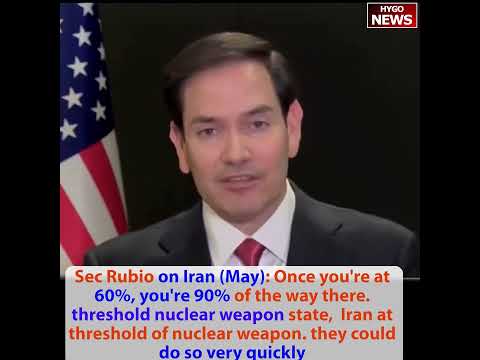
 Rubio on Iran (May): Once 60% then 90% threshold nuclear very quickly; Bessent: Tariff Derangement
Rubio on Iran (May): Once 60% then 90% threshold nuclear very quickly; Bessent: Tariff Derangement
Secretary of State Marco Rubio’s May interview on Iran has emerged as the clearest public articulation of the technical basis for the administration’s urgency about the Iranian nuclear program. Rubio walked through the arithmetic of uranium enrichment and explained why reaching 60% means a state is effectively 90% of the way to weapons-grade material. Treasury Secretary Scott Bessent returned to his “Tariff Derangement Syndrome” diagnosis, citing the latest CPI and PPI numbers — both 0.1% for the month — as vindication of the administration’s trade posture. Director of National Intelligence Tulsi Gabbard, in her March testimony, acknowledged that Iran’s enriched uranium stockpile is “at its highest levels and is unprecedented for a state without nuclear weapons.” Senator Elizabeth Warren pushed the Democratic framing that the One Big Beautiful Bill cuts healthcare for the vulnerable. And Speaker Mike Johnson articulated why Iran was “very close to nuclear capability” and why action to prevent it was necessary.
The Enrichment Mathematics
Rubio’s most important contribution was the technical explanation that many Americans have not heard before. “When you say 60, that’s misleading when people hear that number because they think 60% enrichment and 90% is what you need for a weapon. Actually, 90% of the work it takes to get to weapons grade enrichment is getting to 60. Once you’re at 60, you’re 90% of the way there.”
The point is nonlinear. Uranium enrichment is not a linear process. The energy cost and technical difficulty of raising the concentration of U-235 from natural levels (0.7%) to 60% is enormously larger than the cost of raising it from 60% to 90%. Most of the “work” — in the physics and engineering sense — is done by the time a state reaches 60%. The step from 60% to 90% is relatively fast.
”Threshold Nuclear Weapons State”
Rubio provided the term of art that defines Iran’s current status. “You are in essence a threshold nuclear weapons state, which is what Iran basically has become. They are at the threshold of a nuclear weapon. If they decided to do so, they could do so very quickly.”
“Threshold nuclear weapons state” is the IAEA and diplomatic terminology for a country that has developed the technical capability to build a nuclear weapon but has not yet crossed the final line of assembly and testing. The distinction matters because international law and nonproliferation agreements treat threshold states differently from declared states. A threshold state has not broken any declared prohibition. It has simply positioned itself to be able to break the prohibition rapidly if it chooses.
”If They Stockpile Enough”
Rubio provided the specific mechanism. “If they stockpile enough of that 60% enriched, they could very quickly turn it into 90 and weaponize it. That’s the danger we face right now. That’s the urgency here.”
The stockpile matters because weaponization requires a critical mass of fissile material. A kilogram of 60% enriched uranium is a fraction of the way to a weapon. But enough kilograms stockpiled at 60% can be rapidly raised to 90% and assembled into weapons-grade quantity in a short window. The rate at which Iran is stockpiling 60% material determines how quickly, from a cold start, it could produce weapons.
”No Country In The Region Wants Iran To Have A Nuclear Weapon”
Rubio extended the analysis to the regional perspective. “That’s why Israel feels urgency about it. That’s why we feel urgency about it, but not just us. Throughout the Gulf region, no country in the region wants Iran to have a nuclear weapon.”
The observation is important because the regional consensus extends beyond the usual pairing of Israel and Saudi Arabia. Kuwait, the UAE, Oman, Qatar, Bahrain — all the Gulf Cooperation Council members — have, at various points, indicated concern about Iranian nuclearization. Even states with formal diplomatic relations with Tehran have made clear, privately if not publicly, that an Iranian weapon would transform the regional balance in ways that no Gulf state welcomes.
The Missile Delivery Problem
Rubio added the delivery component. “And you also talk about not just the weapon. They have long range missiles that they can deliver those weapons to. This is a very grave risk.”
A nuclear weapon without a delivery system is a policy problem. A nuclear weapon with a long-range delivery system is an existential problem. Iran has developed increasingly capable ballistic missile technology over the past 20 years. Its Shahab, Qadr, and newer systems provide ranges that cover much of the Middle East, parts of Europe, and potentially U.S. military installations in the region.
The combination — 60% enriched uranium, capable ballistic missiles, and declared willingness to destroy the State of Israel — is what produces the urgency Rubio is describing.
”Enriching Openly”
Rubio then addressed the transparency — or lack of pretense — in Iran’s current posture. “In fact, their Congress, their legislative branch actually passed a law requiring them to enrich at a certain level because JCPOA, the Obama deal with Iran was canceled. So this is a critical moment. The president has made it a priority.”
The reference to the Iranian legislative action is significant. Iran is not enriching in secret. The Majlis (Iran’s parliament) has passed legislation mandating enrichment levels that exceed the JCPOA limits. Iran is, in effect, declaring its policy in legislation. The argument that Iran is a subject of unfair international scrutiny collapses when Iran’s own legislative body has openly codified the behavior the international community finds concerning.
”Too Close For Comfort”
Rubio closed his assessment with the urgency framing. “And now people understand the urgency here because they are fairly close, too close for comfort to a nuclear weapon. We have to roll that back one way or another. And we hope it’s peacefully and through the process of negotiation.”
The “one way or another” formulation is where diplomatic restraint and strategic resolve meet. The administration prefers peaceful denuclearization through negotiation. The administration is prepared to use force to denuclearize if negotiation fails. Iran is being asked to choose the mechanism.
Gabbard’s March Testimony
The video also captures DNI Gabbard’s March congressional testimony — the very testimony Trump later publicly disputed. “Iran’s enriched uranium stockpile is at its highest levels and is unprecedented for a state without nuclear weapons.”
Read in context, Gabbard’s testimony does not contradict Rubio’s assessment. She acknowledged that Iran’s stockpile is at unprecedented levels for a non-nuclear state. That acknowledgment is consistent with Rubio’s threshold-state characterization. The disagreement — to the extent one exists — is about whether Iran had made the final political decision to weaponize, not about whether Iran had the material to weaponize.
”A Decades-Long Taboo”
Gabbard’s other observation was about the rhetorical climate in Iran. “In the past year, we’ve seen an erosion of a decades-long taboo in Iran on discussing nuclear weapons in public, likely emboldening nuclear weapons advocates within Iran’s decision-making apparatus.”
The point is about regime internal dynamics. Iran has, for decades, denied any intention to pursue nuclear weapons. That public posture — even when contradicted by private behavior — served as an internal restraint on the state’s nuclear program. When the public taboo erodes, the restraint weakens. Iranian officials who would previously have faced internal criticism for advocating weaponization can now do so openly.
The combination of Gabbard’s observation about the eroding taboo and Rubio’s observation about the technical capability is the combined case for urgency. Iran has the technical means and, increasingly, the political will.
Bessent’s “Tariff Derangement Syndrome”
Bessent returned to the economic argument that has been a through-line of the administration’s summer messaging. “I call it DDS and a lot of people think that’s Trump Arrangement Syndrome. It’s Tariff Arrangement Syndrome. The next stage.”
The evolution from “Trump Derangement Syndrome” to “Tariff Derangement Syndrome” is deliberate. Bessent is arguing that the same irrational opposition that animated the anti-Trump politics of the first term has been redirected toward tariff policy specifically, and that the opposition is unable to acknowledge when the data does not support its predictions.
”Democrats Were In Favor Of Tariffs”
Bessent then made the political observation. “A lot of Democrats are in favor of tariffs, but now that President Trump is leading the charge, they can’t be. So they call them the Trump tariffs. All these predictions have just been baseless and a flop and nobody wants to admit it. Nobody wants to admit it.”
The observation is accurate in terms of political history. Democratic politicians — particularly those associated with organized labor — have traditionally favored tariff protection for American manufacturing. Sherrod Brown, Bob Casey, Bernie Sanders, and others have long argued for tariff instruments. The current Democratic posture of tariff opposition is, Bessent argues, a reflex against Trump rather than a policy disagreement with tariffs in principle.
The CPI And PPI Numbers
Bessent delivered the latest data. “The CPI, the PPI were both 0.1% last month. The cumulative was the best number since 2020. The month before that was the best number since 2021.”
Consumer Price Index and Producer Price Index are the two primary inflation measures. Both came in at 0.1% for the month — a near-zero reading that would have been welcomed as extraordinary news a year ago when inflation fears were dominant. The “best number since 2020” framing positions the current moment as the most favorable inflation environment since the pre-pandemic period.
Household Income
Bessent then pivoted to real income. “Household income growth was 0.7 or 0.8% in April for one month. That’s out of the park.”
Household income growth of 0.7-0.8% in a single month is, as Bessent says, “out of the park.” If that rate persisted for a full year, it would translate to roughly 10% annual growth in household income — a figure that has not been seen in many decades. The monthly rate is likely unsustainable at that level, but the single-month print is an indicator that the labor market is producing unusually favorable outcomes.
Warren’s Counter-Framing
Senator Elizabeth Warren delivered the Democratic counter. “The Republican bill is a twofer. It cuts access to healthcare for millions of Americans, for babies, for people with disabilities, for seniors living in nursing homes, and is a giant giveaway to billionaires. Republicans get it both.”
The framing is the same one Schumer, Wyden, and Baldwin have used. The bill “cuts healthcare” and “gives to billionaires.” The administration’s response is the same — the bill strengthens care for vulnerable populations by preventing illegal immigrants from receiving Medicaid funds meant for American citizens, and the billionaire giveaway charge rests on the retention of corporate tax rates that were set in 2017 and that Democrats themselves supported in prior years on different legislative vehicles.
Speaker Johnson On Iran
Speaker Mike Johnson’s framing was straightforward. “Iran was very close to nuclear capability and President Trump has been crystal clear throughout his career in politics by saying that Iran can never have nuclear weapons. They would use it against Israel immediately and they would use it against the US if they could. So it had to be stopped and I think most of the people in the world who think in common sense terms applaud that.”
Johnson’s contribution is the House leadership’s endorsement of the administration’s posture. The House, which will need to provide authorization for any extended military action, is speaking with one voice — the Speaker is supporting the president.
”Not A Wartime President”
Johnson’s close captured the Trump temperament on the question. “The President wants peace in the region. He does not want to be a wartime president, but we have to protect our country, our citizens, and that’s what this is about.”
The observation that Trump “does not want to be a wartime president” is consistent with Trump’s own statements. His preferred legacy is peace deals, not wars. The current situation is, in his framing, not a war he chose. It is a situation he inherited from prior administrations and that requires a decision — a decision he is reluctant to make in the direction of war but prepared to make if negotiation fails.
Key Takeaways
- Rubio’s nuclear physics explanation: “Once you’re at 60, you’re 90% of the way there. You are in essence a threshold nuclear weapons state.”
- DNI Gabbard in March: “Iran’s enriched uranium stockpile is at its highest levels and is unprecedented for a state without nuclear weapons.”
- Rubio on the political timing: Iranian parliament “passed a law requiring them to enrich at a certain level” — the regime is not hiding the behavior.
- Bessent on the data: “The CPI, the PPI were both 0.1% last month. The cumulative was the best number since 2020.”
- Speaker Johnson: “Iran was very close to nuclear capability…They would use it against Israel immediately and they would use it against the US if they could.”