 HYGO News
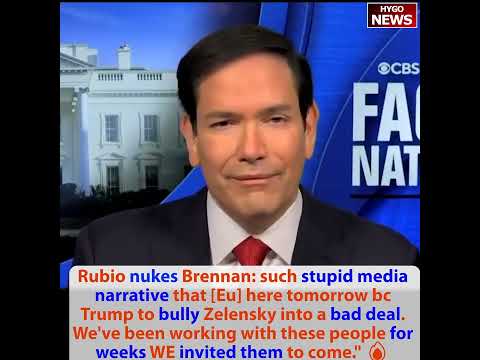
 Rubio nukes Brennan: stupid media narrative Trump to bully Zelensky; each side to give something
Rubio nukes Brennan: stupid media narrative Trump to bully Zelensky; each side to give something
Secretary of State Marco Rubio demolished CBS Face the Nation host Margaret Brennan’s premise that European leaders were traveling to Washington to protect Zelensky from being bullied. Rubio’s corrections: the U.S. invited them, has been coordinating with them for weeks, and their role is collaborative diplomacy, not rescue. Rubio: “This is such a stupid media narrative that they’re coming here tomorrow because Trump is going to bully Zelensky into a bad deal. We’ve been working with these people for weeks … We invited them to come.” On the sanctions threat: “If he did this now, the moment the President puts those additional sanctions, that’s the end of the talks. You’ve basically locked in at least another year, a year and a half of war and death and destruction.” On the nature of deals: “The only way to reach a deal is for each side to get something and each side to give something. And that’s been very difficult. If it was easy, this wouldn’t have been going on for three and a half years.” On meeting asymmetry: “We’ve had one meeting with Putin and like a dozen meetings with Zelensky.” And on the sheer effort: “The President called them from the airplane, spent two hours in the middle of the night talking to them.”
Brennan’s Premise
Margaret Brennan’s question premise. “You know there is concern from the Europeans that President Zelensky is going to be bullied into signing something away. That’s why you have these European leaders coming as backup tomorrow.”
That is the Democratic media framing. European leaders as protective rescue force for Zelensky. Trump as potential bully who would force Zelensky into unfavorable terms. European presence as check on Trump’s aggressive posture.
Rubio’s Immediate Correction
Rubio’s response. “No it isn’t. That’s not where they’re coming as backup. That’s not true. That’s not true. They’re not coming here tomorrow to keep Zelensky from being bullied. They’re not coming as backup.”
Direct contradiction. Not a hedge. Not a partial acknowledgment. Direct rejection of the premise.
Brennan’s pushback. “Well that’s February. Overlock was meeting in front of television cameras where President Zelensky—”
Brennan referring to the February 2025 Oval Office incident where Trump, Vance, and Zelensky had a tense exchange on camera — Trump and Vance pushing Zelensky to accept more cooperative posture. Brennan treats that incident as evidence of Trump’s bullying pattern.
Rubio’s response. “Do you know how many meetings he had since then?"
"We’ve Had One Meeting with Putin and Like a Dozen Meetings with Zelensky”
“Oh no, I know and I was just up in Alaska watching the one with Vladimir Putin where a red carpet rolls—”
Brennan pivoting to the Alaska summit. The “red carpet rolls out” framing suggests Trump’s deferential posture toward Putin contrasted with harder-line treatment of Zelensky.
Rubio’s correction. “No but it was Zelensky. We’ve had more meetings. We’ve had one meeting with Putin and like a dozen meetings with Zelensky.”
That is the specific factual correction. The meeting-count asymmetry does not favor Putin. Trump and his administration have had approximately 12 meetings with Zelensky versus one with Putin. The time allocation overwhelmingly favors Zelensky.
That factual pattern directly contradicts Brennan’s “bully Zelensky” framing. If the administration were planning to bully Zelensky, it would not have invested 12x more meeting time with Zelensky than with Putin. That investment reflects genuine engagement with Ukraine’s position, not preparation to force unfavorable terms on Ukraine.
”Such a Stupid Media Narrative”
Rubio’s direct challenge. “So that- but that’s not true. They’re not coming here tomorrow to keep Zelensky from being bullied. They’re coming here tomorrow because we’ve been working with the Europeans. We talked to them last week. There were meetings in the UK over the previous weekend. And they said President Trump was going to demand the ceasefire. As early as Thursday.”
Specific documentation. U.S. coordination with Europeans. UK meetings over the weekend. Trump’s ceasefire demand timeline. All of this was known and coordinated before Alaska. European leaders coming to Washington reflects pre-existing coordinated diplomacy.
“But you said that they’re coming here tomorrow to keep Zelensky from being bullied. They’re not coming here tomorrow. This is such a stupid media narrative that they’re coming here tomorrow because the Trump is going to bully Zelensky into a bad deal. We’ve been working with these people for weeks. For weeks on this stuff.”
“Such a stupid media narrative.” That is the specific vocabulary. Not wrong. Not mistaken. Stupid. Rubio is explicitly calling out the CBS framing as intellectually dishonest.
“Weeks on this stuff.” The coordination has been ongoing for weeks. Not hours. Not days. Weeks of specific, detailed work with European counterparts. The Sunday morning TV framing of “backup for Zelensky” does not account for the sustained pre-work.
”We Invited Them to Come”
“They’re coming here tomorrow because they chose to come here tomorrow. We invited them to come. We invited them to come. The President invited them to come.”
Three repetitions of “We invited them.” That is Rubio driving the point. European leaders are not inserting themselves uninvited. They are responding to U.S. invitation. The administration is managing the diplomatic architecture, not reacting to European intervention.
The Walk-Out Question
Brennan continuing. “But the President told those European leaders last week that he wanted a ceasefire. The President went on television said he would walk out of the meeting if Vladimir Putin didn’t agree with on it. He said there would be severe consequences if he didn’t agree to one. He said he’d walk out in two minutes. He spent three hours talking to Vladimir Putin and he did not get one.”
That is the specific accusation. Trump said he would walk out if Putin did not agree to ceasefire. Trump spent three hours with Putin. No ceasefire. Therefore Trump failed to follow through on his stated threat.
Rubio’s response. “Because obviously something, things happened during that meeting. Our goal here is not to stage some production for the world to say oh how dramatic he walked out. Our goal here is to have a peace agreement to end this war. And obviously we felt and I agreed that there was enough progress. Not a lot of progress but enough progress made in those talks to allow us to move to the next phase.”
That is substantive explanation. Trump did not walk out because the meeting produced “enough progress” to justify continuing. Not “a lot of progress” — enough progress. The calibrated characterization is diplomatic precision.
“Our goal here is not to stage some production for the world to say oh how dramatic he walked out.” That is critical framing. Walk-outs are theatrical. The administration is seeking substantive outcomes. If staying in the meeting produces better substantive outcomes than walking out, staying is the correct choice even if walking out would produce better optics.
”Take with a Grain of Salt”
“Now understand and take with a grain of salt. I’m not saying we’re on the verge of a peace deal but I am saying that we saw movement. Enough movement to justify a follow-up meeting with Zelensky and the Europeans. Enough movement for us to dedicate even more time to this.”
That is diplomatic calibration. Not oversell. Not undersell. Honest assessment. “Not on the verge of a peace deal” — the deal is not imminent. But “enough movement” — specific progress that justifies continued investment.
“Follow-up meeting with Zelensky and the Europeans.” The specific next step. Not aspirational. Scheduled. European leaders traveling to Washington. Zelensky meeting scheduled.
“Dedicate even more time to this.” The administration is prepared to continue investing time. Not treating the war as a quick-resolution priority. Treating it as a substantial ongoing commitment that will require sustained attention.
”Sanctions Would End the Talks”
Brennan asking about additional sanctions. Rubio’s response. “You talk about the sanctions. Look at the end of the day. If peace is not going to be possible here and this is just going to continue on as a war, the President has that option to then come in and impose new sanctions. But if he did this now, the moment the President puts those additional sanctions, that’s the end of the talks.”
That is the specific tactical point. Sanctions are a tool. Imposing them now forecloses diplomatic options. Once sanctions escalate, Russia’s willingness to engage in good-faith diplomacy collapses. The war continues.
“You’ve basically locked in at least another year, a year and a half of war and death and destruction. We may unfortunately wind up there but we don’t want to wind up there. We want to wind up with a peace deal that ends this war so Ukraine can go on with the rest of their lives and rebuild their country and be assured that this is never going to happen again.”
A year to year-and-a-half of additional war if sanctions escalate now. That is the specific tradeoff. Demand sanctions for political optics, lock in another 12-18 months of war. Or hold sanctions in reserve, continue diplomacy, potentially end the war in months.
“Be assured that this is never going to happen again.” That is the deeper goal. Not merely ending the current war. Ensuring this specific conflict does not recur. That requires specific security architecture — NATO posture, Ukraine defenses, European deterrence capacity — beyond just a ceasefire.
”Each Side to Get Something and Each Side to Give Something”
“That’s the goal here. We’re going to do everything possible to make that happen if it’s doable. It will require both sides to make concessions. It will require both sides to get things they’re asking for. That’s how these deals are made, whether we like it or not.”
That is the specific negotiating reality. Both sides make concessions. Both sides receive concessions. Zero-sum thinking produces no deals. Positive-sum framing — each side gets enough to justify the concessions they make — is how deals happen.
“Well that’s what these negotiations are about and as you can imagine, everybody goes into a negotiation wanting 100% of what they want. That includes Ukraine but obviously the Russians.”
Both sides have maximalist opening positions. Ukraine wants territorial integrity plus security guarantees plus reconstruction financing plus NATO membership. Russia wants territorial recognition plus NATO non-expansion plus sanctions relief plus recognition of Russian language rights in formerly Ukrainian territories.
Neither side gets 100%. Both sides give. Both sides get. The question is what the specific equilibrium looks like.
”If It Was Easy, This Wouldn’t Have Been Going on for Three and a Half Years”
“And the only way to reach a deal on anything, whether it’s in business or in politics or in geopolitics, the only way to reach a deal is for each side to get something and each side to give something. And that’s been very difficult. If it was easy, this wouldn’t have been going on for three and a half years.”
That is critical rebuttal to the “easy peace” framing. The war has continued 3.5 years precisely because the negotiations are hard. Multiple previous diplomatic attempts (Minsk agreements, Istanbul talks in April 2022, various bilateral attempts) have failed. Each failure reflects specific substantive obstacles, not lack of effort.
Trump’s current diplomatic engagement is serious. Its potential success — which is not guaranteed — would represent substantive diplomatic achievement, not lucky timing. The previous inability to achieve peace reflects the genuine difficulty of the substantive issues.
”The Longer These Wars Go On, the Harder They Are to End”
“Understand the longer these wars go on, the harder they are to end unfortunately because one side is always looking for leverage on the other, in this particular case the Russian side as well.”
That is the specific diplomatic dynamic. Extended wars create entrenched positions. Each side develops specific leverage points. Giving up specific leverage becomes politically impossible for the specific leader who gave it up.
Russia’s specific leverage: territorial control, energy revenue, nuclear deterrence, manufacturing capacity for extended conflict. Ukraine’s specific leverage: Western support, specific international sympathy, documented resistance. Neither side easily surrenders its leverage.
“I think that’s the core of what we’re trying to work through here.” The leverage management is the specific diplomatic challenge. Finding terms that allow both sides to preserve enough leverage to justify ending the war.
”Two Hours in the Middle of the Night”
“That’s why Zelensky’s coming tomorrow, that’s why European leaders are coming tomorrow, that’s why the President called them from the airplane, spent two hours in the middle of the night talking to them.”
That is the specific operational detail. Trump flew from Alaska to Washington overnight. During that flight (or on arrival at 3AM), Trump spent two hours on the phone with European leaders and Zelensky. That is specific, demanding effort.
For contrast: many past presidents would have delegated those calls to Secretary of State or National Security Advisor. Trump directly engaged. Personal phone calls at midnight-3AM with specific European leaders and Zelensky. The specific direct engagement reflects specific diplomatic seriousness.
”The President Deserves Credit”
“That’s why we’ve been engaged with them every step of the way, is we are trying to find what can we get to that both sides can agree on. And it’s been difficult. This is a hard issue set, but we’re dedicating a lot of time to it and the President deserves credit for dedicating time to it.”
Rubio’s closing. The administration is engaged. The issue is hard. Success is not guaranteed. But the specific effort — including Trump’s personal time commitment — deserves acknowledgment regardless of outcome.
“Deserves credit for dedicating time to it.” That is the specific point. Even if the diplomacy ultimately fails, the specific effort to pursue peace is itself praiseworthy. Past administrations criticized for not doing enough on Ukraine. Trump administration specifically dedicating substantial presidential time to potential peace.
Key Takeaways
- Rubio demolishing CBS’s premise: “This is such a stupid media narrative that they’re coming here tomorrow because Trump is going to bully Zelensky into a bad deal. We’ve been working with these people for weeks … We invited them to come.”
- On meeting asymmetry: “We’ve had one meeting with Putin and like a dozen meetings with Zelensky” — directly contradicting the framing that Trump was favoring Putin over Zelensky.
- On why Trump didn’t walk out: “Our goal here is not to stage some production for the world to say oh how dramatic he walked out. Our goal here is to have a peace agreement to end this war.”
- On sanctions timing: “If he did this now, the moment the President puts those additional sanctions, that’s the end of the talks. You’ve basically locked in at least another year, a year and a half of war and death and destruction.”
- On the nature of deals: “The only way to reach a deal is for each side to get something and each side to give something. And that’s been very difficult. If it was easy, this wouldn’t have been going on for three and a half years.”