 HYGO News
 Rubio nukes ABC Putin 'red carpet', Putin not meet with Macron/UK, only one leader has any chance
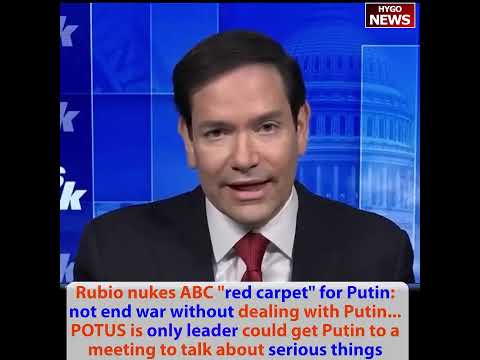
Rubio nukes ABC Putin “red carpet”, Putin not meet with Macron/UK, only one leader has any chance
Secretary of State Marco Rubio on ABC dismantled the “red carpet legitimized Putin” media framing and explained why Trump’s unique diplomatic position cannot be replaced by other Western leaders. And Washington State Democratic Rep. Adam Smith acknowledged DC crime is a “policy problem” Democrats should address — with his own children living there. Rubio: “Putin is already on the world stage … The guy’s conducting a full-scale war in Ukraine … He has the world’s largest tactical nuclear arsenal and the second largest strategic nuclear arsenal … All the media’s done is talk about Putin all the time for the last four or five years.” On the necessity of engagement: “You’re not going to end a war between Russia and Ukraine without dealing with Putin. That’s just common sense.” On Trump’s unique position: “Putin’s not going to meet with Macron. He’s not going to meet with the UK, with all due respect to these leaders … There’s only one leader in the world that has any chance of bringing these two sides together … that’s President Trump. And you forfeit that role the minute you put additional sanctions on him.” Rep. Adam Smith: “Crime is too high … Democrats make have a mistake if we act like crime is not a policy problem we’re worrying about … Both of my children live in Washington, D.C. It’s not the safest place in the world."
"Red Carpet” Framing
The ABC interviewer’s premise. “Critics of President Trump will say the poppin’ circumstance, the red carpet, the warm handshake, that President Trump simply lost that, that Putin gained there, just by being on the world stage and walking down a red carpet with the president. Your reaction to that?”
“Poppin’ circumstance” is Whisper’s rendering of “pomp and circumstance.” The specific framing: the ceremonial trappings of the Alaska summit — red carpet, warm handshake, ceremonial welcome — constituted diplomatic wins for Putin. Putin gained legitimacy on the world stage simply by appearing with Trump.
Rubio’s Response: “Already on the World Stage”
“Well, I mean, critics of President Trump are always going to find something to criticize. You don’t pay attention to it anymore, but I will tell you this.”
Rubio’s preliminary framing. Trump critics criticize everything. Specific criticisms have lost credibility through repetition. Substantive responses matter more than responding to each specific critique.
“Putin is already on the world stage. He’s already on the world stage. The guy’s conducting a full-scale war in Ukraine. He’s already on the world stage.”
Triple repetition of the core point. Putin’s world-stage presence is not created by the Alaska red carpet. Putin’s world-stage presence derives from:
- Running one of the two largest nuclear arsenals in the world
- Leading a country with major natural resource exports (oil, gas, grain, rare earths)
- Conducting a major war (Ukraine) with global implications
- Having permanent UN Security Council seat with veto power
- Leading a nuclear-armed nation that is fighting a country Western democracies are supporting
A red carpet in Alaska does not create or even materially amplify Putin’s world-stage position. Putin is already there — by virtue of Russia’s actual strategic position.
Nuclear Arsenal Scale
“He has the world’s largest tactical nuclear arsenal in the world and the second largest strategic nuclear arsenal in the world.”
That is factually precise. Russia’s tactical nuclear arsenal is the world’s largest — approximately 1,000-2,000 tactical warheads depending on estimation methodology. Russia’s strategic nuclear arsenal (ICBMs, SLBMs, strategic bombers) is second only to the U.S. at approximately 1,500+ deployed strategic warheads plus larger reserves.
“He’s already on the world stage.” The nuclear position alone puts Putin on the world stage. No red carpet required. Ignoring Putin (refusing to engage diplomatically) does not remove Russia’s nuclear weapons or reduce Putin’s strategic weight. It simply removes U.S. influence over how that weight is deployed.
”Four or Five Years of Media Attention”
“All the media’s done is talk about Putin all the time for the last four or five years.”
That is the self-contradiction in the red-carpet-legitimizes-Putin framing. American media has devoted extensive coverage to Putin since 2015 (when the Russia-collusion narrative began) and especially since February 2022 (Ukraine invasion). Putin’s face has appeared on American television more than most American politicians during that period.
If media coverage legitimized Putin, he was already maximally legitimized before the Alaska summit. Adding Alaska coverage does not meaningfully increase his media presence. The specific coverage of the Alaska summit continues the pre-existing pattern rather than representing a step-change.
”You’re Not Going to End a War Without Dealing with Putin”
“You’re not going to have a peace agreement between Russia and Ukraine. You’re not going to end a war between Russia and Ukraine without dealing with Putin. That’s just common sense. I shouldn’t even have to say it.”
That is the decisive rhetorical point. To end the war, someone must engage Putin. Refusing to engage Putin is equivalent to accepting indefinite war continuation. That is the specific choice.
“That’s just common sense. I shouldn’t even have to say it.” Rubio’s frustration. The media framing treats engagement with Putin as illegitimate — but refusing to engage means the war continues. That refusal is itself a substantive policy choice that the media does not scrutinize with equivalent intensity.
”Russian Side to Agree to Things They Don’t Want to Agree To”
“So people can say whatever they want. Ultimately, at the end of the day, we have to get the Russian side to agree to things that they don’t want to agree to if we’re going to have peace. If not, there’ll just be a war. They’ll keep killing each other.”
That is the specific negotiation objective. Russia must agree to things Russia does not want. Ukraine must agree to things Ukraine does not want. Mutual reluctance is the starting point. Finding specific terms where both sides’ reluctance is manageable is the art of the negotiation.
“There’ll just be a war. They’ll keep killing each other.” The specific alternative. Without diplomacy, war continues. The casualty rates documented elsewhere (7,000+ per week) continue indefinitely. That outcome is what media critics of the Alaska summit implicitly prefer — because their critique leaves no alternative path to peace.
”Life Will Go On in America”
“And life will go on in America and in the rest of the world, but not for Ukraine.”
That is the specific consequence asymmetry. American life continues regardless. European life continues largely unaffected. But Ukraine continues losing approximately 7,000 people per week. Ukrainian territory continues being destroyed. Ukrainian civilians continue dying.
The specific moral weight falls on Ukraine. Continuing the war is not a neutral choice. It is a choice that produces specific Ukrainian suffering. Media figures who dismiss Trump’s peace diplomacy bear partial responsibility for the continued suffering — because they contribute to the political difficulty of pursuing peace.
”He Could Have Just Said, This Is Biden’s War”
“So the president has invested a lot of time in trying to bring an end to this war. He deserves credit for doing that. He gets criticism for doing that. He could have just let this war go on. The president could have just said, this is Biden’s war. It started under him. We’ll do what we can for Ukraine, but we’re going to focus on other things. He could have easily said that.”
That is the counterfactual Trump could have adopted. Blame Biden. Distance the administration from the war. Focus on domestic priorities. Let Ukraine continue fighting with declining support.
That counterfactual would have been politically easier. Trump avoided specific political costs associated with engagement (bully-Zelensky accusations, Putin-red-carpet criticism, etc.). But the casualty rate continues. Ukrainian suffering continues.
“He’s the only leader in the world that can get Putin to a meeting to talk about serious things.”
Specific U.S. diplomatic advantage. Trump uniquely can bring Putin to the table. Avoiding that engagement would have foreclosed the specific opportunity for peace. Taking the engagement is the administration’s specific active choice.
”One Leader in the World That Has Any Chance”
“Putin’s not going to meet with Macron. He’s not going to meet with the UK with all due respect to these leaders. None of these leaders are going to be able to bring him to the table and talk to them. There’s only one leader in the world that has any chance of bringing these two sides together. If there is a chance, there’s only one leader in the world that can do it, and that’s President Trump.”
That is the specific attribution. Macron — French President. UK leadership (Starmer). Other European leaders. None would succeed in bringing Putin to the table. Only Trump.
Why? Putin’s specific calculation:
- Trump represents U.S. strategic weight Putin respects
- Trump’s political independence allows him to engage without Western coordination constraints
- Trump’s first-term relationship with Putin created baseline trust
- Trump’s transactional diplomacy resonates with Putin’s approach
European leaders, by contrast, face specific limits:
- European economic weight is insufficient to command Putin’s attention alone
- European coordination requirements slow decision-making
- European sanctions-first posture has foreclosed constructive engagement
- Specific European leaders (Macron especially) have limited Putin credibility
”Forfeit That Role the Minute You Put Additional Sanctions”
“And you forfeit that role the minute you put additional sanctions on him. We may get to that point, unfortunately. But if we do, it means that peace talks are no longer possible.”
That is the specific tactical constraint. Sanctions escalation ends diplomacy. Trump’s unique role depends on not imposing additional sanctions during active diplomacy. Every day sanctions hold at current levels, the diplomacy can continue.
“We may get to that point, unfortunately.” Rubio acknowledging the possibility of diplomatic failure. If Putin refuses reasonable terms, if Zelensky rejects achievable deals, if both sides dig in despite the casualty costs — then sanctions escalate and diplomacy ends.
“If we do, it means that peace talks are no longer possible.” Specific consequence. Once sanctions escalate, Putin’s political position prevents continued diplomacy. The war settles in for another year or more. The Ukrainian death toll continues.
”Real World Ramifications”
“And that would be very unfortunate because the real world ramifications are that while we’re here calling each other names and doing TV interviews about this stuff and all that in American politics, there are people who today will be in, even as we speak, people that have nothing to do with this war are suffering as a result of it.”
That is the moral weight. While American media conducts political theater about Alaska summit optics, Ukrainian civilians continue dying. Ukrainian conscripts continue being killed. Ukrainian cities continue being destroyed. The political conversation is divorced from the ongoing human cost.
“People that have nothing to do with this war are suffering as a result of it.” Civilian suffering. Elderly Ukrainians without power in winter. Children separated from parents. Families displaced from homes. The war’s costs are not borne primarily by combatants but by civilians with no direct engagement.
”We’ve Seen It in Cambodia and Thailand”
“I think we are very fortunate and blessed and should be thankful to have a president that has made peace and the achievement of peace a priority of his administration. We’ve seen it in Cambodia and Thailand. We’ve seen it in India, Pakistan. We’ve seen it in Rwanda and the DRC. And we’re going to continue to pursue any opportunities we can find to bring about peace in the world.”
That is the specific track record. Cambodia-Thailand border agreement. India-Pakistan de-escalation after brief conflict. Rwanda-DRC peace framework. Multiple other conflicts addressed.
Trump’s peace-making is not theoretical. It is documented and operational. The same approach — direct engagement, specific negotiating leverage, willingness to engage unpleasant counterparts — has produced results in other contexts. Applying it to Russia-Ukraine is the latest application, not an unprecedented experiment.
Adam Smith on DC Crime
The segment ends with Rep. Adam Smith, Washington State Democrat. “The crime is too high. And I think Democrats make, have a mistake. If we act like crime is not a policy problem we’re worrying about. It is. Both of my children live in Washington, D.C. You know, it’s not, it’s not the safest place in the world. And also some of the policies that Democrats advanced around crime over the course of the last 10 or 15 years very clearly did not work. There was not enough transparency and not enough accountability. So we ought to be able to say that.”
That is a rare specific Democratic acknowledgment. Crime is too high in DC. Democrats make mistakes if they deny the problem. Smith’s own children live in DC and face the safety challenges. Democratic crime policies from the past 10-15 years “clearly did not work.”
That is substantially different from the Jeffries “illegitimate power grab” framing. Smith is acknowledging policy failures and the need for different approaches. He is providing an opening for bipartisan response to crime — the opposite posture from the uniform Democratic opposition some other members have maintained.
Key Takeaways
- Rubio on the “red carpet legitimizes Putin” framing: “Putin is already on the world stage … The guy’s conducting a full-scale war in Ukraine … He has the world’s largest tactical nuclear arsenal … All the media’s done is talk about Putin all the time for the last four or five years.”
- On the necessity of engagement: “You’re not going to end a war between Russia and Ukraine without dealing with Putin. That’s just common sense. I shouldn’t even have to say it.”
- On Trump’s unique position: “Putin’s not going to meet with Macron. He’s not going to meet with the UK, with all due respect to these leaders … There’s only one leader in the world that has any chance of bringing these two sides together … that’s President Trump.”
- On sanctions consequences: “You forfeit that role the minute you put additional sanctions on him … if we do, it means that peace talks are no longer possible.”
- Rep. Adam Smith (D-WA): “Democrats make have a mistake if we act like crime is not a policy problem we’re worrying about … Both of my children live in Washington, D.C. It’s not the safest place in the world.”