 HYGO News
 Rubio: not our war, only country/leader can bring Putin to table; we wagged finger at Putin? Not PPV
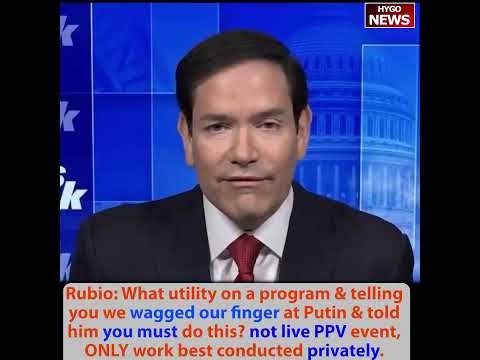
Rubio: not our war, only country/leader can bring Putin to table; we wagged finger at Putin? Not PPV
Secretary of State Marco Rubio laid out a comprehensive diplomatic framework covering the sanctions status, the U.S. role, negotiation privacy, and the path to the trilateral meeting. Rubio: “The Russians are already facing very severe consequences. There’s not a single sanction that’s been lifted, not one … All the American support continues for Ukraine.” On the U.S. position: “This is not our war. The United States is not in a war. Ukraine is in a war … We happen to be in the role of the only country in the world, with the only leader in the world, that can actually bring Putin to a table to even discuss these things.” On negotiation privacy: “What utility would there be of me going on a program and telling you, we’ve wagged our finger at Putin and told him, you must do this and you must do that … As much as everyone would love it to be a live pay-per-view event, these discussions only work best when they are conducted privately.” On the nature of peace: “If one side gets everything they want, that’s not a peace deal. It’s called surrender.” And on the path forward: “Ultimately, where this should lead is to a meeting between the three leaders, between Zelensky, Putin, and President Trump, where we could finalize."
"Not a Single Sanction That’s Been Lifted”
Rubio’s opening factual baseline. “Well, first of all, the Russians are already facing very severe consequences. There’s not a single sanction that’s been lifted, not one. I mean, they’re facing all the same sanctions that have been in place today. All the American support continues for Ukraine.”
That is critical factual correction. Media framings have sometimes suggested Trump’s Putin engagement includes sanctions relief. Rubio directly contradicts that framing. Not one sanction lifted. All prior sanctions remain in place. Russia continues facing full existing economic pressure.
“All the American support continues for Ukraine.” U.S. support for Ukraine is not suspended during the negotiation period. Weapons continue flowing. Intelligence sharing continues. Economic support continues. The negotiation is not being conducted at the cost of Ukraine’s defense capacity.
Sanctions as Reserve
“And ultimately, look, if we’re not going to be able to reach an agreement here at any point, then there are going to be consequences. Not only the consequences of the war continuing, but the consequences of all those sanctions continuing and potentially new sanctions on top of it as well.”
That is the specific consequence framework. Current sanctions remain. Additional sanctions are in reserve. If diplomacy fails, sanctions escalate — and the war continues with the economic pressure intensifying.
“Potentially new sanctions on top of it as well.” Specific new sanctions would come if diplomacy fails. Those could include:
- Secondary sanctions on countries buying Russian oil
- Enhanced financial restrictions
- Tech export controls
- Targeted sanctions on specific Russian officials or entities
- Sectoral restrictions beyond current scope
”But What We’re Trying to Do Right Now Is End the War”
“But what we’re trying to do right now is end the war. In order to end the war, you’ve got to give every opportunity that exists. You have to be open to any opportunity that exists to bring it about.”
That is the specific priority ordering. Ending the war is the current priority. All diplomatic opportunities must be tested. Any opportunity that could produce war-ending must be explored.
If every opportunity is tested and the war cannot be ended, then escalated sanctions become the approach. But sanctions escalation forecloses diplomatic options. The specific sequence matters — diplomacy first, sanctions as failure-path.
”This Is Not Our War”
“And here’s the thing to remind everybody, when the President says this is not our war, but let’s be frank, this is not our war. The United States is not in a war. Ukraine is in a war. We’ve been supporting Ukraine.”
That is the specific ontological framing. The U.S. is not at war with Russia. Ukraine is at war with Russia. U.S. role: supporter of Ukraine, not belligerent.
That distinction matters legally and politically:
- The U.S. has no formal declaration of war against Russia
- U.S. military personnel are not deployed in combat roles in Ukraine
- U.S. war powers constraints do not apply as they would in a declared war
- Voters’ assessment of Ukraine policy is different from their assessment of a direct U.S. war
”Only Country With the Only Leader”
“We happen to be in the role of the only country in the world, with the only leader in the world, that can actually bring Putin to a table to even discuss these things.”
That is the specific U.S. position. Putin will talk to Trump. Putin will not talk to most other world leaders. The U.S. uniquely — and Trump specifically — has access to Putin for serious diplomacy.
Why only the U.S. and only Trump? Several factors:
- U.S. strategic weight (nuclear parity, economic scale, military capacity)
- Trump’s personal relationship with Putin (cultivated over first term and since)
- Trump’s willingness to engage Putin as a serious counterpart rather than pariah
- Trump’s political independence (not requiring approval from other Western leaders)
Other leaders — Macron, Merz, Starmer, Meloni — could theoretically engage Putin. But Putin would not treat them as equal negotiating counterparts. Trump represents the specific U.S. strategic weight that Putin respects.
”If Tomorrow the War Continues, Life in America Will Not Be Fundamentally Altered”
“Now, the President has traveled all the way to Alaska, all the way back, has dedicated months and months of work, him, our entire team on this matter, because we want to see an end to the war. But if tomorrow the war continues, life in America will not be fundamentally altered.”
That is specific realism. The war continues means more Ukrainian and Russian deaths. More European and broader global costs. But American domestic life is not fundamentally transformed by the war’s continuation.
That framing matters. American voters’ perspective on Ukraine policy is secondary to their perspective on domestic issues. If Trump’s engagement with Ukraine is seen as distracting from domestic priorities, voters might prefer disengagement. The clarification: Ukraine engagement is pursued because Trump wants peace, not because American national interests require the specific engagement.
“So I think that we have to understand is that this has been a priority for this President because he wants to promote peace.”
That is the motivational framing. Not American self-interest. Peace — for Ukrainians, Russians, Europeans. Trump is pursuing the peace because peace is the normative goal, not because specific American interests demand it.
“I think we should be happy that we have a President that’s trying to promote peace and bring a war to an end.” That is the concluding framing. Regardless of partisan view of Trump, Americans can appreciate a president pursuing peace rather than escalating toward war.
”I Wouldn’t Name Them on Your Program”
Brennan asking about Putin concessions. “Can you name any concessions that Vladimir Putin made during this meeting? Have any concessions been asked?”
Rubio’s response. “I wouldn’t name them on your program. Why would I do that? Where is the pressure?”
That is specific diplomatic reality. Negotiating concessions — revealed publicly before deals are concluded — weakens the negotiating position of the party making concessions. Putin cannot politically defend concessions that become public prematurely. Russian domestic constituencies react negatively to perceived Russian weakness.
“Where is the pressure?” That is Rubio’s pointed counter. Naming specific concessions on CBS would not create pressure — it would undermine the diplomacy. CBS viewers learning concessions does not force Putin to act. Putin reading Russian media reports of the CBS disclosure would be politically pressured to retract the concessions.
”Live Pay-Per-View Event”
“Because you can’t have a peace agreement unless both sides give and get. You can’t have a peace agreement unless both sides make concessions. That’s a fact. That’s true in virtually any negotiation. If not, it’s just called surrender. And neither side is going to surrender. So both sides are going to have to make concessions. So of course concessions were asked. But what utility would there be of me going on a program and telling you, we’ve wagged our finger at Putin and told him, you must do this and you must do that. It’s only going to make it harder and less likely that they’re going to agree to these things. So these negotiations, as much as everyone would love it to be a live pay-per-view event, these discussions only work best when they are conducted privately.”
“Live pay-per-view event” is Rubio’s specific framing of media expectations. Viewers want drama. Specific details. Confrontational moments that generate clicks and coverage.
But diplomacy does not work as entertainment. Private discussions produce movement. Public confrontation produces theater. Serious negotiations require private space where parties can propose, withdraw, modify, and concede without public political cost.
“As much as everyone would love it” — Rubio acknowledging the audience’s expectations. “These discussions only work best when they are conducted privately.” Audiences wanting entertainment get less useful diplomacy. Audiences willing to wait for outcomes get better outcomes.
”Space for Concessions”
“Serious negotiations in which people who have to go back and respond to constituencies, because even the Dalatarian governments have constituencies they have to respond to, people have to go back and defend these agreements that they make. And so, and figure out a way to explain them to people. So we need to create space for concessions to be made.”
“Dalatarian” is Whisper’s rendering of “totalitarian” — Rubio’s point is that even authoritarian governments have domestic constituencies. Putin cannot simply dictate to his political and security elite. Putin must justify agreements to senior Russian officials, security services, oligarchs, and public opinion.
“Space for concessions to be made.” That is the specific diplomatic requirement. Putin needs time, privacy, and political cover to make concessions. Public pressure producing premature disclosure eliminates the space. No space means no concessions. No concessions means no deal.
”War Is Only Going to Get Worse”
“This war is only going to get worse. It’s not going to get better. You’ve seen that in the escalation and the attacks. Russia’s economy is now 100% full-time war footing. They are producing munitions. The Ukrainians are as well. Both sides are hitting each other very, very hard. And the war is only going to get worse.”
That is the specific tactical reality. Russia on full war footing — defense production accelerated, conscription extended, economic resources concentrated on war effort. Ukraine similarly mobilized — long-range strikes, manpower mobilization, technology development.
Both sides hitting each other “very, very hard.” Russian strikes deep into Ukraine. Ukrainian strikes deep into Russia. The war’s intensity is increasing, not decreasing. Waiting for the war to end naturally is not an option.
”Stupid Leaks and Things of That Nature”
“But people that are out there talking what they don’t know with all these stupid leaks and stings of that nature, they all want to just sound important. They don’t know what they’re talking about. President’s been very clear. What Zelensky’s going to agree to, that’s up to them to decide.”
“Stupid leaks.” That is Rubio’s characterization. Anonymous sourcing from unnamed officials. Former officials offering analysis without actual access to current negotiations. Retired diplomats speculating without specific knowledge.
“They all want to just sound important.” The specific motivation Rubio attributes. Leaking or commenting confers pseudo-status. Being quoted in major media outlets feels important. But without actual knowledge, the commentary is worse than useless — it distorts public understanding.
“President’s been very clear. What Zelensky’s going to agree to, that’s up to them to decide.” Trump’s position is documented. Zelensky decides Ukraine’s terms. Trump facilitates. Trump does not impose. The specific role separation.
”That’s Not a Peace Deal. It’s Called Surrender”
“Here’s what I can tell you for certain. You can’t have a peace deal between two warring factions, unless both sides agree to give up something, and both sides agree that the other side gets something. Right? Otherwise, if one side gets everything they want, that’s not a peace deal. It’s called surrender. And I don’t think this is a war that’s going to end anytime soon on the basis of surrender.”
That is the clarifying framework. Peace deals involve mutual concessions. Unilateral demands become surrender demands. Neither Russia nor Ukraine is going to surrender. Therefore both must make concessions.
“Not going to end anytime soon on the basis of surrender.” The specific rejection of either-side-wins framing. Ukraine will not surrender territorial integrity. Russia will not surrender strategic interests. Both must give. Both must get.
”Meeting Between the Three Leaders”
“So this is tough stuff. I mean, it’s difficult to bring these two sides together. We made some progress, we believe, and now we’ll have to follow up on that progress. And ultimately, where this should lead is to a meeting between the three leaders, between Zelensky, Putin, and President Trump, where we could finalize. But we’ve got to get this thing closer before we get to that point.”
The specific end-state. Trilateral meeting. Zelensky, Putin, Trump. At that meeting, the deal is finalized. The deal cannot be finalized without that meeting. The meeting cannot happen without sufficient preparatory progress to justify the principals’ engagement.
“We’ve got to get this thing closer before we get to that point.” The current phase. Closing remaining gaps. Setting up the trilateral. Ensuring the trilateral will produce final deal rather than failed performance.
Key Takeaways
- Rubio on the sanctions status: “The Russians are already facing very severe consequences. There’s not a single sanction that’s been lifted, not one … All the American support continues for Ukraine.”
- On the U.S. role: “This is not our war. The United States is not in a war. Ukraine is in a war … We happen to be in the role of the only country in the world, with the only leader in the world, that can actually bring Putin to a table to even discuss these things.”
- On negotiation privacy: “What utility would there be of me going on a program and telling you, we’ve wagged our finger at Putin and told him, you must do this … As much as everyone would love it to be a live pay-per-view event, these discussions only work best when they are conducted privately.”
- On the peace vs. surrender distinction: “If one side gets everything they want, that’s not a peace deal. It’s called surrender. And I don’t think this is a war that’s going to end anytime soon on the basis of surrender.”
- On the path to trilateral: “Where this should lead is to a meeting between the three leaders, between Zelensky, Putin, and President Trump, where we could finalize. But we’ve got to get this thing closer before we get to that point.”