 HYGO News
 Rubio After Lavrov Meeting: 'Trump Is the Only Leader in the World Who Can' End the Ukraine War
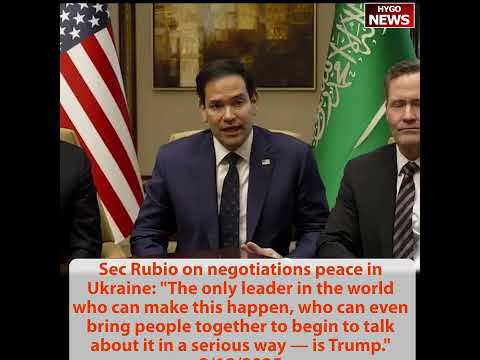
Rubio After Lavrov Meeting: “Trump Is the Only Leader in the World Who Can” End the Ukraine War
Following Secretary of State Marco Rubio’s historic meeting with Russian Foreign Minister Sergei Lavrov in Saudi Arabia in February 2025, both Rubio and National Security Advisor Mike Waltz delivered forceful assessments of the Ukraine peace process. Rubio declared that “for three and a half years while this conflict has raged, no one else has been able to bring something together like what we saw today, because Donald Trump is the only leader in the world that can.” Waltz revealed that both Putin and Zelensky had told Trump in the Oval Office, “Only you, President Trump, could drive this war to a conclusion,” and that the president had “shifted the entire global conversation from not if the war is going to end, but just how it’s going to end."
"The Only Leader in the World That Can”
Rubio opened his post-meeting remarks with a statement that framed the entire diplomatic achievement in terms of Trump’s unique capacity as a leader.
“For three and a half years while this conflict has raged — or three years while it’s raged — no one else has been able to bring something together like what we saw today, because Donald Trump is the only leader in the world that can,” Rubio said.
He returned to this theme repeatedly throughout his remarks, building it into a refrain. “The only leader in the world who can make this happen, who can even bring people together to begin to talk about it in a serious way, is President Trump,” Rubio said. “He’s the only one in the world that can do that right now.”
And again: “Donald Trump is the only leader in the world that could initiate that process. And today was the first step in that process.”
The repetition was deliberate. Rubio wanted to establish an irrefutable talking point: no one else had accomplished what Trump had in just weeks. The Biden administration had spent years managing the conflict without ever achieving direct U.S.-Russia diplomatic engagement on peace terms. European leaders had conducted various shuttle diplomacy efforts without breakthroughs. Trump had done in weeks what no other leader had managed in years.
Rubio Meets Lavrov: “The First Step of a Long and Difficult Journey”
Rubio provided context for the Saudi Arabia meeting, framing it as the opening move in a process that would be neither quick nor easy.
“It’s been three and a half years since there’s been any sort of regularized contact between the United States and Russia,” Rubio noted. “And in some cases, between any of the participants in this conflict and Russia.”
He described the meeting’s objective with diplomatic precision. “The goal of today’s meeting was to follow up on the phone call the president had a week ago and begin to establish those lines of communication,” Rubio said. “The work remains. Today is the first step of a long and difficult journey, but an important one.”
The Secretary of State was careful to temper expectations while maintaining optimism. “Obviously a lot of work remains before we have a result,” he said. “But President Trump’s the only one that can do it.”
He framed the stakes in terms that went beyond the two belligerents. “From that could emerge some very positive things for the United States, for Europe, for Ukraine, for the world,” Rubio said. “But first it begins by the end of this conflict. And so the only thing President Trump’s trying to do is bring about peace.”
Rubio expressed a view that the world owed Trump gratitude: “It’s what he campaigned on. It’s something the world should be thanking President Trump for doing. He’s been able to achieve what for three, two and a half, three years, no one else has been able to achieve, which is to begin this process, a serious process.”
Waltz: “An Endless War Turned into a Meat Grinder”
National Security Advisor Mike Waltz added a more visceral description of why the Trump administration had made ending the war such an urgent priority.
“What the President did not find acceptable was an endless war in Europe that has literally turned into a meat grinder of people on both sides,” Waltz said.
The “meat grinder” characterization was one of the starkest descriptions of the Ukraine conflict that any senior American official had offered publicly. It conveyed the industrial-scale killing that had defined the war, particularly along the eastern front where both sides had been engaged in grinding attrition warfare with enormous casualty rates on both sides.
Waltz then made what may have been the most significant analytical claim of the briefing: “If you just think about just in a few months, President Trump has shifted the entire global conversation from not if the war is going to end, but just how it’s going to end.”
The shift from “if” to “how” was a powerful framing because it characterized the end of the war as already decided in principle. Under Biden, the question had been whether the war would end through negotiation at all, or whether it would continue indefinitely with the United States supplying weapons to Ukraine while Russia absorbed the costs and continued fighting. Under Trump, the question had shifted to the terms of the settlement.
Both Putin and Zelensky: “Only You, President Trump”
Waltz then revealed a private detail from Oval Office conversations that underscored the unique position Trump occupied.
“In the Oval Office less than a week ago, both President Putin and President Zelensky both said to him, ‘Only you, President Trump, could drive this war to a conclusion,’” Waltz said.
The claim that both belligerent leaders — who had not spoken to each other and whose countries were actively engaged in combat — had independently told the same thing to Trump was remarkable. If true, it meant that both sides had concluded that no other world leader had the combination of credibility, leverage, and willingness to broker a deal.
For Putin, Trump represented a leader who was willing to engage with Russia’s security concerns rather than dismiss them. For Zelensky, Trump represented a leader who had the domestic political standing to impose terms that Ukraine’s Western allies would support. For both, Trump was the only figure who could create the conditions for a negotiated end to the war.
”Fair, Sustainable, and Enduring”
Rubio outlined the principles that would guide the negotiation, drawing directly from Trump’s campaign commitments.
“As he said when he campaigned for president, he wants it to end in a way that’s fair, he wants it to end in a way that’s sustainable and enduring, not that leads to another conflict in two to three years,” Rubio said. “That’s not going to be easy to achieve, but he’s the only one in the world that can begin that process.”
The emphasis on sustainability was significant because it addressed the concern that any ceasefire would simply freeze the conflict temporarily, allowing both sides to rearm before the fighting resumed. The same concern had been central to VP Vance’s earlier comments about seeking “a durable, lasting peace, not the kind of peace that’s going to have Eastern Europe in conflict just a couple years down the road.”
Rubio also addressed the inclusivity of the process. “No one is being sidelined here,” he said, responding to concerns that Ukraine or European allies might be excluded from negotiations. “But President Trump is in a position that he campaigned on to initiate a process that could bring about an end to this conflict.”
The Diplomatic Context
The Rubio-Lavrov meeting in Saudi Arabia was the highest-level direct diplomatic contact between the United States and Russia since the full-scale invasion of Ukraine began in February 2022. The choice of Saudi Arabia as the venue was consistent with Trump’s earlier indication that he expected to meet Putin there as well.
The meeting followed Trump’s phone calls with both Putin and Zelensky, Witkoff’s three-hour meeting with Putin in Moscow, and Vance’s meeting with Zelensky in Munich. The rapid sequence of diplomatic engagements across multiple channels demonstrated the administration’s multi-track approach: presidential phone diplomacy, envoy missions, and now secretary of state-level meetings, all converging toward the same objective.
Key Takeaways
- Secretary Rubio said “Donald Trump is the only leader in the world” who could bring the Ukraine war to an end, repeating the claim multiple times after meeting with Russian Foreign Minister Lavrov in Saudi Arabia.
- NSA Waltz revealed that both Putin and Zelensky had told Trump in the Oval Office: “Only you, President Trump, could drive this war to a conclusion.”
- Waltz said Trump had “shifted the entire global conversation from not if the war is going to end, but just how it’s going to end” and described the conflict as a “meat grinder.”
- Rubio said the meeting with Lavrov was “the first step of a long and difficult journey” after three and a half years of no regularized U.S.-Russia contact.
- The administration committed to a peace that was “fair, sustainable, and enduring” rather than one that “leads to another conflict in two to three years.”