 HYGO News
 Ron DeSantis says he will send migrants to Delaware 11/10/2021
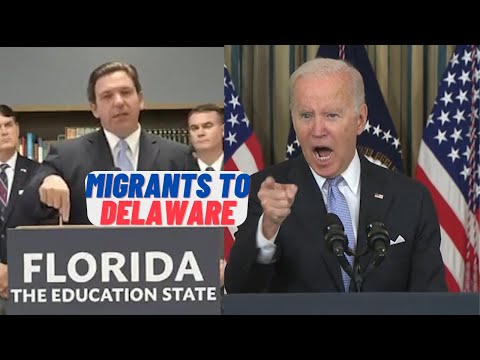
“I Will Send Them to Delaware”: DeSantis Threatens to Bus Migrants After Secret Federal Flights to Florida
On November 10, 2021, Florida Governor Ron DeSantis held a press conference in which he threatened to send migrants to President Biden’s home state of Delaware after revelations that the federal government had been flying undocumented migrants into Jacksonville on clandestine flights, many arriving in the early morning hours. DeSantis said Florida had been given no notification of the flights, that the state had learned about them only through federal government leakers, and that his office was aware of 78 such flights in recent months. The governor also slammed Biden for the $450,000 migrant payment controversy and the broader border crisis, arguing that law-abiding Americans were being told to “grin and bear it” on gas prices and grocery bills while illegal immigrants were offered taxpayer-funded compensation.
The Secret Flights to Jacksonville
DeSantis opened by describing how Florida had discovered the migrant flights. A reporter noted that the governor’s office was aware of 78 flights carrying migrants to the Jacksonville area in recent months and asked for details about who was on board and how many people were involved.
DeSantis confirmed the flights were happening without state involvement. “There’s no notification to the state of Florida. These are done mostly in the middle of the night and it’s clandestine and we really have no say into it,” he said. “I know when we initially got wind of this, it wasn’t through normal channels. It’s people in the federal government who are effectively leaking this to us so that we have a heads up on it.”
DeSantis spoke with officials at the Jacksonville Aviation Authority, who confirmed the federal government’s role: “Feds come in, they do it, they got a bus.”
The White House had pushed back on the characterization of the flights as secretive. Press Secretary Jen Psaki was shown in the video responding: “Well, I’m not sure that it’s in the middle of the night, but let me tell you what’s happening here.” A reporter immediately corrected her with specific times: “2:30 AM. 4:29 AM.” Another reporter quipped: “Earlier than you might like to take a flight.”
DeSantis said the flights had been occurring since at least May 2021 and were continuing. He noted that Jacksonville had to deal with public health consequences, including COVID-related issues connected to the arrivals.
”I Will Send Them to Delaware”
DeSantis then issued the threat that became the press conference’s headline. “My view would be, why don’t we — if they’re going to come here, we’ll provide buses and provide them. I will send them to Delaware and do that,” DeSantis said. “If he’s not going to support the border being secured, then he should be able to have everyone there.”
The comment previewed what would become a major political strategy for Republican governors over the following year. DeSantis would eventually follow through on the threat, and Texas Governor Greg Abbott would adopt a similar approach, busing migrants to Washington, D.C., New York City, and Chicago. The tactic forced the immigration debate from an abstraction at the southern border into a visible reality in Democratic-led cities, generating national attention and political controversy.
DeSantis also noted that the state was tracking buses arriving from South Texas in addition to the flights. “We’re also looking at buses from South Texas where those buses are taking folks and buses that are coming in to the state of Florida and certainly in other parts,” he said.
The “Perverse Incentives” of Immigration Enforcement
DeSantis offered an observation about the immigration system that drew attention for its counterintuitive logic. He argued that under the current enforcement framework, getting caught by immigration authorities was actually better for migrants than avoiding detection.
“It’s interesting. If you’re trying to deter kind of illegal migration in the interior of the country, if you come illegally and they don’t catch you, it’s actually in some respects worse than if they catch you,” DeSantis said. “Because when they catch you, they’ll give you money or potentially put you on a conveyance to get you somewhere. Whereas if they don’t catch you, you’re kind of on your own and you don’t necessarily get any money from the government and everything. Really, really perverse incentives.”
The observation highlighted what critics saw as the fundamental dysfunction of the Biden administration’s approach to border enforcement: a system in which apprehension led to release into the interior of the country, government transportation, and potential financial compensation, rather than deterrence or removal.
DeSantis Connects the Border to Everyday Costs
DeSantis tied the border crisis directly to the economic frustrations Americans were experiencing in their daily lives, drawing a contrast between the treatment of illegal immigrants and the burdens placed on citizens.
“The president has said that basically they want to even pay reparations to people who came illegally. Just think about that,” DeSantis said. “You as an American, you get higher gas prices. You get higher grocery bills. You get told basically to just grin and bear it. Someone breaks the law, comes illegally. They’re going to cut them a check for hundreds of thousands of dollars. That is just unbelievable.”
The video included Biden’s original exchange with reporters about the $450,000 payments, showing his initial denial (“If you guys keep sending that garbage out, yeah. But it’s not true”) followed by his reversal days later (“You deserve some kind of compensation, no matter what the circumstance”).
DeSantis used the contradiction to reinforce his argument that the administration’s priorities were inverted: “The fact of the matter is, this border should be secured. We know what to do because it was working prior to Biden taking office.”
The Legal and Airspace Problem
DeSantis acknowledged a practical challenge in resisting the federal flights. The federal government controls airspace and air traffic, meaning that neither the state of Florida nor the city of Jacksonville could legally block the flights from arriving.
“The federal government has basically the runway when it comes to air traffic in this country,” DeSantis said. “I don’t control the airspace. City of Jacksonville doesn’t control the airspace. The feds control the airspace. So they can shut us out.”
He mentioned a pending lawsuit as one potential avenue for relief but expressed skepticism about whether the Biden administration would comply with any adverse court ruling. DeSantis cited the OSHA vaccine mandate case, which had been stayed by the Fifth Circuit Court of Appeals, but which the administration had told businesses to follow anyway.
“What did the Biden administration say to businesses? Ignore the court and follow our rule anyways,” DeSantis said. “They basically said, to hell with these court decisions, they’re going to do whatever they feel like doing.”
He noted that at least some of the flights involved individuals classified as unaccompanied alien children, or UACs, including people who were “posing as being under 18” but were actually in their twenties. DeSantis cited one specific case of an individual who “posed as a minor, came in, was really in the 20s.”
Key Takeaways
- DeSantis revealed that Florida had received no notification of 78 federal flights carrying migrants to Jacksonville, many arriving at 2:30 AM and 4:29 AM, and that the state learned about them only through federal government leakers — prompting his threat to bus migrants to Biden’s home state of Delaware.
- He highlighted “perverse incentives” in the immigration system where getting caught by authorities was better for migrants than evading detection, since apprehension led to government transportation, release, and potential financial compensation.
- DeSantis connected the border crisis to everyday economic pain, contrasting Americans being told to “grin and bear it” on gas prices and grocery bills with the administration’s willingness to “cut a check for hundreds of thousands of dollars” to people who entered the country illegally.