 HYGO News
 DeSantis: Florida Returning $900M Biden Couldn't Take Back; Calls for Balanced Budget Amendment -- 'Paid Off 41% of State Debt'
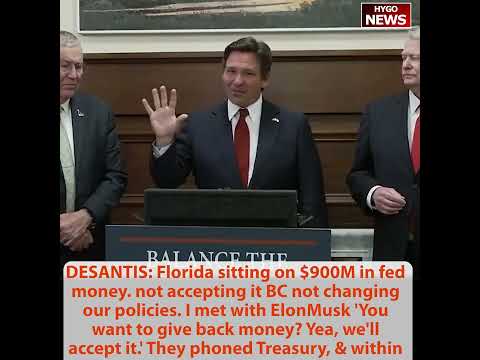
DeSantis: Florida Returning $900M Biden Couldn’t Take Back; Calls for Balanced Budget Amendment — “Paid Off 41% of State Debt”
Florida Governor Ron DeSantis revealed in March 2025 that his state was sitting on almost $900 million in federal funds it had refused to spend because they came with “strings attached” — DEI mandates, woke policies, and refugee resettlement requirements. When DeSantis tried to return the money, “the Biden administration literally did not know how to take back the money.” After meeting with Elon Musk on Friday, “within 30 minutes we had a plan to do it.” DeSantis then made the case for a balanced budget amendment, revealing that Florida had paid off 41% of its total state debt accumulated since the 1840s during his tenure, with 27 states already on board and a path to the 34 needed to trigger Article 5.
”$900 Million We’re Not Going to Accept”
DeSantis told the story that illustrated the federal government’s dysfunction in the most absurd possible terms.
“During the Biden administration, we rejected federal funds on a variety of things because they had strings attached,” DeSantis explained. “Some of the road funding — we had to do all the DEI and woke policies, which were totally contrary to our state’s policy.”
He noted that Florida had been ahead of the curve: “We had kind of led the fight against that stuff. Now it’s more fashionable to be against it. We were kind of having an uphill battle.”
The specific refusal: “So we did it, and we told the Department of Transportation and the Biden administration, ‘Here’s $350 million or however much it is — we’re not using it.’”
The bureaucracy’s response was stunning: “And they’re like, ‘We don’t know how to take it back.’ They literally did not know how to take back the money.”
The same pattern repeated across agencies: “Same thing on refugee money to send back, I believe, to HHS. They didn’t do it.”
The result: “So I’m sitting on almost $900 million. We’re not going to accept it because we’re not going to change our behavior. So let’s send it back and be part of the DOGE efforts.”
The image of a federal government that could not accept returned money was a perfect metaphor for bureaucratic dysfunction. The system was designed to distribute funds, never to reclaim them. No process existed for a state to say “we don’t want this” because no one had imagined that a state would voluntarily decline federal money.
”Within 30 Minutes, We Had a Plan”
DeSantis described the contrast between the Biden-era bureaucracy and the DOGE-era efficiency.
“So we went up and met with Elon on Friday in Washington, and he had one of his lieutenants there,” DeSantis said. “And they were just like, ‘You want to give back money? Yeah, we’ll accept it.’”
The resolution was almost instantaneous: “They got on the phone to Treasury, and within 30 minutes we had a plan to do it. And so we have initiated that.”
The juxtaposition was devastating. The Biden administration’s bureaucracy had been unable to accept returned money for years. DOGE arranged the return in 30 minutes. The difference was not technological or legal — it was the difference between a system designed to spend and a system designed to save.
”DOGE Has a Lot of Promise”
DeSantis offered his assessment of DOGE’s broader impact.
“What’s the promise of DOGE generally? I think there’s a lot of promise,” DeSantis said. “When you see some of the spending that’s happened, nobody justifies some of the grants that have been going out on some of these things.”
He diagnosed the underlying problem: “It was clearly taking taxpayer money and using it to push an ideological agenda. It was not about serving the interests of the country or what’s in the public’s interest. It was an ideological niche interest. And basically these agencies had been taken captive by this viewpoint and used your money for that.”
DeSantis acknowledged the structural challenge: “Elon and they’re using a lot of savvy tech and all this stuff, showing how the government mismanages money, but also just substantively — should government spend it on this? Because people have voted to do this in Congress for many years. Why are they doing it? How do you justify it?”
He identified the tension: “So you’re running into the momentum that Elon has with DOGE with the fact that Congress has not been willing to change its behavior.”
The Balanced Budget Amendment: 27 States and Counting
DeSantis then pivoted to his primary purpose: advocating for a balanced budget amendment through the Article 5 convention process.
“The reason we’ve gotten into this with respect to fiscal is because there are certain incentives for the people that are in Washington to behave the way they do, and we need to change those incentives,” DeSantis said. “And that involves we the people in our states doing what the Founding Fathers put in the Constitution — to propose an amendment to provide some of those constraints on their behavior. In this case, requiring a balanced budget for the U.S. government.”
He cited his own state’s record as proof the concept worked: “I have to balance the budget in Florida. Idaho has to balance the budget. Don’t tell me it can’t be done.”
Then the fiscal achievement that underscored his credibility: “When I became governor in 2019, if you take all the debt in the history of Florida — from the 1840s when we became a state that we’ve accumulated until I became governor — just in my tenure, we’ve paid off 41% of the state’s total debt.”
He elaborated: “That’s not just an annual surplus. We run that, but we’re actually digging in, taking our surplus, doing tax cuts and other things, but then paying down this debt. By the time my term expires, we will likely have paid down over half of the state’s debt that was accumulated over 180 years.”
The Path to 34 States
DeSantis outlined the specific pathway to triggering an Article 5 convention.
“Idaho has an opportunity to certify this proposed amendment under Article 5 of the Constitution,” he said. “There have been 27 states, including Florida, that have done it.”
He previewed his next move: “As Governor Little mentioned, I’m going to be going to Montana, and we’re going to be meeting with those folks. If Idaho and Montana join the fight, that gets us to 29.”
He described the proximity to the threshold: “There’s a couple other states that are on the precipice as well. You need 34 states to trigger Article 5 where you would actually write an amendment and then eventually send it to the states for ratification.”
DeSantis predicted that the threshold might not even need to be reached: “I don’t think it would even get that far. I think if you got to 33 states, I think Congress would see the writing on the wall, and I think they would rush to write an amendment that they would then pass and then send it to the states for ratification.”
He noted the ratification standard: “Keep in mind, it requires three-quarters of the states to ratify any changes to the Constitution.”
DeSantis closed with a statement of constitutional philosophy: “I’m a small-c conservative. I’m a big believer that the Founding Fathers did better than anyone has ever done in devising a plan of government. It’s not something that I would do lightly, asking for an amendment to the Constitution.”
The balanced budget amendment campaign represented a structural approach to fiscal discipline that complemented the Trump administration’s DOGE-driven cost-cutting. DOGE could identify waste and cancel contracts; a balanced budget amendment would create a permanent constitutional constraint that prevented future administrations from returning to deficit spending.
Key Takeaways
- DeSantis revealed Florida was sitting on $900M in federal funds it refused to use because of DEI strings. The Biden administration “literally did not know how to take back the money.”
- After meeting with Elon Musk, a plan to return the funds was arranged “within 30 minutes” through Treasury.
- Florida paid off 41% of all state debt accumulated since the 1840s during DeSantis’s tenure, with over half expected by term’s end.
- 27 states have joined the balanced budget amendment push; DeSantis said reaching 33 would likely force Congress to act before the 34-state Article 5 threshold.
- DeSantis diagnosed the federal spending problem: “Agencies had been taken captive by an ideological viewpoint and used your money for that.”