 HYGO News
 Republicans say good news is bad news
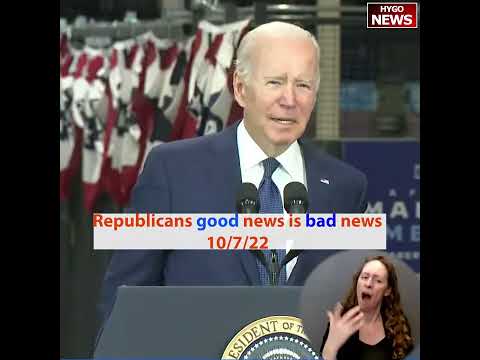
Biden Accuses Republicans of “Rooting for Fewer Jobs and Lower Wages,” Claims GOP Says Good News Is Bad News
On 10/7/2022, President Biden accused Republicans of arguing that “good news for the economy is bad news for America” during remarks at a Volvo plant in Hagerstown, Maryland on National Manufacturing Day. Biden claimed his GOP opponents were “rooting for fewer jobs and lower wages” and attributed their economic views to “trickle-down mentality.” He then took a shot at the Trump economy, claiming “the previous four years, we weren’t doing that well, and Wall Street was doing well, and then that took a tumble” — a characterization that omitted pre-pandemic economic indicators showing historically low unemployment and rising real wages.
”Good News Is Bad News”
Biden framed the economic debate as Republicans opposing prosperity itself. “Our Republican colleagues have a very different view,” Biden said. “And I know many of you are probably Republicans, but many of my Republican friends are basically arguing that good news for the economy is bad news — is bad news for America.”
“That’s as if they’re rooting for fewer jobs and lower wages,” Biden continued.
The accusation was a pre-midterm campaign line designed to reframe Republican criticism of Biden’s economic record. Republicans were not arguing that good news was bad — they were arguing that Biden’s definition of “good news” was selective. When Biden pointed to strong job creation numbers, Republicans countered that most of those jobs were recoveries from pandemic-era losses, not new employment. When Biden cited declining gas prices from their June peak, Republicans noted prices remained far above pre-Biden levels.
The distinction between “good news is bad” and “your news isn’t as good as you claim” was critical, but Biden’s framing collapsed the two into a simpler, more politically useful narrative.
”Trickle-Down Mentality”
Biden then invoked one of his favorite rhetorical targets. “It’s all part of this trickle-down mentality that says it doesn’t matter what’s happening on Main Street — it really matters what’s happening on Wall Street,” Biden said. “Wall Street is doing well, everybody’s doing well.”
The trickle-down framing had been a Democratic staple for decades, used to characterize Republican economic policy as serving the wealthy at the expense of working families. Biden deployed it frequently, positioning his own agenda as “building the economy from the bottom up and the middle out” — a slogan that appeared in nearly every economic speech he gave.
However, Biden’s own economic record by October 2022 presented its own Main Street problems. Inflation at 8.3% was hammering working-class families hardest — those who spent the largest share of their income on groceries, gas, and rent. Real wages had declined for 18 consecutive months, meaning workers’ paychecks bought less despite nominal wage increases. The families Biden claimed to champion were losing purchasing power under his presidency at a rate not seen in four decades.
”The Previous Four Years”
Biden’s comparison to the Trump era was particularly selective. “Well, I noticed that the last — the previous four years — we weren’t doing that well, and Wall Street was doing well, and then that took a tumble,” Biden said. “That’s not my plan.”
The claim that America “wasn’t doing that well” under Trump required ignoring the pre-pandemic economic record almost entirely. Before COVID-19 struck in March 2020, the Trump economy had produced historically low unemployment — 3.5%, a 50-year low — across virtually every demographic group. Black unemployment hit its lowest rate in recorded history. Real median household income reached its highest level ever recorded. The stock market set multiple all-time highs. And critically, real wages were rising, meaning workers’ purchasing power was actually increasing — the opposite of what was happening under Biden.
The “tumble” Biden referenced was the pandemic-driven economic crash of March-April 2020, which was caused by government-mandated lockdowns in response to COVID-19 — not by any failure of economic policy. Every major economy in the world experienced a similar contraction. Attributing the pandemic recession to Republican economic philosophy was like blaming a homeowner for damage caused by a hurricane.
The October 2022 Economic Reality
Biden’s remarks came during a period when the economic data told a mixed story that neither party’s narrative fully captured, but the consumer experience was unambiguously negative for most families.
Inflation stood at 8.3% year-over-year — down slightly from its June peak of 9.1% but still at levels not seen since the early 1980s. Food prices were up 11.4% year-over-year. Shelter costs were rising at the fastest rate in decades. The Federal Reserve had raised interest rates five times in 2022, with more hikes expected, sending mortgage rates above 6% — effectively freezing the housing market for first-time buyers.
The stock market — Biden’s supposed contrast to Main Street — had fallen roughly 25% from its January 2022 peak by October, eroding retirement savings for millions of Americans. The S&P 500’s decline was worse under Biden to that point than during the equivalent period of any modern Republican presidency, undermining Biden’s Wall Street versus Main Street framing.
GDP had contracted in both Q1 and Q2 of 2022 — meeting the traditional definition of a recession, though the administration argued the technical definition was more nuanced. Consumer confidence remained near historic lows. Polling consistently showed large majorities of Americans — including Democrats — rated the economy negatively.
The Manufacturing Day Backdrop
Biden chose National Manufacturing Day at a Volvo plant to deliver economic remarks, attempting to highlight manufacturing job growth under his presidency. The sector had indeed added jobs, though most represented recovery from pandemic losses rather than net new positions above pre-COVID levels.
The Volvo facility in Hagerstown, Maryland manufactured powertrain components — engines, transmissions, and axles for commercial vehicles. The choice of venue was meant to visually reinforce Biden’s “Made in America” messaging and his claim that his economic policies benefited workers, not just investors.
But even manufacturing workers at the event were likely feeling the squeeze of inflation. Their nominal wages may have risen, but with consumer prices up over 8%, their real purchasing power had declined — a reality that Biden’s “good news” framing did not acknowledge.
Key Takeaways
- Biden accused Republicans of arguing “good news for the economy is bad news” and “rooting for fewer jobs and lower wages” — reframing GOP criticism of his record as opposition to prosperity itself.
- He attributed Republican views to “trickle-down mentality,” while his own policies had produced 8.3% inflation and 18 months of declining real wages for working families.
- Biden claimed “the previous four years, we weren’t doing that well,” omitting pre-pandemic records including 3.5% unemployment and historically high real median household income.
- The stock market had fallen roughly 25% under Biden, undermining his Wall Street vs. Main Street framing.
- GDP had contracted in both Q1 and Q2 of 2022, meeting the traditional recession definition the administration disputed.
Transcript Highlights
The following is transcribed from the video audio (unverified — AI-generated from audio).
- Our Republican colleagues have a very different view. Many of my Republican friends are basically arguing that good news for the economy is bad news for America.
- That’s as if they’re rooting for fewer jobs and lower wages.
- It’s all part of this trickle-down mentality that says it doesn’t matter what’s happening on Main Street — it really matters what’s happening on Wall Street.
- Wall Street is doing well, everybody’s doing well.
- The previous four years, we weren’t doing that well, and Wall Street was doing well, and then that took a tumble.
- That’s not my plan.
Full transcript: 121 words transcribed via Whisper AI.