 HYGO News
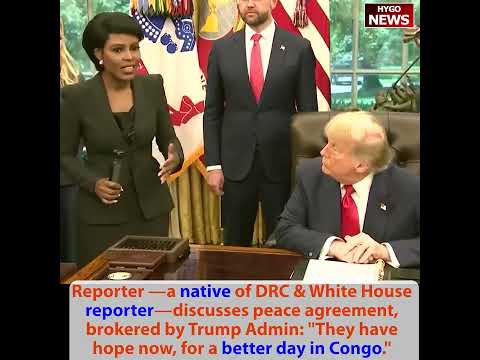
 Reporter DRC native & WH reporter better day in Congo; mainstream media not give Trump credit
Reporter DRC native & WH reporter better day in Congo; mainstream media not give Trump credit
One of the most remarkable press exchanges of the Trump second term happened when the only African reporter credentialed to the White House — a native of the Democratic Republic of Congo — brought firsthand reporting from her home country. The reporter had traveled to Congo the day before the press briefing to gauge public reaction to the Trump-brokered Rwanda-Congo peace agreement. What she witnessed was, in her account, genuine hope after decades of conflict. She also disclosed that Congolese President Félix Tshisekedi plans to nominate Trump for the Nobel Peace Prize in recognition of his administration’s work. Trump’s response — gratitude, acknowledgment that no other president had attempted this — became the clip that defined the exchange, along with his candid observation about his predecessor’s awareness: “I don’t think Biden tried. I don’t think he knew he was alive."
"The Only African Reporter Accrediting”
The reporter’s opening established her distinctive position. “So as Caroline has mentioned, president first of all want to let you know that I’m the only African reporter accrediting here the White House over for the entire continent.”
The observation is worth pause. Africa is a continent of 1.4 billion people across 54 countries. That it has only one reporter credentialed to the White House reflects the broader reality of how American media institutions have staffed their Washington bureaus. African stories — when they are covered at all — are typically covered from other capitals or through wire services. Dedicated White House coverage of African issues through African journalists is rare.
The reporter’s presence is therefore consequential. She is the voice that can bring African perspective directly into the American political conversation. Her question to the president — about the Congo peace deal — is the kind of question that almost no other White House reporter would ask, at least not with the same depth of understanding.
”I Went To See Firsthand”
The reporter described her trip. “So I just arrived from Congo Democrat Republic of the Congo yesterday. I went to see firsthand How the people’s is feeling and the president’s message presidents felice just to get about this upcoming peace deal. And let me tell you first hand what I witness myself.”
The reporter had gone to Congo specifically to document public reaction to the peace agreement. She spoke directly with Congolese citizens. She interviewed the Congolese president. She returned to Washington with reporting grounded in direct observation rather than in distant analysis.
”They Know Your Name”
The reporter’s observation was striking. “I spoke with the people in the street. I spoke with you. They know your name. They know that a president name President Trump is working hard to finally bring peace to the country.”
The simple factual claim — that ordinary Congolese citizens know Trump’s name and associate it with the peace effort — says something about the information environment. In a country with limited internet penetration, heterogeneous media access, and decades of civil conflict, ordinary citizens nevertheless know the American president’s name and understand his administration’s role in the peace process.
“I saw hope they have hope now for a better day in Congo they see what you’re doing as a future better future for Congo.” The hope is the reporter’s direct observation. Congolese citizens are not abstractly grateful to American foreign policy. They are concretely hopeful about their specific future.
Interview With President Tshisekedi
The reporter then described her interview with the Congolese president. “I had opportunity to sit down with president Felix Sakek for an interview because I want to understand his mind as he’s thinking He’s feeling about everything that your administration is doing and he told me firsthand that for many years many American presidents overlook this conflict. They didn’t do nothing even myself.”
President Tshisekedi’s statement — that “many American presidents” had overlooked the conflict — is factually accurate. The Rwanda-Congo situation has persisted across multiple American administrations. Clinton, Bush, Obama, Biden — each administration addressed the conflict only at the margins. None brokered a comprehensive peace.
“I cover president Biden’s administration I pressed many times about this conflict people are dying in Congo this country has so much potential But they need help because this war is destroying the country. They never gave me any answer.”
The reporter’s firsthand account confirms the lack of prior American engagement. She asked the Biden White House about the conflict. She received no substantive response.
”He’s Very Thankful”
The reporter continued. “And he told me president Chisekete that he’s very you have no idea He’s very thankful for what you’re doing for what your administration doing not only him the entire Congo these people They see that finally they will have hope.”
The Tshisekedi gratitude is the bilateral confirmation. Not only does Trump claim credit for the peace agreement — the Congolese president himself is publicly thankful for the administration’s work.
“The entire Congo” extends the gratitude beyond the head of state. The reporter is claiming that the Congolese population as a whole appreciates what the Trump administration has done.
The Nobel Peace Prize Nomination
The reporter then delivered news that would have been a major story on its own. “And president Chisekete also mentioned at the end of my interview That when peace finally come to Democrat Republic of the Congo He’s thinking to nominate you as a noble price piece because he said you deserve you have been working to bring peace In the in the world not only at the Congo and he’s very hopeful to meet you in the future.”
Tshisekedi is planning to nominate Trump for the Nobel Peace Prize. That nomination, if it occurs, would add Trump to the list of American presidents — most recently Obama in 2009 — who have received the Nobel Peace Prize for diplomatic work.
Trump’s prior complaints that the Nobel committee “only gives it to liberals” — which he repeated during the NATO summit — would be rendered less pointed if an African head of state formally nominated him. The nomination itself would not guarantee the prize. But it would position Trump’s case for consideration.
”You Are Beautiful”
Trump’s response managed the emotional register carefully. “So nice boy with and it’s so beautifully stated and Caroline said number one she did say and I shouldn’t say this because it’s politically incorrect She said she’s beautiful and you are beautiful I’m not allowed to say that you know that couldn’t be the end of my political career But you are beautiful and you’re beautiful inside.”
The passage is vintage Trump. He acknowledges the political sensitivity of calling a female reporter beautiful. He does it anyway. He extends the compliment to “beautiful inside” — making clear that the observation is about character as much as appearance.
Whether critics will find the comment politically objectionable is a separate question. The reporter’s own response — captured only partially in the transcript — appeared welcoming of the compliment.
”Covered Africa For A Long Time”
The reporter noted her extensive background. “I wish I had more reporters like you Covered Africa for a long time. Yes for over 10 years I follow it. I cover even your first administration. Yes, I know that that’s great.”
Ten years of covering Africa, including Trump’s first administration, gives the reporter substantial institutional knowledge. She has watched American administrations engage with African issues across multiple political cycles. Her assessment that the Trump administration’s engagement is distinctive carries weight that a less experienced reporter’s would not.
”No Other President Could Do It”
The reporter then framed the achievement. “Well, thank you That’s so nice that you said that now that your administration and congratulations has secured peace in Africa to a bloody horrific war That’s gone on for decades and no other president could do it.”
“No other president could do it” is the striking assessment. The reporter is not saying no other president had not tried. She is saying that the peace agreement Trump has secured was beyond what prior administrations could achieve.
That framing is significant because it positions the peace agreement not as a continuation of prior diplomatic work but as a distinctive accomplishment of the current administration.
”They Tried” — “Actually I Don’t Think They Tried”
Trump pushed the framing further. “But you’re right no other president could do it they tried and they well they didn’t even try I don’t think I don’t think I actually don’t think they tried.”
Trump is making the sharper claim. Prior presidents didn’t just fail — they didn’t seriously attempt. The Rwanda-Congo conflict, in Trump’s framing, was a problem American foreign policy could have addressed for decades but chose not to.
”He Didn’t Know He Was Alive”
Trump’s sharpest line came in reference to Biden. “You think Biden tried he didn’t know he was alive.”
The observation is harsh. Trump is suggesting that Biden lacked the cognitive awareness to even know what his administration was doing, let alone to initiate complex African peace negotiations. The characterization fits Trump’s broader critique of Biden’s cognitive condition that has dominated recent political commentary.
Whether the characterization is fair depends on one’s assessment of Biden’s actual condition during his presidency. The investigation of that condition — including the Tanden deposition — continues.
”The Media Will Never Give Me Credit”
The reporter’s final question. “Do you mean you will finally give you credit where credit is due?”
Trump’s response. “No, the media will never give me credit But the people give me credit. That’s why I’m here the people didn’t give me this while we’re here in a landslide We got all seven states. We won the popular vote. We’re so the media won’t give me credit But the people give me credit. That’s more important to me.”
“The media will never give me credit but the people give me credit” is the political formulation. Trump is arguing that what matters is not the media’s framing but the voters’ assessment. Voters gave him the “landslide” that his political legitimacy rests on. Their validation is what he values.
”All Seven States”
Trump referenced the specific electoral outcome. “We got all seven states” — the seven swing states in the 2024 election. Trump won all of them. That is the electoral fact that underpins his claim to a mandate.
Why The Exchange Matters
The exchange with the Congolese reporter matters for several reasons.
First, it is firsthand reporting from the country most affected by the peace agreement. The reporter went there. She spoke with citizens. She interviewed the president. Her account is not media spin — it is direct observation.
Second, it documents the Nobel Peace Prize nomination pending from the Congolese president. Whether the nomination ever converts to an award is a separate question, but the nomination itself is news.
Third, it provides a foreign perspective on American politics that is different from what European or Asian capitals provide. The Congolese perspective is one of gratitude for American engagement — a perspective that is rare in current international reporting.
Fourth, it captures Trump’s candid assessment of his predecessor in a way that the political context has increasingly made relevant. The Biden cognitive question is, at this point, a live investigation. Trump’s contribution is his blunt personal observation.
The Broader African Engagement
The Trump administration’s African engagement, as evidenced by this peace agreement and the reporter’s account of Congolese public reaction, represents a specific strategic posture. The administration appears willing to invest diplomatic resources in African peace processes that prior administrations avoided.
Whether that investment continues depends on several factors. The Rwanda-Congo peace agreement must hold. Implementation requires sustained engagement. Other African conflicts may require similar attention. The administration’s diplomatic capacity is finite and is currently distributed across many regional tracks.
If the African engagement continues, the reporter’s coverage will provide a distinctive window into how that engagement is received in the affected countries. Her presence as the only African reporter in the White House is therefore an asset the administration should value and maintain.
Key Takeaways
- The Congolese reporter on her trip: “I spoke with the people in the street…They know your name. They know that a president name President Trump is working hard to finally bring peace to the country.”
- President Tshisekedi’s Nobel Peace Prize plan: “He’s thinking to nominate you as a Nobel Prize peace because he said you deserve.”
- The reporter’s judgment: “No other president could do it.” Trump extension: “Actually I don’t think they tried.”
- Trump on Biden: “He didn’t know he was alive.”
- Trump’s political framing: “The media will never give me credit but the people give me credit. That’s more important to me.”