 HYGO News
 Repeated: first major piece of legislation I introduced was to reform the immigration
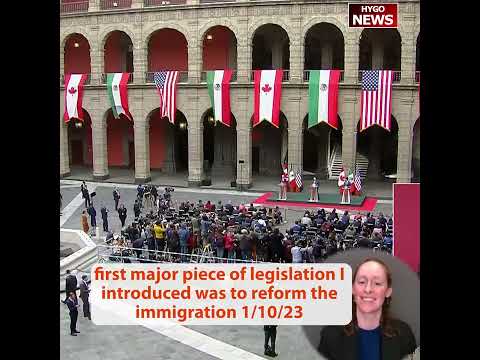
Biden Repeats Immigration Reform Claim in Mexico City While Presiding Over Record Border Crossings
On January 10, 2023, President Biden stood alongside Mexican President Andrés Manuel López Obrador and Canadian Prime Minister Justin Trudeau in Mexico City and repeated a claim he had made many times before: “When I got elected, the first thing I — the first major piece of legislation I introduced was to reform the immigration process.” The statement came during a joint press conference at the North American Leaders’ Summit, where Biden also described the current situation as “the greatest migration in human history around the world, as well as in this hemisphere.” The remarks drew scrutiny because Biden was making them while presiding over record-shattering border-crossing numbers and just days after his first presidential visit to the U.S.-Mexico border, which critics said amounted to a carefully managed photo opportunity rather than a genuine engagement with the crisis.
”Both Extremes Are Wrong”
Biden’s response to a reporter’s question at the press conference began with a characteristic moment of self-deprecating humor. “The first question, now I forgot. (Laughter.) Your first question related to —” he said, before the reporter attempted to restate the question. Biden quickly interjected: “I’m only joking.”
When he did answer, Biden framed the immigration debate as a problem of political polarization rather than policy failure. “The answer is — the answer is: You’ve got both — both the extremes are wrong. It’s a basic middle proposition,” Biden said.
The framing was significant. By positioning both sides as extreme, Biden was attempting to claim the center on an issue where his administration’s record had been consistently criticized from the right for being too permissive at the border and occasionally from the left for maintaining certain Trump-era enforcement mechanisms. The “basic middle proposition” language suggested a common-sense approach, but the border numbers told a different story about the practical results of that approach.
Biden then pivoted to the broader context of global migration. “As was mentioned by all of us in one way or another, this has been the greatest migration in human history around the world, as well as in this hemisphere,” he said. This framing served a dual purpose: it acknowledged the scale of the problem while distributing responsibility beyond the borders of any single country, including his own.
The Immigration Reform Claim
The centerpiece of Biden’s remarks was the repeated assertion about his immigration legislation. “When I got elected, the first thing I — the first major piece of legislation I introduced was to reform the immigration process,” Biden said.
This was factually accurate in a narrow sense. On his first day in office, January 20, 2021, Biden did send the U.S. Citizenship Act of 2021 to Congress. The bill proposed an eight-year pathway to citizenship for undocumented immigrants, eliminated per-country visa caps, and increased diversity visa allocations. However, the bill went nowhere in Congress. It was never brought to a vote in either chamber, even when Democrats controlled both the House and Senate.
What Biden consistently omitted from this talking point was that introducing legislation and actually passing it were two very different things. The immigration reform bill became a symbolic gesture rather than a legislative achievement. By January 2023, when Biden repeated the claim in Mexico City, the bill had been dormant for nearly two years. The claim functioned as a rhetorical placeholder — proof of intent rather than proof of results.
Biden also said during the broader press conference that “my Republican friends in Congress should join us in the solutions,” shifting responsibility for the legislative failure to the opposition party. He described an unusual coalition supporting his proposals: “my proposals are supported by the Chamber of Commerce, by the American labor movement, not — I mean, which is an unusual coalition — and a whole range of people.”
The Record Behind the Rhetoric
The context surrounding Biden’s remarks made them particularly notable. Biden was speaking in Mexico City about immigration reform while his administration was presiding over historically unprecedented border-crossing numbers.
In fiscal year 2022, which ended September 30, U.S. Customs and Border Protection recorded nearly 2.4 million border-crossing arrests — a record-shattering figure that exceeded any previous year in the agency’s history. The numbers for the first months of fiscal year 2023 were not improving. October and November 2022 showed illegal border crossings up 40 percent and 34 percent, respectively, compared to the same months in 2021 — which had itself been a record year at the time.
Biden had not made border security a priority of his 2020 presidential campaign. In fact, as a candidate, he was adamant in his opposition to physical barriers on the U.S.-Mexico border. He pledged during the campaign that “not another foot of wall” would be constructed during his presidency. This position stood in stark contrast to his predecessor’s signature policy initiative, which had been the construction of a border wall.
The gap between Biden’s campaign rhetoric, his legislative proposals, and the actual conditions at the border created a credibility problem that followed him to Mexico City. He was standing in a foreign capital talking about immigration reform while the border situation his critics called a crisis continued to worsen by every measurable metric.
The El Paso Visit
Just days before the Mexico City summit, Biden had made his first visit to the U.S.-Mexico border as president on January 8, 2023. The visit came to El Paso, Texas — nearly two full years into his presidency. The timing was widely viewed as a political necessity ahead of the Mexico City trip rather than a substantive policy engagement.
The El Paso visit drew criticism on multiple fronts. City officials had reportedly cleaned up areas along the border ahead of the presidential visit, removing encampments and relocating migrants so that Biden would not encounter the conditions that had become routine in the city. Critics argued that the visit was staged to avoid any unscripted encounters with the humanitarian situation on the ground.
Biden did not interact with migrants during the visit. He toured the port of entry, met with border officials, and delivered remarks, but the carefully controlled nature of the trip reinforced the perception that the administration was more interested in managing the optics of the border situation than confronting its reality.
The contrast was sharp: a president who avoided the border for two years, visited only under political pressure, had the area cleaned up before his arrival, and then flew to Mexico City to talk about immigration reform as if it were a priority his administration had been pursuing all along.
The Broader Pattern
Biden’s Mexico City remarks fit a broader pattern in his approach to immigration. He consistently framed himself as someone who had tried to fix the system from day one — pointing to the January 2021 legislation — while distancing himself from the consequences of his administration’s actual border policies.
The executive actions Biden took in his first weeks in office — halting border wall construction, ending the “Remain in Mexico” policy, and narrowing interior enforcement priorities — were broadly seen as contributing to the surge in border crossings. But Biden rarely connected those actions to the results. Instead, he pointed to global migration trends and Republican obstruction as the primary explanations for the border situation.
In Mexico City, with López Obrador and Trudeau at his side, Biden was in a setting that allowed him to present immigration as an international challenge requiring cooperative solutions rather than a domestic policy failure requiring accountability. The “greatest migration in human history” framing served that purpose well — it was true as a factual matter, but it also conveniently diffused responsibility.
Key Takeaways
- Biden repeated in Mexico City on January 10, 2023 that “the first major piece of legislation I introduced was to reform the immigration process,” referencing his January 2021 bill that was never brought to a vote in either chamber — while presiding over a record 2.4 million border-crossing arrests in fiscal 2022 and further increases of 40% and 34% in October and November.
- Biden framed the immigration debate by saying “both extremes are wrong” and called the current situation “the greatest migration in human history” — positioning the crisis as a global phenomenon rather than a result of specific policy decisions, while telling reporters his proposals were supported by both “the Chamber of Commerce” and “the American labor movement.”
- The remarks came just two days after Biden’s first-ever presidential visit to the U.S.-Mexico border in El Paso, where critics said city officials cleaned up migrant encampments ahead of his arrival and Biden did not interact with any migrants — despite having campaigned on a promise that “not another foot of wall” would be built.