 HYGO News
 Leavitt: Border Crossings Hit 'Lowest Level in American History' -- Down 94%; Over 200 Successful Houthi Strikes
Leavitt: Border Crossings Hit “Lowest Level in American History” — Down 94%; Over 200 Successful Houthi Strikes
Press Secretary Karoline Leavitt delivered a comprehensive briefing on April 1, 2025 — the eve of “Liberation Day” — announcing that southwest border crossings in March had fallen to “the lowest level in American history, down 94% from March of last year under President Biden.” She reported that Houthi strikes had escalated from 100 to over 200 successful operations, that school choice was “the civil rights issue of our time,” and previewed the next day’s tariff announcement: “The ultimate change will happen when companies decide to do business in the United States. They will face no tariff at all when they choose to invest here."
"Lowest Level in American History”
Leavitt opened with the border statistics that represented the administration’s most dramatic achievement.
“At our southern border, there is more massive news,” Leavitt said. “Southwest border crossings in March fell to the lowest level in American history — down 94% from March of last year under President Biden, when 137,000 illegal aliens poured across our wide-open southern border.”
She described what had changed for Border Patrol: “Thanks to President Trump’s leadership, Border Patrol agents are now back to doing the jobs they signed up for — securing the border rather than serving as travel agents for illegal aliens.”
Leavitt cited even hostile media confirming the transformation: “The Los Angeles Times captured the Trump effect on the border with a recent article. Their headline read: ‘California-Mexico border, once overwhelmed, is now nearly empty.’ With so few migrants coming into the US, they wrote, shelters that once served migrants have completely closed.”
A 94% decline in border crossings was not an incremental improvement; it was a near-total cessation of illegal immigration at the southern border. The number represented the difference between 137,000 crossings in March 2024 and approximately 8,200 in March 2025 — a transformation achieved without new legislation, without new border infrastructure, and within approximately 70 days of Trump taking office.
The enforcement-as-deterrence model had been validated at a scale that exceeded even the administration’s own projections. When potential migrants believed they would be caught, detained, and deported — rather than processed and released — they did not attempt the crossing. The border was not sealed by a wall; it was sealed by the credible expectation of consequences.
The LA Times citation was particularly effective because the outlet was not sympathetic to the Trump administration. When even hostile media confirmed that the border was “nearly empty” and migrant shelters were closing, the data was beyond dispute.
Over 200 Houthi Strikes
Leavitt provided an update on the military campaign that showed escalating momentum.
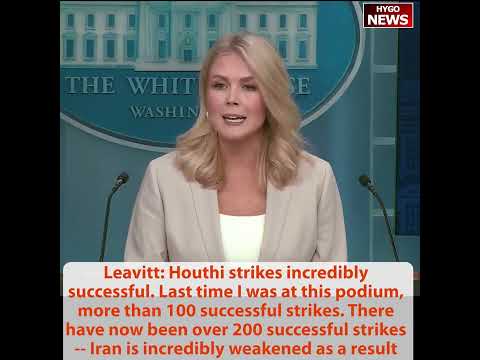
“These Houthi strikes have been incredibly successful,” she said. “Last time I was at this podium, there were more than 100 successful strikes. There have now been over 200 successful strikes against the Houthis.”
She described the strategic impact: “Iran is incredibly weakened as a result of these attacks. And we have seen — they’ve taken out Houthi leaders, they’ve taken out critical members who were launching strikes on naval ships and on commercial vessels.”
Leavitt stated the objective: “And this operation will not stop until the freedom of navigation in this region is restored, which is a critical principle. And this president stands behind our Defense Department, who’s doing a tremendous job.”
The doubling from 100 to 200 strikes in the span of days between briefings demonstrated that the campaign was intensifying, not winding down. The administration was methodically degrading the Houthis’ ability to threaten shipping — not through isolated retaliatory strikes but through a sustained campaign designed to eliminate the group’s military infrastructure.
The “freedom of navigation” framing connected the Houthi campaign to a principle of international law that predated the current conflict by centuries. The right of commercial vessels to transit international waters without being attacked was a foundation of global trade. By defending that principle with military force, the Trump administration was performing a function that benefited every trading nation — not just the United States.
Raskin and Deportations
Leavitt addressed Democratic pushback on deportation policy, referencing Rep. Jamie Raskin’s demand for the return of deported individuals.
She cited Raskin’s position — “to demand the return of people unlawfully taken to El Salvador on that so-called plane full of gangbangers” — and then countered with the administration’s record.
“Deportations of illegal aliens who threaten the safety of the American people are continuing at a rapid pace,” Leavitt said. “The next time you see Democrats protesting future illegal alien removals from our country — President Trump is focused on fulfilling his greatest obligation, to keep the American people safe and to defend our country.”
The framing positioned Democrats as advocates for returning convicted felons to American communities while the administration was protecting public safety. Raskin’s demand that deported gang members be brought back was, in the administration’s telling, an inversion of the government’s most basic responsibility.
School Choice: “Civil Rights Issue of Our Time”
Leavitt addressed education policy with language that reframed school choice as a social justice issue.
“The president is very supportive of school choice,” she said. “He has said that school choice is the civil rights issue of our time. And he wants every child, regardless of zip code, socioeconomic status, how much money their parents have, to be able to go to the school of their choosing that best suits their educational needs.”
She connected the policy to the broader education restructuring: “And he is going to empower state and local leaders to make those decisions on behalf of our nation’s children.”
The “civil rights issue” framing was deliberately provocative. School choice had historically been opposed by the same political coalition that claimed the civil rights mantle. By characterizing school choice as the civil rights fight of the current era, Trump was arguing that the real barrier to equal opportunity was not race or gender but zip code — and that the government policy trapping children in failing schools by zip code was the modern equivalent of the segregation policies that the civil rights movement had fought.
Liberation Day Eve: “No Tariff at All”
Leavitt delivered the final preview of the next day’s tariff announcement.
“The ultimate change for these companies and these countries will happen when they decide to do business in the United States of America,” she said. “They will face no tariff at all if these companies choose to invest here in the United States and to move their production and their manufacturing here.”
She previewed the announcement: “As for tomorrow, the president will be addressing the decades of unfair trade practices that have ripped our country off and American workers off. It has hollowed out our middle class. It has destroyed our heartland. And the president is focused on reshifting our global economy to ensure that America is once again the manufacturing superpower of the world.”
The “no tariff at all” promise was the carrot that complemented the tariff stick. The message to every foreign company was binary: build in America and pay nothing, or build abroad and pay 25% or more. The simplicity of the choice was the policy’s greatest strength.
Key Takeaways
- Southwest border crossings in March 2025 hit “the lowest level in American history” — down 94% from March 2024. The LA Times confirmed: “California-Mexico border is now nearly empty.”
- Houthi strikes escalated from 100 to over 200, taking out leaders and critical military members. “Iran is incredibly weakened. This operation will not stop until freedom of navigation is restored.”
- Trump called school choice “the civil rights issue of our time” — every child should attend “the school of their choosing regardless of zip code.”
- Eve of Liberation Day: “Companies will face no tariff at all when they choose to invest in the United States and move their manufacturing here.”
- Leavitt: Trump’s tariff plan will “address decades of unfair trade practices that have hollowed out our middle class and destroyed our heartland.”