 HYGO News
 Rep. Jasmine Crockett: OBBB 'Reverse Robin Hood, Stealing From Those Who Need Most, Giving to Rich' -- The Bill Actually STOPS Illegals from Stealing; Bill Clinton Stuns CBS: 'I Never Saw Biden's Cognitive Decline -- I Didn't Read the Book'; Speaker Johnson on CBO: 'Assumes Anemic 1.8% Growth -- US Has Never Sustained Below 2%'
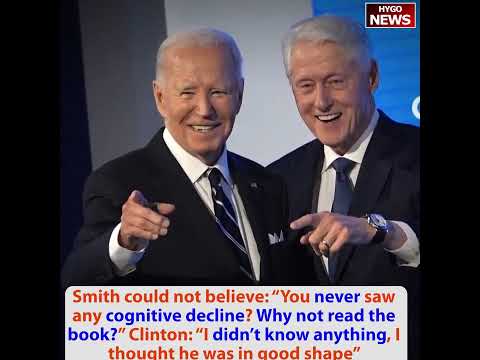
Rep. Jasmine Crockett: OBBB “Reverse Robin Hood, Stealing From Those Who Need Most, Giving to Rich” — The Bill Actually STOPS Illegals from Stealing; Bill Clinton Stuns CBS: “I Never Saw Biden’s Cognitive Decline — I Didn’t Read the Book”; Speaker Johnson on CBO: “Assumes Anemic 1.8% Growth — US Has Never Sustained Below 2%”
Multiple striking exchanges marked June 1, 2025. Rep. Jasmine Crockett (D-TX) attacked the OBBB: “This is literally a reverse Robin Hood of literally stealing from those that need resources the most and giving it to those that are rich. Gut critical things that literally people rely on to live… so maybe somebody can go and buy yet another jet or another yacht.” Bill Clinton stunned CBS News correspondent Tracy Smith in an interview. Smith asked if Clinton had noticed Biden’s cognitive decline — Clinton: “No. I thought he was a good president. I had never seen him and walked away thinking he can’t do this anymore. He was always on top of his brief.” Smith: “You never saw any cognitive decline?” Clinton: “No. I didn’t know anything about any of this and I haven’t read the book.” On why he hadn’t read Tapper/Thompson’s Original Sin: “He’s not president anymore and I think he did a good job… Some people are trying to use this as a way to blame him for the fact that Trump was reelected.” Speaker Mike Johnson: “This is not a spending bill. This is a reconciliation package. What my friends are missing is the tremendous and historic level of spending cuts. CBO projects anemic 1.8% growth. Never in US history has the economy sustained less than 2% over a 10-year period. Remember 2017 TCJA: CBO was often off its estimates by $1.5 trillion because they underestimated growth.”
The Crockett Attack
Rep. Jasmine Crockett (D-TX) had been one of the most aggressive Democratic voices on OBBB.
“So the idea that you would go through and you would like gut critical things, things that literally people rely on to live,” Crockett said.
She delivered the inequality framing: “Also that say maybe somebody can go and buy yet another jet or another yacht.”
She made the moral indictment: “It just doesn’t seem right because it isn’t right.”
She articulated the core claim: “This is literally a reverse Robin Hood of literally stealing from those that need resources the most and giving it to those that are rich.”
The “Reverse Robin Hood” Framing
Crockett’s Robin Hood framing was emotionally potent but factually problematic.
Robin Hood legend: The folk hero who “robbed from the rich and gave to the poor.” Though historically the legend involved robbing government tax collectors rather than wealthy individuals generally.
“Reverse Robin Hood”: Democrats had used this framing repeatedly to attack Republican tax policy — taking from poor and giving to rich.
OBBB reality:
- Working-class tax cuts (no tax on tips, overtime)
- Middle-income tax cuts (15% for $30K-$80K)
- Child tax credit expansion (families)
- Medicaid work requirements (able-bodied adults)
- No new top-rate cuts for wealthy
- Various provisions neutral or harmful to wealthy
Who benefited from OBBB:
- Service workers with tip income
- Hourly workers earning overtime
- Middle-income families with children
- Working-class homeowners
- New parents
- Small business owners
Who didn’t benefit or was harmed:
- Wealthy individuals (no new top-rate cuts)
- Corporations (no new corporate rate reductions)
- Clean energy subsidies (rolled back)
- Federal contractors (reduced federal spending)
- International dependency sectors
Crockett’s “reverse Robin Hood” framing contradicted the bill’s actual distributional impact. The bill’s benefits were concentrated among working and middle-class Americans, not the wealthy.
The “Jet or Yacht” Imagery
Crockett’s specific imagery was politically calculated.
“Maybe somebody can go and buy yet another jet or another yacht” was:
- Visually evocative
- Inequality-focused
- Morally charged
- Factually unconnected to the bill
- Emotionally manipulative
The OBBB did not provide tax benefits for yacht or jet purchases. The bill did not include:
- Yacht purchase tax credits
- Jet purchase deductions
- Aviation fuel subsidies
- Private aircraft depreciation enhancements
- Any specific luxury good benefits
Crockett was using the imagery of wealthy consumption to frame a tax bill that actually benefited working-class Americans. This was political rhetoric disconnected from factual analysis.
The Reverse Robin Hood Reality
The actual “who steals from whom” question had a different answer under OBBB:
What was happening: OBBB was preventing illegal immigrants from stealing benefits intended for Americans. The 1.4 million illegal immigrants on Medicaid, plus 4.8 million able-bodied non-working Americans, were receiving benefits they weren’t entitled to.
Who was being stolen from: Legitimate American taxpayers whose resources were being diverted to ineligible recipients.
Who was receiving benefits: Working-class Americans through direct tax cuts, not the wealthy through new tax preferences.
The actual Robin Hood:
- Illegal immigrants stealing from American taxpayers through Medicaid fraud
- Able-bodied non-workers claiming disability or other benefits inappropriately
- Fraudulent applicants receiving various federal benefits
- Federal contractors and grant recipients consuming taxpayer resources inappropriately
OBBB’s reforms would:
- Restore benefits to legitimate recipients
- Prevent theft from taxpayers
- Enable work requirements that expected contribution
- Support legitimate medical needs
- Maintain program sustainability
So the OBBB was the opposite of “reverse Robin Hood” — it was actual Robin Hood, taking back resources that had been stolen and returning them to legitimate beneficiaries.
Clinton on Biden’s Decline
The Bill Clinton interview was extraordinarily revealing.
CBS News’s Tracy Smith asked: “There’s this book that came out that talks about Joe Biden and the people around him seeing that he had cognitive and physical decline.”
She asked the specific question: “Did you ever have a moment with him where you thought maybe he was unfit to run for president?”
Clinton’s response was remarkable: “No. I thought he was a good president.”
He expanded: “The only concern I thought he had to deal with was could anybody do that job until they were 86?”
He made the specific claim: “And we had several long talks. I had never seen him and walked away thinking he can’t do this anymore. He was always on top of his brief.”
Smith’s Incredulous Follow-Up
The CBS correspondent was visibly stunned.
“You never saw any cognitive decline?” Smith asked.
Clinton’s response: “No.”
He continued: “So I didn’t know anything about any of this and I haven’t read the book.”
He made the claim to current assessment: “I saw President Biden not very long ago and I thought he was in good shape.”
He dismissed the book: “But the book didn’t register with me because I never saw him that way.”
The Credibility Problem
Clinton’s denials created significant credibility problems.
The public evidence:
- Biden’s visible physical decline was obvious to anyone watching television
- His cognitive difficulties had been extensively documented
- Multiple specific incidents of confusion, stumbling, and forgetfulness
- Walking and speaking difficulties increasingly pronounced
- Debate performances that had ended his 2024 campaign
The institutional evidence:
- The Tapper/Thompson book documented extensive decline
- Multiple Democratic officials had acknowledged concerns
- Biden’s own staff had admitted the concealment
- His withdrawal from the 2024 race had confirmed decline
- Subsequent revelations had confirmed the reality
Clinton’s position:
- Denying what everyone else had seen
- Claiming no cognitive decline observed
- Refusing to read the definitive book on the subject
- Professing Biden was “always on top of his brief”
- Claiming Biden was “in good shape” recently
Why Would Clinton Deny?
Bill Clinton’s position required explanation:
Political loyalty: Clinton had personal and political loyalty to Biden. Admitting Biden’s decline would have meant admitting that the Democratic Party had knowingly supported an impaired candidate.
Party protection: Acknowledging Biden’s decline would confirm the narrative that Democrats had deceived voters. This would damage Democratic reputation generally.
Personal ego: Clinton’s own policy legacy was tied to Democratic competence. Admitting Democratic competence failure reflected poorly on him.
Legacy protection: Both Clintons had specific interests in maintaining the legitimacy of the Biden administration’s policies and decisions.
Political calculation: Democrats continuing to deny Biden’s decline protected the party’s future political prospects and institutional credibility.
Personal cognitive state: Bill Clinton himself was 78 years old in 2025 and had his own health challenges. His refusal to recognize decline might reflect concerns about his own status.
”Why Didn’t You Read the Book?”
Smith pressed Clinton on his refusal to read the book.
“Why didn’t you read the book?” Smith asked.
Clinton’s response was telling: “I didn’t want to because he’s not president anymore and I think he did a good job.”
He extended the analysis: “And I think we are facing challenges today without president in our history.”
He made the political framing: “And some people are trying to use this as a way to blame him for the fact that Trump was reelected.”
The Trump Framing
Clinton’s reference to Trump’s reelection was revealing.
The implied logic:
- The Tapper/Thompson book was being used to blame Biden for Trump’s 2024 victory
- Acknowledging Biden’s decline would support this “blame Biden” narrative
- Democrats should resist this framing for political reasons
- Therefore, Clinton wouldn’t read the book that supported the framing
This was politically strategic but intellectually dishonest. Avoiding information because it might lead to uncomfortable conclusions was not a defensible epistemic approach. The correct approach would be:
- Read the book
- Evaluate evidence independently
- Reach honest conclusions
- Communicate findings transparently
Clinton’s approach was:
- Refuse to read
- Maintain predetermined conclusions
- Avoid evidence that might change views
- Protect political narrative
This deliberate ignorance was itself evidence of intellectual bad faith.
Speaker Johnson’s Defense
Speaker Mike Johnson defended OBBB against Democratic attacks.
“This is not a spending bill. This is a reconciliation package. It is reconciling a budget,” Johnson said.
He acknowledged the specific spending: “So there is some additional spending, as you noted earlier at the opening, for national security, for historic investments in border security, the largest in generations, because those are necessary expenditures.”
He made the critical point: “But what my friends are missing is the tremendous and historic level of spending cuts that are also in the same package.”
The CBO Critique
Johnson addressed the CBO scoring issue.
“A lot of the analysis that people are pointing to is from groups, for example, like the Congressional Budget Office, the CBO,” Johnson said.
He identified the specific problem: “They have projected anemic economic growth. They’re assuming a growth level of 1.8% over the next 10 years.”
He delivered the historical reality check: “Kristen, never in US history has the US economy sustained less than 2% economic growth over a 10-year period.”
He predicted the actual outcome: “What’s going to happen here is exactly the opposite. We’re going to have historic growth because we’re basing this on the history of the recent past.”
The 2017 TCJA Precedent
Johnson cited specific historical scoring failures.
“Remember in the first Trump administration, the 2017 Tax Cuts and Jobs Act, the CBO was often its estimates of that one by $1.5 trillion, because they underestimated the incredible growth that would be brought about,” Johnson said.
The CBO Track Record
The CBO’s track record of growth projections was indeed problematic.
The 2017 TCJA experience:
- CBO projected TCJA would cost approximately $1.8 trillion in lost revenue
- Actual revenue loss was roughly $300-400 billion
- Growth effects made up approximately $1.4 trillion of the difference
- CBO had underestimated by roughly 80%
The broader pattern:
- CBO consistently underestimated growth effects of tax cuts
- Static scoring biased toward showing tax cuts as fiscally damaging
- Dynamic effects often more than double static projections
- Reality had consistently been better than CBO projections
- Growth assumptions had been consistently too pessimistic
Why CBO got it wrong:
- Methodology designed to assume no behavioral response
- Growth assumptions based on historically depressed periods
- Didn’t account for incentive effects of tax cuts
- Political pressures to not overstate economic benefits
- Institutional conservatism in growth projections
The “Historic Growth” Prediction
Johnson’s prediction of “historic growth” had precedent.
Trump first term pre-COVID:
- Strong GDP growth (averaging 2.9% for 2018-2019)
- Historic low unemployment
- Strong wage growth
- Record-low black and Hispanic unemployment
- Rising median incomes
What drove that growth:
- TCJA tax cuts
- Regulatory reductions
- Energy policy reforms
- Trade renegotiations
- Business confidence
OBBB plus second-term policies:
- Larger tax cuts than TCJA
- More aggressive regulatory reforms
- Comprehensive energy policy
- More aggressive trade restructuring
- Manufacturing renaissance policies
If the first Trump term had produced strong growth, the second term’s more aggressive policies could plausibly produce:
- Comparable or stronger growth
- Continued wage increases
- Continued employment gains
- Continued investment
- Continued consumer confidence
Johnson’s “exactly the opposite” of CBO projections was optimistic but not implausible.
”Jet Fuel” and “All Boats Rise”
Johnson described the intended effect.
“There’s going to be jet fuel,” Johnson said.
He explained the name: “The reason we call it the Big Beautiful Bill is because it is a tremendous pro-growth package entwined in this legislation that is going to make everybody’s incomes go up.”
He described the benefits: “There’s going to be more job opportunity, more opportunity to climb up that economic ladder in America, because job creators, entrepreneurs, and risk takers will have the government off their backs.”
He articulated the mechanism: “They will have lower taxes and they will be expanding their businesses.”
He described the specific outcome: “We’re incentivizing US manufacturing again. We’re bringing jobs back to the US.”
He made the rising tide metaphor: “That’s going to help everybody, all boats rise like we did in 2017, except this time it’s on steroids.”
The “On Steroids” Framing
Johnson’s “on steroids” framing was important.
Comparing OBBB to TCJA:
- TCJA: Tax cuts for individuals and businesses, regulatory relief
- OBBB: Extended TCJA plus new cuts, broader scope, energy policy, border enforcement
OBBB was indeed more comprehensive:
- Larger total tax impact
- More extensive regulatory reform
- Broader scope of policy areas
- Greater fiscal scale
- More ambitious economic objectives
If TCJA had produced “all boats rise” in 2017-2019, OBBB’s larger and broader package could potentially produce even stronger effects. The “on steroids” metaphor captured both the scale increase and the aggressive nature of the policy.
Key Takeaways
- Rep. Crockett’s “reverse Robin Hood” attack contradicted by actual OBBB provisions benefiting working and middle-class Americans.
- Bill Clinton to CBS: “I never saw Biden’s cognitive decline. He was always on top of his brief. I didn’t read the book.”
- Clinton on not reading: “He’s not president anymore. Some people use this to blame him for Trump’s reelection.”
- Speaker Johnson on CBO: “Projects anemic 1.8% growth. Never in US history has economy sustained less than 2% over 10 years.”
- 2017 TCJA precedent: “CBO was off estimates by $1.5 trillion because they underestimated growth.”