 HYGO News
 Q: You said WH was watching closely situation at Twitter; KJP: you definitely mischaracterized
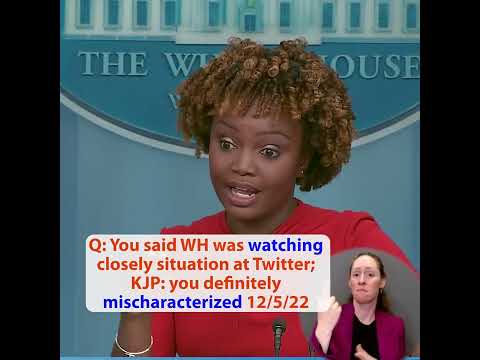
Reporter: “You Said WH Was Watching Closely” — KJP Claims He “Mischaracterized” Her Own Prior Words
On 12/5/2022, a reporter pushed White House Press Secretary Karine Jean-Pierre on the Twitter Files revelations, noting that the White House had previously said it was “keeping a close eye on Elon Musk’s ownership” of Twitter. “Is it the White House view that decisions at Twitter were made appropriately in terms of decisions to censor this reporting ahead of the election?” the reporter asked. Rather than answering, KJP accused the reporter of mischaracterizing her prior statements: “Let me, you mischaracterize actually what I actually said, took it out of context.” She insisted her prior comment had merely meant the administration was “seeing what is happening, just like you all are seeing what’s happening with Twitter.” The combative exchange ended with KJP asking the reporter to “ask your question again” — a classic technique for running out the clock without providing substantive answers.
The Reporter’s Setup
The reporter framed the question with context. “Just real quick on Twitter, because you guys said you’re keeping a close eye on Elon Musk’s ownership and the person we’ve talked to you since you released the files a few days ago,” the reporter said.
The reporter was establishing a factual predicate: the White House had previously said it was watching Twitter closely. This wasn’t an invented characterization — the administration had made statements about monitoring Twitter’s trajectory under Musk’s ownership. The reporter was using the administration’s own prior statements to set up a follow-up question.
The logical flow was clear:
- The White House said it was watching Twitter
- Twitter has now released documents about pre-election censorship
- Therefore, what does the close-watching White House think about those decisions?
This was a reasonable journalism framework. If the administration was actively monitoring Twitter, then asking for its views on major Twitter developments was a natural follow-up.
The Direct Question
The reporter’s question was specific. “Is it the White House view that decisions at Twitter were made appropriately in terms of decisions to censor this reporting ahead of the election?” the reporter asked.
This was the same substantive question that had been asked in a prior exchange (article 1496). The reporter was pursuing the question again, looking for an answer that had not been forthcoming the first time. Persistence on important questions was part of professional journalism — reporters often had to ask the same question multiple times to get answers from administrations that preferred not to engage.
The question had clear features:
- “White House view” — Asked for the administration’s official position
- “Decisions at Twitter” — Referenced specific actions taken by the platform
- “Appropriately” — Asked for a normative judgment
- “Censor this reporting” — Referenced the Hunter Biden laptop story censorship
- “Ahead of the election” — Emphasized the timing during the 2020 campaign
The “Mischaracterized” Attack
KJP’s response was combative. “Let me, you mischaracterize actually what I actually said, took it out of context when you asked her a question,” KJP said.
The accusation of mischaracterization was a common KJP technique when reporters used her prior statements as the basis for follow-up questions. By claiming the reporter had distorted her prior words, KJP could:
Avoid answering the current question — By redirecting to debate about prior phrasing.
Put the reporter on the defensive — Forcing them to defend their characterization.
Create confusion — Making it harder for viewers to follow what was actually being asked.
Delay substantive engagement — Running out clock time with procedural disputes.
The “actually” repeated twice in the sentence (“actually what I actually said”) was characteristic of KJP’s emphasis patterns. The doubled “actually” wasn’t making the statement more emphatic — it was filling verbal space while composing the thought.
The “when you asked her a question” — with “her” presumably referring to herself — was another grammatical stumble typical of KJP’s real-time speech patterns.
What Had KJP Actually Said?
The reporter had referenced KJP’s prior statement about the White House “keeping a close eye on” Twitter. This was a reasonable paraphrase of the administration’s position at various points during Musk’s acquisition. KJP’s accusation that this was a mischaracterization was itself questionable.
The White House had, in fact, made various statements about monitoring Twitter:
- That the administration was concerned about potential disinformation on the platform
- That the administration was watching developments
- That officials were tracking changes to content moderation
- That the administration had concerns about various aspects of the transition
The reporter’s phrase “keeping a close eye on” was a fair characterization of this general posture. KJP’s claim that this was mischaracterization served her political purposes but wasn’t supported by a specific distinction between what she had said and what the reporter had restated.
”Just Like You Guys Are Reporting”
KJP offered an alternative characterization of her prior comments. “When I answered the question and I already actually already addressed this, about how the White House and the administration is seeing what’s happening on Twitter, we were, we follow also what’s going on just like you guys are reporting, just like you guys are seeing,” KJP said.
The “just like you guys are reporting” framing was politically clever. It positioned the White House as a passive observer of Twitter news — just another consumer of reporting — rather than as an active monitor with potential policy implications.
If the White House was simply watching in the same way as journalists, then:
- It wasn’t forming policy positions
- It wasn’t preparing regulatory actions
- It wasn’t evaluating whether Twitter’s decisions were appropriate
- It was just consuming information
This framing effectively escaped the substantive question. The reporter had asked whether the White House had a view on the decisions. KJP’s response was that the White House was just watching like everyone else, with no particular view.
The “just double your guys reporting” and “just like you guys are seeing” doubled phrasing was again characteristic of KJP’s verbal patterns under pressure — filling time with repetitions rather than advancing her argument.
”Clear That Up”
KJP continued to frame the exchange as correction. “So just want to clear that up because you definitely mischaracterized what I said or put it out of context,” KJP said.
The “definitely mischaracterized” formulation was rhetorically striking. KJP was expressing certainty that the reporter had mischaracterized her — even though the reporter’s paraphrase was reasonable and commonly used. The emphatic “definitely” functioned as rhetorical force rather than factual description.
The “or put it out of context” alternative was also revealing. KJP wasn’t sure whether the reporter had mischaracterized or had only taken her comment out of context. The uncertainty suggested that even KJP wasn’t confident about the specific error she was accusing the reporter of. She was just sure there was some error, somewhere, in how the reporter had referenced her prior words.
”Ask Your Question Again”
KJP’s response ended with a procedural demand. “And so can you ask your question again?” KJP said.
This was a well-practiced technique for eating clock time. By asking the reporter to restate, KJP:
Created delay — Each restatement consumed time that limited follow-ups.
Suggested confusion — Implied that the question had been unclear, shifting responsibility to the reporter.
Forced re-phrasing — Sometimes creating opportunities for rhetorical shift.
Disrupted pressure — Interrupted the reporter’s attempt to hold her to a specific question.
The demand for restatement also allowed KJP to avoid answering the question asked. If the reporter restated the question, KJP could answer the restatement; if the reporter refused to restate and moved to a different question, KJP had successfully avoided the original substantive question.
The Substantive Question Remained
Throughout KJP’s response, the substantive question remained unanswered. Did the White House think Twitter’s decisions to censor the Hunter Biden laptop reporting had been appropriate?
KJP hadn’t:
- Said yes
- Said no
- Said the administration was still evaluating
- Distanced the current administration from 2020 decisions
- Referenced any specific aspect of the Twitter Files
- Taken any position on media censorship generally
The answerlessness was itself the answer. The administration couldn’t publicly endorse the suppression (it would appear to be endorsing censorship of news damaging to Biden) and couldn’t publicly condemn it (it would be criticizing an outcome that benefited Biden politically). The bind was political, and the escape was procedural — arguing about characterization rather than engaging with substance.
The Pattern Recognition
The exchange followed a pattern recognizable across many KJP briefings:
Step 1 — Difficult substantive question asked Step 2 — Claim of mischaracterization Step 3 — Pivot to process issues Step 4 — Request for restatement Step 5 — Never return to substance
This pattern frustrated White House reporters throughout KJP’s tenure. The goal of briefings was to extract administration positions on public matters. When briefings became procedural disputes about phrasing and characterization, the informational function of the briefing was defeated.
For the administration, however, this pattern was often successful. Difficult questions rarely produced damaging answers. The news coverage of briefings often focused on KJP’s evasiveness rather than on what specific answers she had given — which meant the administration’s substantive position remained undisclosed.
The Twitter Files Disclosure Sequence
The question came in the context of ongoing Twitter Files disclosures. Matt Taibbi’s first thread, released on December 2, 2022, focused on the Hunter Biden laptop suppression. Subsequent installments would reveal:
- Political shadow-banning (Michael Shellenberger, December 9)
- Permanent Trump ban process (Bari Weiss, December 10)
- FBI communications with Twitter (Matt Taibbi, later December)
- COVID-19 content suppression (David Zweig, December 26)
Each installment produced new information that raised additional questions about government-platform coordination and political bias in content moderation. The administration’s posture throughout — that these disclosures were “distractions” and “old news” — became increasingly implausible as more documentation emerged.
KJP’s December 5 refusal to engage was an early moment in what would become a sustained pattern of administration stonewalling on Twitter Files questions. The administration’s inability to address the substance eventually forced other avenues of accountability — including congressional hearings in 2023 that produced further documentation of government-platform coordination.
Key Takeaways
- A reporter pressed KJP on the White House view of Twitter’s pre-election decisions to censor the Hunter Biden laptop story, referencing her prior statements about watching Twitter closely.
- KJP accused the reporter of mischaracterizing her prior comments: “You mischaracterize actually what I actually said, took it out of context.”
- She recast her prior position as merely observing Twitter “just like you guys are reporting” rather than evaluating its decisions.
- KJP never answered whether the administration thought the 2020 censorship decisions had been appropriate.
- The exchange ended with KJP asking the reporter to “ask your question again” — a standard technique for avoiding substantive answers.
Transcript Highlights
The following is transcribed from the video audio (unverified — AI-generated from audio).
- Just real quick on Twitter, because you guys said you’re keeping a close eye on Elon Musk’s ownership.
- Is it the White House view that decisions at Twitter were made appropriately in terms of decisions to censor this reporting ahead of the election?
- Let me, you mischaracterize actually what I actually said, took it out of context.
- The White House and the administration is seeing what’s happening on Twitter, we follow also what’s going on just like you guys are reporting.
- So just want to clear that up because you definitely mischaracterized what I said or put it out of context.
- And so can you ask your question again?
Full transcript: 178 words transcribed via Whisper AI.