 HYGO News
 Q: You look fabulous in that suit! Trump: I said the same thing! Fake News: hatred & animosity
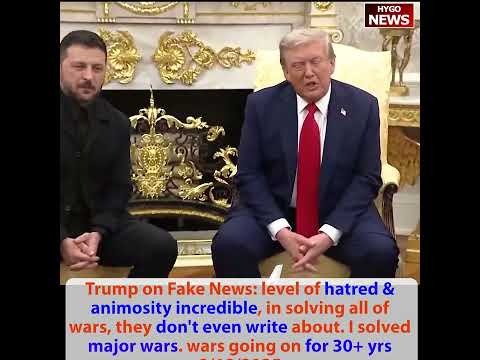
Q: You look fabulous in that suit! Trump: I said the same thing! Fake News: hatred & animosity
Trump welcomed Zelensky to the White House with a notable opening moment — a reporter who had previously attacked Zelensky for his informal attire at the February 2025 meeting apologized and complimented his new suit, with Trump saying “I said the same thing!” Trump then outlined the diplomatic progress, praised the seven European leaders also meeting at the White House, and delivered a broader media critique about press hatred toward Trump regardless of his actual accomplishments. The opening exchange: Reporter: “President Zelensky, you look fabulous in that suit.” Trump: “I said the same thing!” Reporter: “I apologize to you. You look wonderful.” On the diplomatic progress: “I think progress is being made, very substantial progress, in many ways … We had a good meeting just a short while ago with the president of Russia. And I think there’s a possibility that something could come out of it.” On the human stakes: “A lot of people last week, for whatever reason, a big number, a lot of soldiers, both on both sides. And I know the president. I know myself and I believe Vladimir Putin wants to see it ended.” And on media bias: “The level of hatred and animosity is incredible … In solving all of these wars, they don’t even write about it. I saw major wars. I saw wars that have been going on for 31, 35, and 37 [years].”
The “Fabulous Suit” Exchange
The opening moment. Reporter: “President Zelensky, you look fabulous in that suit.” Trump: “I said the same thing.”
That is a deliberate callback. At the February 2025 Oval Office meeting, the same reporter had criticized Zelensky for wearing his traditional military-style combat gear rather than formal attire. That criticism became a specific viral moment. The reporter’s aggressive posture toward Zelensky’s informal clothing generated substantial coverage.
For this August meeting, Zelensky wore a more formal suit — responding to the earlier criticism. The reporter apologized publicly. Trump acknowledged having “said the same thing” — meaning Trump had also commented on Zelensky’s suit earlier.
“I said someone that attacked you last time. See, that was an eye of a member. Yeah, I apologize to you. You look wonderful.”
Whisper’s transcription is fragmentary, but the meaning is clear. The reporter: “I said [something to someone who] attacked you last time. That was a lapse of my judgment. I apologize to you. You look wonderful.”
That is rare press behavior. A reporter publicly apologizing for earlier aggressive conduct. Acknowledging the earlier criticism was unfair. Accepting Zelensky’s new appearance graciously.
”No, My First Question for You”
“No, my first question for you, President Zelensky. In the same suit.”
The reporter transitioning to substantive question. “In the same suit” — meaning Zelensky is now wearing the specific formal suit the reporter had previously demanded. The preliminary apology is complete. Now the substantive question.
“Is the eye changed? You are not. Maybe yours is much better.”
“The eye changed” is Whisper’s rendering of some phrase — possibly “I’ve changed” (reporter acknowledging personal evolution) or “the eye changed” (perspective shift). Context suggests the reporter acknowledging his view has changed while Zelensky’s substance has not.
“Well, thank you very much.” Zelensky’s diplomatic acceptance.
”An Honor to Have the President of Ukraine With Us”
Trump’s transition to substantive framing. “It’s an honor to have the president of Ukraine with us. We’ve had a lot of good discussions. We had a lot of good talks. And I think progress is being made, very substantial progress, in many ways.”
“An honor.” That is specific diplomatic vocabulary. Trump characterizing Zelensky’s visit as an honor. The language signals respect for Ukraine’s position and Zelensky’s specific leadership.
“Progress is being made, very substantial progress, in many ways.” That is Trump’s update on the diplomacy. Not minimal progress. Not merely procedural progress. “Very substantial progress.” Multiple dimensions (“in many ways”) — territorial, security, economic, and political elements all moving.
”Possibility That Something Could Come Out of It”
“We had a good meeting, as you know, just a short while ago with the president of Russia. And I think there’s a possibility that something could come out of it.”
The Alaska summit reference. Trump characterizing his recent meeting with Putin as “good.” Possibility of specific outcomes emerging.
“Possibility that something could come out of it” is calibrated language. Not certainty. Not mere hope. Specific possibility. The outcome depends on the continuing engagement with Zelensky and the European leaders.
”Seven Very Powerful Leaders From Europe”
“And today’s meeting is very important. We have, I guess, the seven very powerful leaders from Europe. And we’re going to be meeting with them right after this meeting.”
Seven European leaders at the White House. That is an extraordinary diplomatic gathering. Specifically:
- Macron (France)
- Merz (Germany)
- Starmer (UK)
- Meloni (Italy)
- Tusk (Poland)
- Von der Leyen (European Commission)
- Rutte (NATO Secretary General) or another senior leader
“Very powerful leaders.” Trump’s characterization. The heads of major European powers together in Washington for specific Ukraine coordination. That kind of gathering typically occurs at NATO summits or major European conferences. Convening them at the White House for a single coordinated meeting is significant diplomatic logistics.
“Right after this meeting.” Sequential scheduling. Zelensky bilateral first. Trilateral-or-broader meeting with European leaders second. That structure reflects Trump’s specific priorities — engage Ukraine directly first, then coordinate with European allies.
”Thank You Very Much for Being Here”
“And thank you very much for being here. Thanks so much. Yes, I’m proud of you.”
“I’m proud of you.” That is personal framing from Trump to Zelensky. Not diplomatic politeness. Personal pride. A specific compliment to Zelensky’s leadership and courage.
For context, Trump has previously criticized Zelensky publicly. The February 2025 Oval Office exchange included specific Trump-Vance pushback on Zelensky’s posture. The warmth of the current exchange represents evolution — Trump has come to respect Zelensky despite past friction.
”Never the End of the Road”
Trump on the diplomatic process. “I can never say that it’s never the end of the road. People are being killed and we want to stop that. So I would not say it’s the end of the road. No, I think we have a good chance of doing it.”
“I would not say it’s the end of the road.” Trump rejecting the framing that negotiations might be finite. As long as people are dying, diplomacy continues. There is no “we tried; too bad” conclusion — because the human cost of the war’s continuation is unacceptable.
“I think we have a good chance of doing it.” Consistent with Trump’s prior framing. “Good chance” — specific probability estimate. Diplomacy is not certain. But success is specifically achievable.
”Almost Four Years Now”
“It’s been almost four years now that a lot of people were killed last week. A lot of people last week. I mean, millions of people killed, but a lot of people last week, for whatever reason, a big number, a lot of soldiers, both on both sides.”
Four years of war. February 2022 to August 2025 is approximately 3.5 years, trending toward four. Trump rounding up emphasizes the war’s duration.
“Millions of people killed.” That is Trump’s aggregate figure. Various analyst estimates vary — some estimates range from 250,000 to 1 million+ killed across both sides, with large additional numbers wounded and displaced. Trump’s “millions” may include wounded and displaced rather than only killed.
“A big number, a lot of soldiers, both on both sides.” Trump’s repeated emphasis on specific weekly casualties. Consistent with his 5,000-7,000 weekly figures from earlier statements. Hundreds dying every day.
”I Believe Vladimir Putin Wants to See It Ended”
“And I know the president. I know myself and I believe Vladimir Putin wants to see it ended.”
Trump’s personal assessment of Putin’s motivation. Based on his 3-hour conversation at Alaska and his longer-term Trump-Putin relationship, Trump believes Putin genuinely wants the war ended.
Whether that is accurate depends on the specific terms Putin would accept. If Putin wants the war ended on Russian-favorable terms (territorial retention, NATO non-expansion, sanctions relief), that is different from Putin wanting the war ended on acceptable-to-Ukraine terms.
“It’s an amazing phenomenon. I said that if in the settlement you got Moscow, Saint Petersburg, and thousands of miles around them, they would say I made a bad deal.”
Trump’s hypothetical. Even if the peace settlement gave Ukraine territorial control over Moscow, St. Petersburg, and vast Russian territory, media critics would still frame it as “Trump made a bad deal.” That is the specific media bias Trump is identifying — partisan animosity that cannot recognize any Trump achievement regardless of substance.
”Level of Hatred and Animosity Is Incredible”
“The level of hatred and animosity is incredible. Not with all. We have great people up here. We also have terrible people up there that I think are told what to say.”
Trump differentiating among reporters. Some reporters are “great people.” Others are “terrible people” who are “told what to say” — meaning they are receiving direction from news organization management rather than independently analyzing the situation.
The specific assertion: editorial direction produces the uniformly hostile Trump coverage rather than reporters’ individual judgment. If reporters were free to cover Trump substantively, many would acknowledge his accomplishments. The hostile coverage reflects organizational priorities, not individual analyst judgment.
”Wars That Have Been Going On for 31, 35, and 37 [Years]”
“In solving all of these wars, they don’t even write about it. I saw major wars. I saw wars that have been going on for 31, 35, and 37, and a couple quicker ones.”
The specific decades-long conflicts Trump has addressed:
- India-Pakistan (effective independence conflict, multiple wars, 70+ years of recurring tensions)
- Armenia-Azerbaijan (Nagorno-Karabakh conflict, ~35 years)
- DRC-Rwanda (various phases, 30+ years of conflict)
- Cambodia-Thailand (border tensions, decades)
- Israel-Iran (multiple dimensions, decades)
“31, 35, and 37” — specific duration figures matching specific conflicts. Trump is not speaking abstractly. He is referring to specific conflicts with specific historical durations that he has now addressed.
“One that was going to go into a full blown deal very quickly, you know, the one I’m talking about. It was a big one. But they don’t even write about that.”
The specific reference to an unnamed major deal that was close to completion. Possibly referring to a specific ongoing negotiation. The “don’t even write about that” framing — another specific Trump accomplishment not receiving media coverage.
”You’ll Come Out Good”
Trump addressing Zelensky. “No matter what I do, no matter what deal I make from my standpoint, you’ll come out good. Maybe President Putin will come out good. But they’ll say Trump was absolutely horrible.”
That is the specific pattern Trump is identifying. Good deal for Ukraine. Possibly good deal for Russia (different dimensions). But media framing will present the deal as bad for Trump specifically.
“You’ll come out good” — Zelensky specifically will benefit from any Trump-brokered deal. The deal terms will serve Ukrainian interests. But media coverage will not credit Trump for the Ukrainian benefit.
”I Won in a Landslide”
“It’s just that, and I’ve lived with that for a long time. I’ve lived with it since just before the first election. I used to get great publicity. Now I get the worst publicity anyone’s ever gotten in office. But I won in a landslide so that people understand. They’re the only ones that count ultimately.”
“Worst publicity anyone’s ever gotten in office.” Trump’s specific assessment of media coverage. More negative than any previous president. Across more dimensions. With less acknowledgment of specific accomplishments.
“But I won in a landslide.” That is the specific political counterpoint. Despite the media hostility, voters chose Trump decisively in 2024. Trump won every battleground state. The popular vote margin favored Trump.
“They’re the only ones that count ultimately.” Voters matter more than media. Media influence on voters has diminished. Voters form judgments through direct experience and alternative information sources rather than legacy media.
”Putin Came to American Soil”
“It’s very sad when you do the right thing. As an example, they said, because of the fact that Vladimir Putin came to American soil, this was a tremendous defeat for Donald Trump. No, it was really wonderful that he did it. It was a hard thing for him to do, to be honest with you. It was the opposite of what they said.”
The specific media framing Trump rejects. Putin traveling to U.S. soil was, per media coverage, a Trump defeat. Trump’s framing: Putin traveling to U.S. soil was a Trump victory — Putin acceding to U.S.-set terms and traveling to U.S. territory.
“It was a hard thing for him to do.” Putin’s willingness to travel to the U.S. required specific political concessions on his part. That Putin accepted those concessions indicates the diplomatic effort is yielding actual movement.
“The opposite of what they said.” Media framed the logistics as defeat. The actual logistics were victory. Media could not or would not acknowledge the underlying substance.
”Great Dishonesty of the Press”
“Now if he didn’t come, they’d say that was also bad for Trump. There’s no way. There’s just a great dishonesty of the press. And I think that’s why it’s lost its credibility. Its credibility is at an all-time low.”
The specific observation. Every outcome produces negative Trump coverage. If Putin comes, it is a Trump defeat. If Putin does not come, it is also a Trump defeat. The framing produces losses regardless of substance.
“Great dishonesty of the press. Credibility at an all-time low.” That is Trump’s framing. Press credibility has declined. Polling supports that framing — trust in mainstream media has dropped substantially across multiple surveys.
Three Distinct Elements
The suit apology moment (unusual reporter acknowledgment of prior unfair treatment). The substantive summit progress (seven European leaders at the White House, trilateral engagement). Trump’s media critique (specific examples of coverage bias, credibility at historic lows).
Each element serves specific functions. The apology moment humanizes the administration-press dynamic. The substantive progress documents specific diplomatic movement. The media critique provides specific framework for understanding coverage patterns.
Key Takeaways
- The suit apology: Reporter: “President Zelensky, you look fabulous in that suit.” Trump: “I said the same thing!” Reporter: “I apologize to you. You look wonderful” — referring to the earlier February 2025 criticism of Zelensky’s informal attire.
- Trump on progress: “I think progress is being made, very substantial progress, in many ways … We had a good meeting just a short while ago with the president of Russia. And I think there’s a possibility that something could come out of it.”
- On the seven European leaders: “We have, I guess, the seven very powerful leaders from Europe. And we’re going to be meeting with them right after this meeting.”
- On the stakes: “A lot of people last week, for whatever reason, a big number, a lot of soldiers, both on both sides. And I know the president. I know myself and I believe Vladimir Putin wants to see it ended.”
- On media bias: “In solving all of these wars, they don’t even write about it. I saw major wars. I saw wars that have been going on for 31, 35, and 37 [years] … Its credibility is at an all-time low.”