 HYGO News
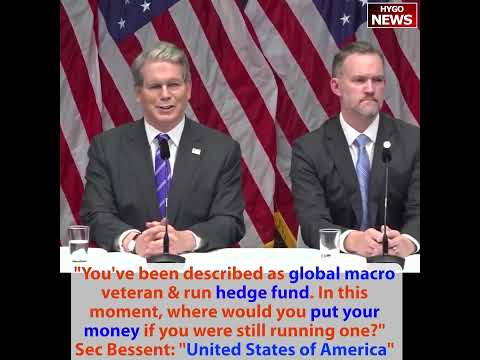
 Q: you global macro where put your money? Bessent: US; great momentum Chinese surprised by magnitude
Q: you global macro where put your money? Bessent: US; great momentum Chinese surprised by magnitude
Asked where he would put money as a global macro hedge fund manager, Treasury Secretary Scott Bessent answered with a single phrase: “United States of America.” Bessent and U.S. Trade Representative Ambassador Greer then delivered an update from Stockholm, where the administration’s third trade meeting with Chinese Vice Premier He Lifeng had concluded. “We had great momentum going into the meeting thanks to the President’s trade deals. I think that the Chinese were surprised by the magnitude of the Japan deal, by the magnitude and the terms of the European deal.” The U.S. team raised specific concerns: Chinese overcapacity globally, Chinese purchases of sanctioned Iranian oil (“about 90%”), and Chinese sales of “about $15 billion of dual-use technologies” to Russia. And they addressed the operational priority: accelerating rare-earth magnet flows from China to U.S. companies, including through third-country routes. Trump arrived for a golf event: “Please welcome onto the tee the 45th and 47th President of the United States of America, Donald J. Trump."
"United States of America”
Bessent’s one-phrase answer. “You’ve been described as a global macro veteran and you’ve run a hedge fund. In this moment, where would you put your money if you were still running one?”
“United States of America.”
That is the bet. The U.S. Treasury Secretary, who previously ran a hedge fund at scale and made markets-level judgments about where capital should flow, is saying publicly that the best place for capital right now is the United States.
Coming from Bessent specifically, the answer carries weight. He is not a political appointee with no market experience. He has personal track record of capital allocation across multiple markets, including global macro positions that required broad judgment about relative country attractiveness. His “United States of America” answer reflects that judgment.
For market participants — foreign investors, sovereign wealth funds, pension managers, hedge funds — Bessent’s public framing is signal. The administration is telling the world’s capital allocators that American assets are the attractive destination. The $600 billion in EU commitments, the $550 billion Japan investment, the $3 trillion cumulative new investment the administration has been documenting — those are consistent with the story Bessent is telling.
The Stockholm Update
The substance of the Stockholm meeting with China. “We had a very fulsome two days with the Chinese delegation led by Vice Premier Holly Fung.”
“Vice Premier Holly Fung” is He Lifeng, the Vice Premier responsible for economic and financial matters under Xi Jinping. He has been China’s primary U.S. trade counterpart since his elevation to that role.
“It was our third meeting. I’m happy to say that London built on Geneva, Stockholm built on London and Geneva. I think we had great momentum going into the meeting thanks to the President’s trade deals.”
The sequence: Geneva → London → Stockholm. Three rounds of bilateral talks between the U.S. Treasury/USTR and Chinese Vice Premier. Progressive escalation in substance, each meeting building on the previous. Stockholm represents the current state.
“Great momentum going into the meeting thanks to the President’s trade deals.” The trade deals with Japan, EU, and others are operating as pressure on the China negotiation. China is watching the U.S. close major deals with other major economies. Each deal demonstrates that the U.S. has alternatives. China’s negotiating leverage declines as the U.S. demonstrates its ability to secure favorable terms with other partners.
”Chinese Were Surprised by the Magnitude”
“I think that the Chinese were surprised by the magnitude of the Japan deal, by the magnitude and the terms of the European deal.”
That is the specific observation. The Japanese and European deals were on scales — and on terms — that Chinese strategic planners apparently did not anticipate. The $1.45 trillion combined EU commitment plus the $550 billion Japan commitment produces approximately $2 trillion in direct U.S.-Pacific/Atlantic commercial realignment.
For China, that scale represents economic pressure without direct confrontation. The U.S. is not forcing China to accept specific terms. The U.S. is demonstrating, through deals with others, that China’s alternatives are narrowing. Each major U.S. deal with a Chinese competitor or alternative partner reduces China’s leverage.
“So I think that they’re never compliant, but I believe that they were in more of a mood for a wide-ranging discussion.”
“Never compliant.” That is Bessent’s characterization. China does not concede under pressure the way other negotiating partners do. Chinese diplomatic practice involves extended engagement, testing positions, and only incremental movement.
“More of a mood for a wide-ranging discussion.” That means the Chinese delegation was willing to discuss a broader set of issues — economic, supply chain, geopolitical — than might have been expected in earlier rounds.
Chinese Overcapacity
Bessent laid out the specific U.S. concerns raised. “We expressed our concern about Chinese overcapacity globally and what that might mean. For this year, for the next few years.”
Chinese overcapacity is the structural economic concern. Chinese manufacturing capacity — especially in EVs, solar panels, batteries, steel, and industrial equipment — has expanded beyond Chinese domestic demand. The surplus is being exported at prices that undercut global producers, destabilizing markets, industries, and trade relationships in Europe, America, and elsewhere.
The administration is concerned that Chinese overcapacity continues to grow. Without coordinated action — tariffs, market-access restrictions, or Chinese capacity rationalization — the overcapacity will continue to produce price dislocations and industrial damage in other countries.
Iranian Oil and Russian Technology
“We expressed our concern for their purchases of sanctioned Iranian oil, which they buy about 90%.”
China buys approximately 90% of Iranian oil exports. The U.S. sanctions on Iran are designed to constrain Iranian revenue from oil sales. Chinese purchases largely evade those sanctions. The U.S. concern: Chinese support of Iran through oil purchases undermines American Iran policy, including pressure related to Iran’s nuclear program.
“We also expressed our regret that we believe that they had sold Russia about 15 billion of dual-use technologies.”
$15 billion in dual-use technology exports from China to Russia. “Dual-use” means items that have both civilian and military applications — electronics, manufacturing tools, chemical inputs, precision instruments. In the context of Russia’s war in Ukraine, those dual-use exports effectively support Russia’s military production.
U.S. policy has been to pressure China to reduce those exports. The $15 billion figure Bessent is raising is substantial — roughly the scale of major arms transactions. Chinese willingness to continue those sales despite American pressure reflects a strategic judgment that the economic benefits (and the strategic value to Russia) exceed the cost of American displeasure.
”Constructive Tone”
“But the overall tone of the meetings was very constructive.”
Despite the specific concerns raised, Bessent characterizes the tone as constructive. That is diplomatic language. Constructive tone means substantive engagement, willingness to discuss, and absence of hostility. It does not mean agreement. China is unlikely to reverse its Iranian oil purchases or stop its Russian dual-use exports just because the U.S. raised concerns. But the discussion itself represents functional diplomatic engagement.
USTR Greer on the Trade Program
Ambassador Greer restated the administration’s trade-program framework. “We also reiterated the premise of the President’s trade program and trade policy, which is to reduce US deficits, increase manufacturing, and reshore our economy.”
Three objectives. Reduce deficits (trade deficits specifically, and by extension federal fiscal deficits through tariff revenue). Increase manufacturing (domestic production capacity). Reshore the economy (return production activities to American soil).
“We made sure that they understood that these are the goals of what the President is trying to do.”
That is the transparency. Chinese negotiators know what the U.S. wants. Not vague talk. Specific objectives. Any agreement must advance those objectives.
“And again, we expressed our satisfaction that many of our major trading partners have come along with this.”
“Came along with this” is diplomatic language for “accepted the U.S. framework.” Japan did. EU did. UK did. Indonesia did. Philippines did. China has not, but the list of partners that have is growing, and China’s relative isolation on holding out against the framework is increasing.
Von der Leyen on Rebalancing
“President von der Leyen and Turnberry on Sunday. When I was there, she specifically mentioned that the US-EU deal is about rebalancing and trying to rectify the giant USUR plus with us.”
“USUR plus” is Whisper’s rendering — probably “US-EU surplus” or similar. Von der Leyen’s framing at Turnberry: the EU deal is about rebalancing an asymmetric trade relationship. That framing validates the Trump-administration premise.
For China, hearing von der Leyen publicly accept the rebalancing framing is significant. If the EU accepts that the prior trade relationship was imbalanced and the new deal corrects it, China cannot credibly argue that the Trump-administration trade framework is illegitimate. The framework has been accepted by one of the world’s largest economies.
Rare Earth Magnets
“And of course, we were here in the first purpose to confirm the implementation of what was agreed in London in terms of accelerating the flow of rare earth magnets from China to US companies.”
Rare earth magnets — the neodymium-iron-boron and samarium-cobalt magnets that are essential inputs for electric motors, wind turbines, missiles, and many other technologies. China dominates rare earth magnet production. The U.S. depends on Chinese supply for critical industrial and defense applications.
The London meeting apparently produced agreement to accelerate the flow. Stockholm’s purpose was to confirm implementation — to verify that what was agreed in principle is being executed in practice.
“And then we were able to discuss further how to make sure that the entire US supply chain, including those that go through third countries, could be accelerated.”
Third-country routes. Some rare earth magnets reach U.S. companies through intermediate countries rather than direct China-U.S. trade. The supply-chain discussion covered accelerating all those routes — not just the direct China-U.S. flow.
The Strategic Context
The U.S.-China trade discussion at Stockholm is operating in a specific strategic context:
- The U.S. has just secured major deals with Japan, EU, UK, Indonesia, Philippines. China’s alternatives to the U.S. market are relatively limited.
- China depends on U.S. markets for export revenue. Chinese manufacturers cannot easily pivot to replace U.S. consumer demand.
- The U.S. depends on Chinese rare earths, specific manufactured components, and other inputs. Those dependencies are being mapped for reshoring.
- Iran’s isolation is increasing. Russia’s war continues. China’s support for both creates friction with the U.S.
In that context, China is choosing to engage in the third round of trade talks rather than escalate. That choice reflects judgment that engagement preserves more options than escalation. Whether the engagement produces substantive deal terms the U.S. can accept is the next question.
Trump on the Tee
The segment closed with Trump arriving at a golf event. “Please welcome onto the tee the 45th and 47th President of the United States of America, Donald J. Trump.”
“45th and 47th” — the formal framing of Trump’s two non-consecutive terms. Grover Cleveland was the only previous U.S. president to serve non-consecutive terms (22nd and 24th). Trump is the second.
The golf event is a moment of public engagement. Trump remains an active golfer in his late 70s. The appearances at his own properties — Turnberry, Doral, Bedminster, Aberdeen, and others — combine business, politics, and personal recreation in ways that are distinctive to his presidency.
Key Takeaways
- Treasury Secretary Scott Bessent, asked where he would put money as a global macro hedge fund manager, answered directly: “United States of America.”
- Bessent on Stockholm China talks: “Great momentum going into the meeting thanks to the President’s trade deals. I think that the Chinese were surprised by the magnitude of the Japan deal, by the magnitude and the terms of the European deal.”
- U.S. concerns raised: Chinese overcapacity, Chinese purchases of “about 90%” of sanctioned Iranian oil, Chinese sales of “about 15 billion of dual-use technologies” to Russia.
- USTR Greer: “The premise of the President’s trade program … is to reduce US deficits, increase manufacturing, and reshore our economy” — with von der Leyen at Turnberry validating the “rebalancing” framing.
- Operational focus: “accelerating the flow of rare earth magnets from China to US companies” — including through third-country supply chain routes.