 HYGO News
 Q: Why not tariffs 1st term? TRUMP: BC I was fighting lunatics like YOU! Kamala' political future
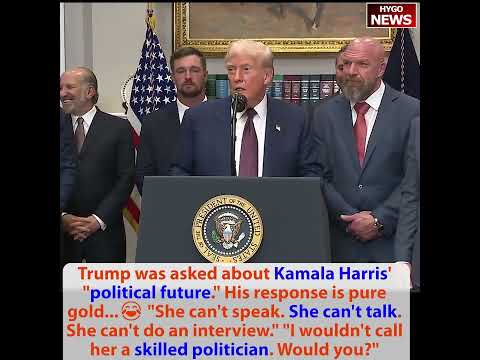
Q: Why not tariffs 1st term? TRUMP: BC I was fighting lunatics like YOU! Kamala’ political future
A reporter asked Trump why he had not invoked the specific tariff authority during his first term. Trump’s answer was blunt: “Because in my first term, I was fighting lunatics like you who were trying to do things incorrectly and inappropriately to a president that was duly elected.” Trump also noted he imposed “hundreds of billions of dollars” of tariffs on China during his first term, before COVID interrupted the broader tariff plan. Biden, in a separate clip, described Kamala Harris’s VP selection as a DEI hire: “I was proud to ask Kamala Harris to run with me, be the first black woman to serve as vice president … I made the cause of civil rights and equality, the foundation of everything I did.” And Trump’s extended assessment of Kamala as politician: “She can’t speak. She can’t talk. She can’t do an interview … I wouldn’t call her a skilled politician. Would you? … I had to beat two. That’s like Dana White … has a fighter that’s getting the hell knocked out of him. They say, ‘Let’s take him out and put somebody else in.’ Didn’t seem fair to me at the time, but where are we? We’re in the White House."
"Lunatics Like You”
The reporter’s question. “Why didn’t you invoke this law in your first term? You could have taken in billions upon billions of dollars in your first term, but you waited into your second term.”
Trump’s response. “Yeah, because in my first term, I was fighting lunatics like you who were trying to do things incorrectly and inappropriately to a president that was duly elected.”
That is direct. “Lunatics like you.” Trump is characterizing the first-term political environment. The Russia collusion investigation, the first impeachment, the daily media attacks, the Mueller inquiry, the various prosecutorial pursuits — all of those operated simultaneously, creating an atmosphere where aggressive policy moves on tariffs would have faced additional coordinated resistance.
“And we did do certain tariffs in the first term. If you look at China, China, we took in hundreds of billions of dollars from China.”
Trump correcting the premise. First-term tariffs were substantial — hundreds of billions collected from Chinese imports. Those tariffs were calibrated, phased in, and focused primarily on China rather than applied across all trading partners.
”When COVID Came”
“But when COVID came, the last thing I was going to do is tell France and Italy and Spain and a couple of other countries that were going to hit you with tariffs. We had a fight the COVID situation.”
That is the decisive explanation. COVID arrived in early 2020. European countries were hit especially hard. Italy’s early 2020 crisis was the first major Western-country COVID surge. France and Spain followed. Those countries needed diplomatic support and cooperation, not new trade friction.
Trump’s judgment: escalating tariffs against European allies during their COVID crisis would have been politically and diplomatically catastrophic. The first term’s tariff plan had to be paused. The 2024 election and the second term became the opportunity to execute what COVID had interrupted.
Biden on Kamala’s VP Selection
Biden, in a separate clip, described how he chose Harris. “I was proud to ask Kamala Harris to run with me, be the first black woman to serve as vice president of the United States. It was important as president, I made the cause of civil rights and equality, the foundation of everything I did. For example, I promised I have an administration that looked like America.”
That is Biden explicitly framing Harris’s selection in demographic terms. Biden made a campaign commitment that his running mate would be a woman, and specifically a woman of color. Harris met that commitment.
“I made the cause of civil rights and equality, the foundation of everything I did.” That is Biden’s self-description. The implication: Harris’s selection was part of the civil-rights-and-equality framework, not purely a political-capability assessment.
The administration’s framing of this clip — “Joe Biden announces Kamala Harris was a DEI hire” — is the specific accusation. Biden’s own words, played back, describe the selection in demographic-diversity terms that align with the DEI framework. Biden’s framing validates the characterization.
Trump on Kamala: “She Can’t Speak”
Asked about Harris’s political future. “Well, she can’t speak. She can’t talk. She can’t do an interview.”
That is Trump’s assessment. Harris’s capacity for extemporaneous political communication has been contested across her career. The viral clips of Harris mishandling specific questions — the “Venn diagram” moment, the “significance of the passage of time” loop, the various campaign stop moments — provided a library of evidence for the critique.
“I thought it was a very strange campaign that we had. You know, I had two of them. We were up by like this massive number of points to invite and they said, let’s change to Kamala.”
“I had two of them” — referring to the 2024 campaign’s two opponents. Biden was the initial opponent. After the debate disaster, Biden withdrew and Harris became the nominee. Trump’s framing: he was already beating Biden decisively. The Democratic Party’s switch to Harris extended the campaign but did not change the outcome.
”Who the Hell Is Harris?”
“Nobody knew who Kamala was. Nobody knew her last name, Harris. They said, we’re going to get vice president Harris. Everyone said, who the hell is Harris? They only knew her by the first name.”
That is Trump’s characterization of Harris’s public recognition. “Kamala” was known. “Harris” was less known. The politically engaged knew both names. The broader public knew only the first name.
“But no, I thought she was a terrible candidate. Look, don’t forget, she didn’t really get the nomination. I mean, that whole nomination was strange.”
“She didn’t really get the nomination.” That is the process critique. Harris was not chosen through the 2020 Democratic primary’s competitive process — she dropped out before primary voting began. Harris was chosen by Biden as VP through the standard selection process. And after Biden’s withdrawal, Harris was effectively anointed rather than selected through open competition.
“She was the first one out. You know, she took a good amount of points with her when she announced, but nobody knew her. Once they got to know her, she dropped out very shortly after she started.”
Trump referring to Harris’s 2020 campaign. She entered the Democratic presidential primary in January 2019 to strong initial reception. Her campaign collapsed by December 2019 — before a single vote had been cast in primary contests. Trump’s framing: when people got to know Harris as a candidate, they moved away from supporting her.
“And she started with a pretty good, you know, she was like in second or third place, but I wouldn’t call her a skilled politician. Would you?"
"I’m Going to Buy It”
“She’s also coming out with a book named Plans You Wouldn’t Buy It. I think I’m going to buy it. I’d love to see it now.”
Trump is interested in reading Harris’s 107 Days book. That is a curious admission. Most politicians would not publicly express interest in reading an opponent’s memoir. Trump, apparently, is interested in what Harris has written about the 2024 campaign.
“Look, I find everything in politics interesting. I sort of enjoy politics.”
That is Trump’s broader self-description. Politics as inherently interesting subject matter, regardless of partisan alignment.
”She Wasn’t a Skilled Person”
“She wasn’t a skilled person. You know, you have skilled politicians, really skilled politicians, and then you have some that aren’t. And she was put in a very tough position, I think.”
That is a mixed assessment. Harris was not skilled (Trump’s framing). Harris was put in a tough position (Trump acknowledging the late-switch context).
“She did have a six-week honeymoon. They were told me the pros said, you know what? She’s going to have a six-week and she did. She was like untouchable in terms of everybody thought great.”
The six-week honeymoon was the period immediately after Biden’s withdrawal in July 2024. Harris polled well. Democratic enthusiasm surged. Campaign donations flooded in. Harris appeared to have genuinely revitalized the Democratic ticket.
“But she didn’t do any interviews or anything, which was strange. Not even friendly interviews with friendly reporters like her, right there, really friendly reporter.”
The interview problem. Harris largely avoided press engagement during the early weeks of her campaign. That decision — to ride the honeymoon without exposing Harris to questioning — was strategic. But it produced perceptions that Harris could not handle press engagement.
”People Said, What’s Wrong With Her?”
“And you know what happened? People said, what’s wrong with her? Why isn’t she doing? She made a mistake. She should have done interviews.”
That is Trump’s diagnosis of Harris’s campaign strategic error. Not doing interviews produced questions. Avoidance generated speculation about why avoidance was necessary.
“She didn’t run a great campaign, but we beat Biden and then we had to beat. Nobody’s beaten two. I had to beat two.”
“I had to beat two.” That is Trump’s summary of the 2024 campaign. Beat Biden (in the debate performance that prompted Biden’s withdrawal). Beat Harris (in the general election). Two opponents in a single cycle.
”Like Dana White”
The wrestling analogy. “That’s like Dana White. The great Dana White has a fight and he has a fighter that’s getting the hell knocked out of him. They say, well, let’s take him out and put somebody else in.”
Dana White — UFC president, wrestling-promoter figure, close Trump ally. The analogy: a fighter losing badly gets pulled out of the match and replaced by another fighter. The substitute may be fresher or less worn down. But the substitution changes the dynamic of the fight in ways that may seem unfair to the original opponent.
“Didn’t seem fair to me at the time, but where are we? We’re in the White House. So I mean, you know, so it worked out.”
“Didn’t seem fair … but we’re in the White House.” That is Trump’s retrospective assessment. At the time, Biden’s withdrawal and Harris’s elevation felt like the Democrats cheating — changing opponents mid-fight. But the outcome was Trump winning regardless. The unfairness of the switch was counterbalanced by Trump’s victory.
Trump’s Political Assessments
What the segment reveals is Trump’s political-assessment framework. He distinguishes between “skilled politicians” and those who aren’t. Harris, in his framing, was not. Biden, in multiple prior framings, was “grossly incompetent.” Obama, in other framings, is the “leader of the gang” directing manufactured intelligence.
Trump’s framework is categorical — politicians are either skilled or not, competent or not, honest or not. That binary judgment is the operating logic. It produces political messaging that is unambiguous: voters know who Trump thinks is skilled (his administration) and who he thinks is not (the opposition).
For the Democratic Party’s 2028 positioning, Trump’s assessment is consequential. He has publicly framed Harris as unskilled. He has publicly framed Biden as incompetent. He has publicly framed Obama as criminal. Those assessments will travel through 2028 political messaging as Republican attacks.
Key Takeaways
- Asked why tariffs weren’t imposed in the first term: “Because in my first term, I was fighting lunatics like you who were trying to do things incorrectly and inappropriately to a president that was duly elected.”
- Trump noted first-term tariff effort: “We took in hundreds of billions of dollars from China” — but COVID interrupted the broader European tariff plan.
- Biden on Kamala Harris’s VP selection: “I was proud to ask Kamala Harris to run with me, be the first black woman to serve as vice president … I made the cause of civil rights and equality, the foundation of everything I did.”
- Trump on Harris: “She can’t speak. She can’t talk. She can’t do an interview … I wouldn’t call her a skilled politician. Would you?”
- On the 2024 switch from Biden to Harris: “Nobody’s beaten two. I had to beat two” — comparing it to Dana White “has a fighter that’s getting the hell knocked out of him … ‘Let’s take him out and put somebody else in.’ Didn’t seem fair to me at the time, but where are we? We’re in the White House.”